Probandari Ari, Mahendradhata Yodi, Widjanarko Bagoes, Alisjahbana Bachti
a Department of Public Health, Faculty of Medicine , Universitas Sebelas Maret , Surakarta , Indonesia.
b Center for Health Policy and Management, Faculty of Medicine , Universitas Gadjah Mada , Yogyakarta , Indonesia.
Glob Health Action. 2017;10(1):1381442. doi: 10.1080/16549716.2017.1381442.
The Tuberculosis Operational Research Group (TORG) implemented a capacity-building model involving academics and practitioners (i.e. clinicians or program staff) in an operational research (OR) team in Indonesia.
This study explored academics' and practitioners' perspectives regarding the benefits of participating in a tuberculosis (TB) OR capacity-building program in Indonesia.
We conducted a qualitative study involving in-depth interviews with 36 academics and 23 practitioners undertaking the TORG capacity-building program. We asked open-ended questions about their experience of the program. Data were analyzed via content analysis.
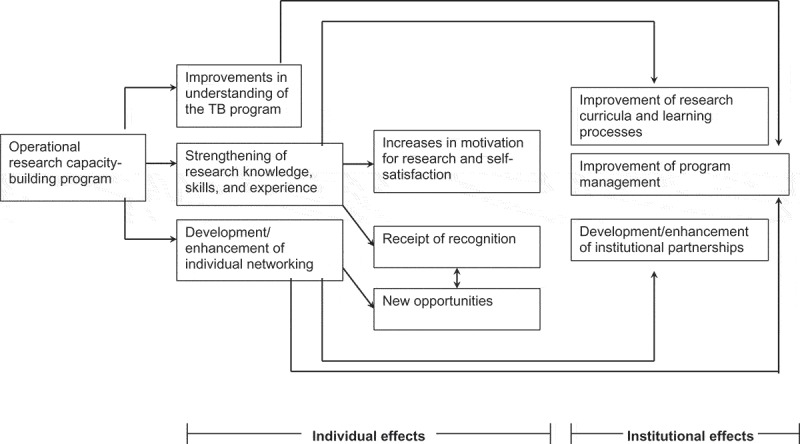
The findings demonstrated the social multiplier effects of the OR capacity-building program. Both academics and practitioners reported perceived improvements in research knowledge, skills, and experience, and described additional individual- and institutional-level benefits. The individual-level benefits level included improvements in understanding of the TB program, motivation for research and self-satisfaction, the development/enhancement of individual networking, receipt of recognition, and new opportunities. The additional benefits reported at an institutional level included improvement in research curricula, in-house training, and program management and the development/enhancement of institutional partnerships.
The program improved not only individuals' capacity for conducting OR but also the quality of the TB program management and public health education. OR should be included in research methodology curricula for postgraduate public health/disease control programs. The capacity-building model, in which academics and program staff collaborated within an OR team, should be promoted.
结核病运筹学研究小组(TORG)在印度尼西亚实施了一种能力建设模式,该模式让学者和从业者(即临床医生或项目工作人员)参与到一个运筹学(OR)团队中。
本研究探讨了学者和从业者对于参与印度尼西亚结核病运筹学能力建设项目的益处的看法。
我们开展了一项定性研究,对36位参与TORG能力建设项目的学者和23位从业者进行了深入访谈。我们就他们对该项目的体验提出了开放式问题。通过内容分析法对数据进行了分析。
研究结果显示了运筹学能力建设项目的社会倍增效应。学者和从业者均报告称,他们在研究知识、技能和经验方面有了明显提升,并描述了在个人和机构层面的其他益处。个人层面的益处包括对结核病项目理解的提高、研究动力和自我满意度、个人社交网络的拓展/加强、获得认可以及新的机会。在机构层面报告的其他益处包括研究课程的改进、内部培训、项目管理以及机构伙伴关系的拓展/加强。
该项目不仅提高了个人开展运筹学研究的能力,还提升了结核病项目管理和公共卫生教育的质量。运筹学应纳入研究生公共卫生/疾病控制项目的研究方法课程中。应推广学者和项目工作人员在运筹学团队内合作的能力建设模式。