Department of Biotechnology, Graduate School of Engineering, Osaka University, 2-1 Yamadaoka, Suita, Osaka, Japan.
Frontier Research Base for Global Young Researchers, Graduate School of Engineering, Osaka University, 2-1 Yamadaoka, Suita, Osaka, Japan.
PLoS One. 2017 Oct 18;12(10):e0186112. doi: 10.1371/journal.pone.0186112. eCollection 2017.
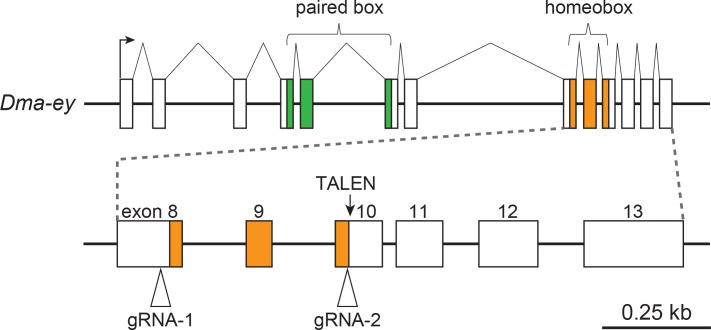
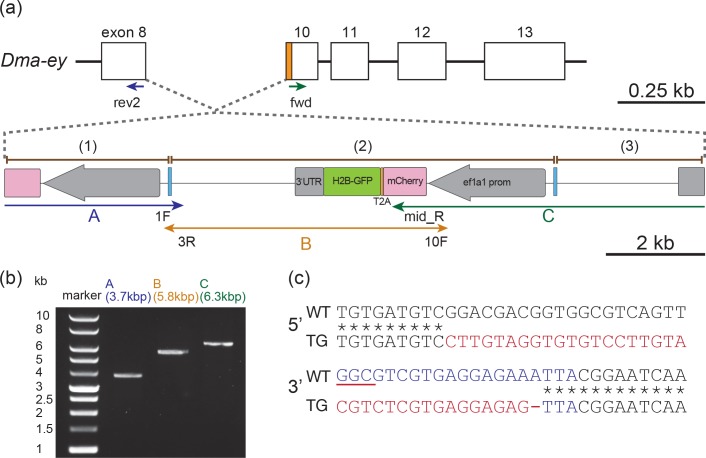
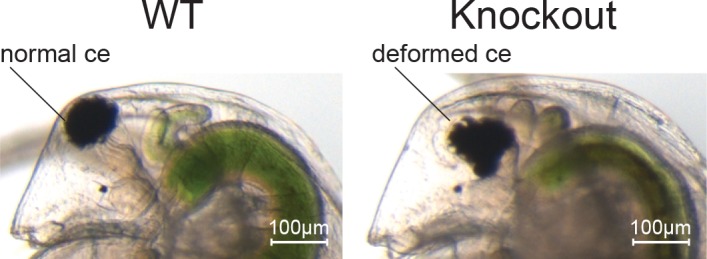
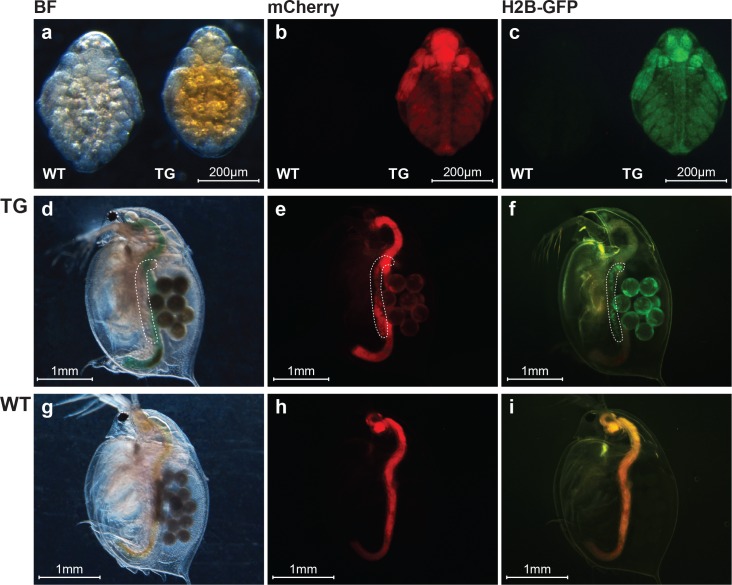
The clustered regularly interspaced short palindromic repeats (CRISPR)/CRISPR-associated system (Cas) is widely used for mediating the knock-in of foreign DNA into the genomes of various organisms. Here, we report a process of CRISPR/Cas-mediated knock-in via non-homologous end joining by the direct injection of Cas9/gRNA ribonucleoproteins (RNPs) in the crustacean Daphnia magna, which is a model organism for studies on toxicology, ecology, and evolution. First, we confirmed the cleavage activity of Cas9 RNPs comprising purified Cas9 proteins and gRNAs in D. magna. We used a gRNA that targets exon 10 of the eyeless gene. Cas9 proteins were incubated with the gRNAs and the resulting Cas9 RNPs were injected into D. magna eggs, which led to a typical phenotype of the eyeless mutant, i.e., eye deformity. The somatic and heritable mutagenesis efficiencies were up to 96% and 40%, respectively. Second, we tested the CRISPR/Cas-mediated knock-in of a plasmid by the injection of Cas9 RNPs. The donor DNA plasmid harboring the fluorescent reporter gene was designed to contain the gRNA recognition site. The co-injection of Cas9 RNPs together with the donor DNAs resulted in generation of one founder animal that produced fluorescent progenies. This transgenic Daphnia had donor DNA at the targeted genomic site, which suggested the concurrent cleavage of the injected plasmid DNA and genomic DNA. Owing to its simplicity and ease of experimental design, we suggest that the CRISPR/Cas-mediated knock-in method represents a promising tool for studying functional genomics in D. magna.
簇状规律间隔短回文重复 (CRISPR)/CRISPR 相关系统 (Cas) 广泛用于介导将外源 DNA 敲入各种生物体的基因组中。在这里,我们报告了一种通过非同源末端连接介导的 CRISPR/Cas 介导的敲入过程,方法是直接在甲壳动物大型溞(一种用于毒理学、生态学和进化研究的模式生物)中注射 Cas9/gRNA 核糖核蛋白(RNP)。首先,我们证实了由纯化的 Cas9 蛋白和 gRNA 组成的 Cas9 RNP 在大型溞中的切割活性。我们使用了靶向无眼基因外显子 10 的 gRNA。将 Cas9 蛋白与 gRNA 孵育,得到的 Cas9 RNP 被注射到大型溞卵中,导致无眼突变体的典型表型,即眼睛畸形。体细胞和可遗传的诱变效率分别高达 96%和 40%。其次,我们通过注射 Cas9 RNP 测试了 CRISPR/Cas 介导的质粒敲入。携带荧光报告基因的供体 DNA 质粒被设计为包含 gRNA 识别位点。共注射 Cas9 RNP 和供体 DNA 导致产生了一个产生荧光后代的创始动物。这种转基因大型溞在靶向基因组位点具有供体 DNA,这表明同时切割了注射的质粒 DNA 和基因组 DNA。由于其简单性和易于实验设计,我们建议 CRISPR/Cas 介导的敲入方法代表了研究大型溞功能基因组学的一种有前途的工具。