Lapierre Pascal, Nazarian Elizabeth, Zhu Yan, Wroblewski Danielle, Saylors Amy, Passaretti Teresa, Hughes Scott, Tran Anthony, Lin Ying, Kornblum John, Morrison Shatavia S, Mercante Jeffrey W, Fitzhenry Robert, Weiss Don, Raphael Brian H, Varma Jay K, Zucker Howard A, Rakeman Jennifer L, Musser Kimberlee A
Emerg Infect Dis. 2017 Nov;23(11):1784-1791. doi: 10.3201/eid2311.170308.
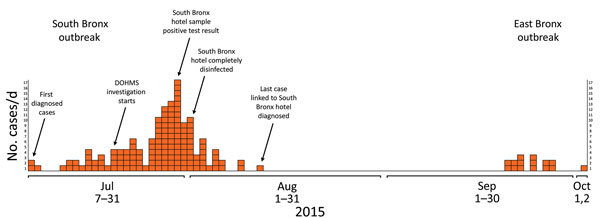
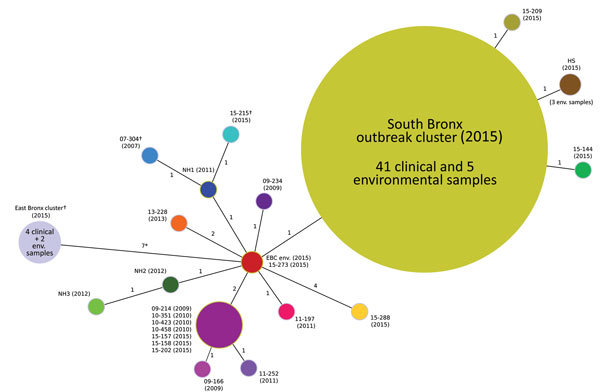
During the summer of 2015, New York, New York, USA, had one of the largest and deadliest outbreaks of Legionnaires' disease in the history of the United States. A total of 138 cases and 16 deaths were linked to a single cooling tower in the South Bronx. Analysis of environmental samples and clinical isolates showed that sporadic cases of legionellosis before, during, and after the outbreak could be traced to a slowly evolving, single-ancestor strain. Detection of an ostensibly virulent Legionella strain endemic to the Bronx community suggests potential risk for future cases of legionellosis in the area. The genetic homogeneity of the Legionella population in this area might complicate investigations and interpretations of future outbreaks of Legionnaires' disease.
2015年夏天,美国纽约市经历了美国历史上规模最大、致死人数最多的军团病疫情之一。共计138例病例,16人死亡,均与南布朗克斯区的一座冷却塔有关。对环境样本和临床分离株的分析表明,此次疫情之前、期间及之后的散发病例都可追溯到一个缓慢进化的单一祖先菌株。在布朗克斯社区检测到一种表面上具有强毒性的军团菌菌株,这表明该地区未来可能出现军团病病例。该地区军团菌种群的基因同质性可能会使未来军团病疫情的调查和解读变得复杂。