Malicki Marek, Iliopoulou Maro, Hammann Christian
Ribogenetics Biochemistry Lab, Department of Life Sciences and Chemistry, Jacobs University Bremen, Bremen, Germany.
Front Microbiol. 2017 Oct 5;8:1869. doi: 10.3389/fmicb.2017.01869. eCollection 2017.
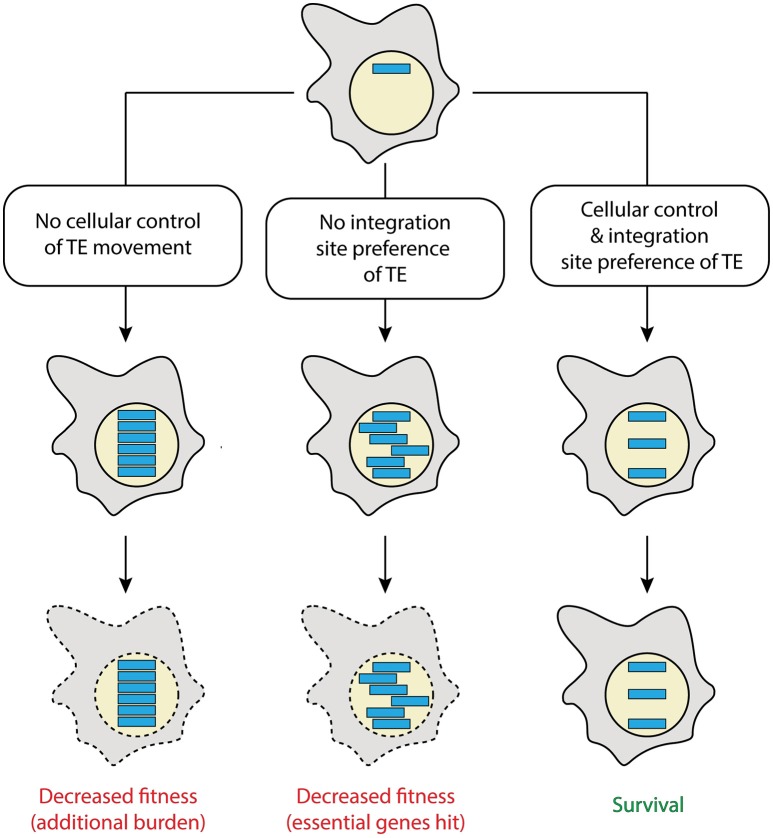
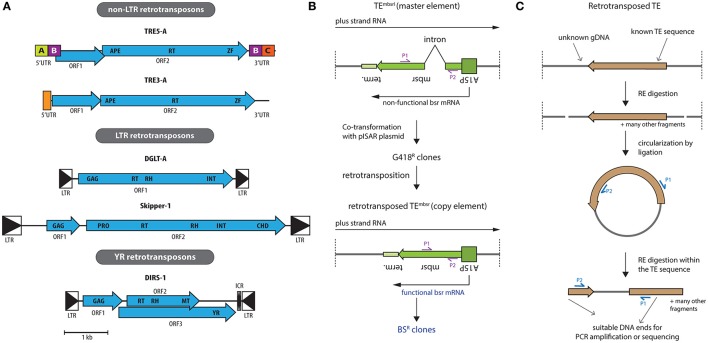
Transposable elements, identified in all eukaryotes, are mobile genetic units that can change their genomic position. Transposons usually employ an excision and reintegration mechanism, by which they change position, but not copy number. In contrast, retrotransposons amplify via RNA intermediates, increasing their genomic copy number. Hence, they represent a particular threat to the structural and informational integrity of the invaded genome. The social amoeba , model organism of the evolutionary Amoebozoa supergroup, features a haploid, gene-dense genome that offers limited space for damage-free transposition. Several of its contemporary retrotransposons display intrinsic integration preferences, for example by inserting next to transfer RNA genes or other retroelements. Likely, any retrotransposons that invaded the genome of the amoeba in a non-directed manner were lost during evolution, as this would result in decreased fitness of the organism. Thus, the positional preference of the retroelements might represent a domestication of the selfish elements. Likewise, the reduced danger of such domesticated transposable elements led to their accumulation, and they represent about 10% of the current genome of . To prevent the uncontrolled spreading of retrotransposons, the amoeba employs control mechanisms including RNA interference and heterochromatization. Here, we review TRE5-A, DIRS-1 and Skipper-1, as representatives of the three retrotransposon classes in , which make up 5.7% of the genome. We compile open questions with respect to their mobility and cellular regulation, and suggest strategies, how these questions might be addressed experimentally.
转座元件存在于所有真核生物中,是可改变其基因组位置的移动遗传单位。转座子通常采用切除和重新整合机制来改变位置,但不改变拷贝数。相比之下,逆转座子通过RNA中间体进行扩增,从而增加其基因组拷贝数。因此,它们对被入侵基因组的结构和信息完整性构成了特殊威胁。社会性变形虫是进化分支变形虫超群的模式生物,其具有单倍体、基因密集的基因组,为无损转座提供的空间有限。它的一些当代逆转座子表现出内在的整合偏好,例如插入到转运RNA基因或其他逆转座元件旁边。很可能,任何以非定向方式侵入变形虫基因组的逆转座子在进化过程中都丢失了,因为这会导致生物体适应性下降。因此,逆转座元件的位置偏好可能代表了自私元件的驯化。同样,这种驯化的转座元件危险性降低导致它们积累,它们约占社会性变形虫当前基因组的10%。为了防止逆转座子不受控制地扩散,变形虫采用了包括RNA干扰和异染色质化在内的控制机制。在这里,我们综述了TRE5-A、DIRS-1和Skipper-1,它们是社会性变形虫中三类逆转座子的代表成员,占社会性变形虫基因组的5.7%。我们汇总了关于它们的移动性和细胞调控方面的未解决问题,并提出了如何通过实验解决这些问题的策略。