Department of Emergency Medicine, Tianjin First Central Hospital, Tianjin, China (mainland).
Department of Institute of Urology, Second Hospital of Tianjin Medical University, Tianjin, China (mainland).
Med Sci Monit. 2017 Oct 23;23:5049-5055. doi: 10.12659/msm.904386.
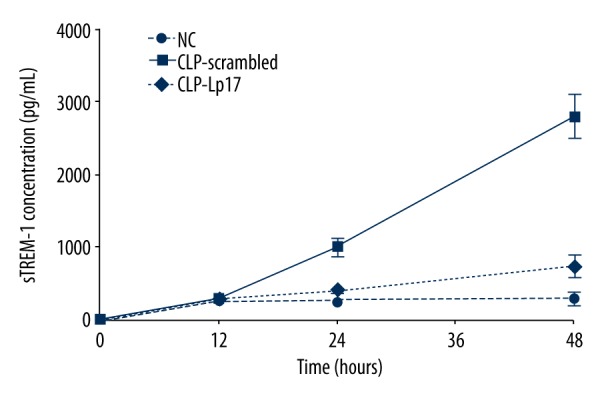
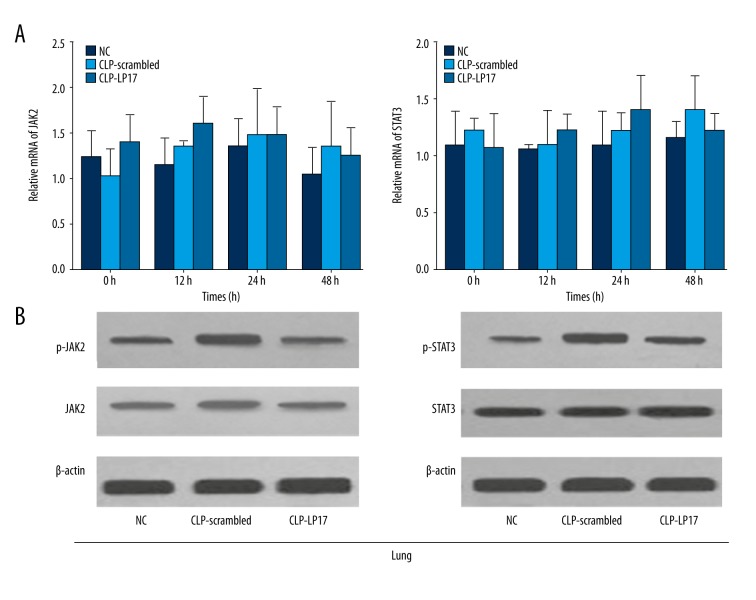
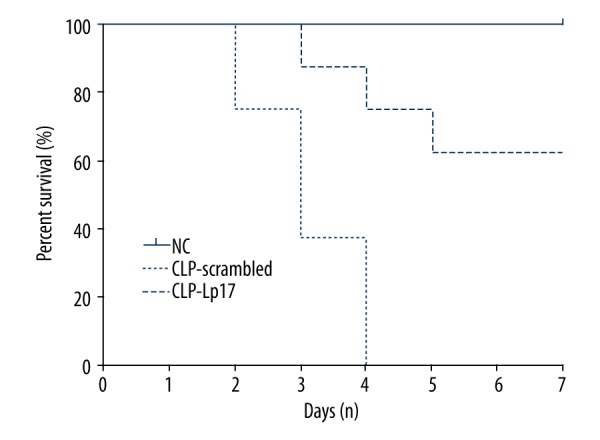
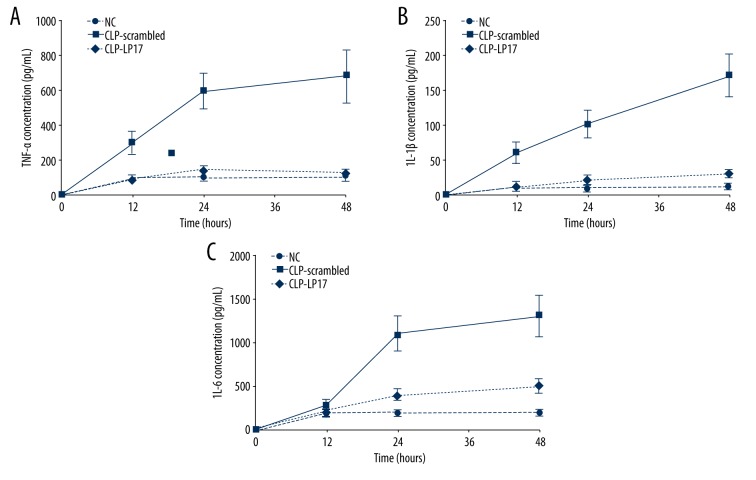
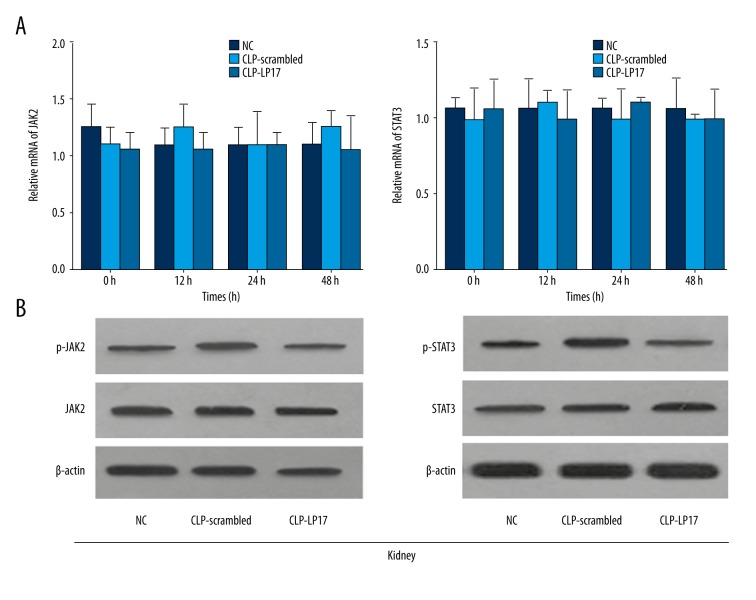
BACKGROUND Blocking of TREM-1 signaling improves survival of mice with sepsis induced by Pseudomonas aeruginosa. However, whether TREM-1 blockade has beneficial effects in polymicrobial sepsis is poorly understood. Here, we aimed to investigate the effect of modulation of the TREM-1 pathway in rats with polymicrobial sepsis induced by cecal ligation and puncture (CLP). MATERIAL AND METHODS Normal Sprague-Dawley (SD) rats with sepsis induced by CLP were allocated randomly to received scramble peptide or LP17 via the jugular vein. Serum level of sTREM-1, IL6, TNF-α, and IL-1β were detected by ELISA assay. The mRNA and protein levels of JAK2 and STAT3 were detected by real-time PCR and Western blot analysis. RESULTS STREM-1 concentration was greatly and progressively increased in rats with CLP-induced sepsis, and the increase was attenuated by TREM-1 inhibitory peptide LP17. More than 60% survival was observed in rats at the experiment endpoint after LP17 treatment. TREM-1 blockade also attenuated the increased level of pro-inflammatory cytokines TNF-α, IL-6, and IL-1β, and thus attenuated systematic and distant inflammatory responses. Furthermore, TREM-1 blockade significantly attenuated the increased levels of pJAK2 and pSTAT3. CONCLUSIONS TREM-1 blockade by the use of an inhibitory peptide LP17 could prolong survival of rats with polymicrobial sepsis and attenuate systematic inflammatory responses through the JAK2/STAT3 signaling pathway. Our results suggest that modulation of TREM-1 by a synthetic peptide might be a potential therapeutic option for polymicrobial sepsis.
阻断 TREM-1 信号可改善铜绿假单胞菌诱导脓毒症小鼠的生存率。然而,TREM-1 阻断在多微生物脓毒症中的有益作用尚不清楚。在这里,我们旨在研究通过盲肠结扎和穿刺(CLP)诱导多微生物脓毒症的大鼠中 TREM-1 途径的调节作用。
正常 Sprague-Dawley(SD)大鼠通过 CLP 诱导脓毒症,随机分为经颈静脉接受乱序肽或 LP17 的大鼠。通过 ELISA 测定血清可溶性 TREM-1(sTREM-1)、IL6、TNF-α 和 IL-1β 水平。通过实时 PCR 和 Western blot 分析检测 JAK2 和 STAT3 的 mRNA 和蛋白水平。
CLP 诱导脓毒症大鼠的 TREM-1 浓度显著且逐渐增加,TREM-1 抑制肽 LP17 可减弱其增加。LP17 治疗后,实验终点大鼠的存活率超过 60%。TREM-1 阻断还减弱了促炎细胞因子 TNF-α、IL-6 和 IL-1β 的增加水平,从而减弱了全身和远处炎症反应。此外,TREM-1 阻断还显著降低了 pJAK2 和 pSTAT3 的水平。
使用抑制性肽 LP17 阻断 TREM-1 可延长多微生物脓毒症大鼠的存活时间,并通过 JAK2/STAT3 信号通路减弱全身炎症反应。我们的研究结果表明,通过合成肽调节 TREM-1 可能是多微生物脓毒症的一种潜在治疗选择。