Zhou Chao, Hovius Steven E R, Pieters Adriana J, Slijper Harm P, Feitz Reinier, Selles Ruud W
Department of Plastic, Reconstructive and Hand surgery, Erasmus MC, Rotterdam, The Netherlands; Hand and Wrist Center, Xpert Clinic, Hilversum, The Netherlands; and Department of Rehabilitation Medicine, Erasmus MC, Rotterdam, The Netherlands.
Plast Reconstr Surg Glob Open. 2017 Sep 25;5(9):e1425. doi: 10.1097/GOX.0000000000001425. eCollection 2017 Sep.
Although the efficacy of collagenase clostridium histolyticum (CCH) injections has been demonstrated by randomized clinical trials, the relative effectiveness of CCH remains uncertain. Our aim was to compare the outcomes of CCH with those of percutaneous needle aponeurotomy (PNA) in daily clinical practice.
We analyzed data from patients undergoing PNA or CCH between 2011 and 2014 at 7 practice sites in the Netherlands. We examined the degree of improvement in contracture and adverse effects at 6-12 weeks after surgery or the last injection. Additionally, we invited patients to complete the Michigan Hand Questionnaire before and at 6-12 months follow-up. To minimize the risk of bias, we used propensity score matching.
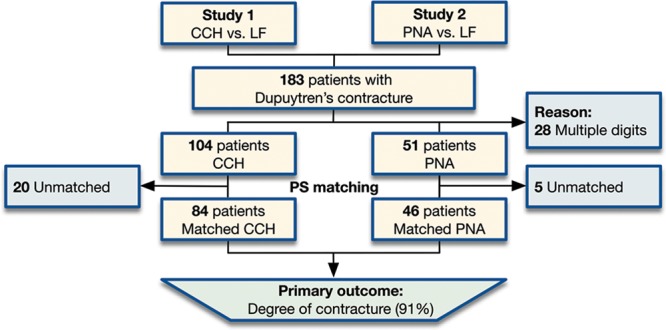
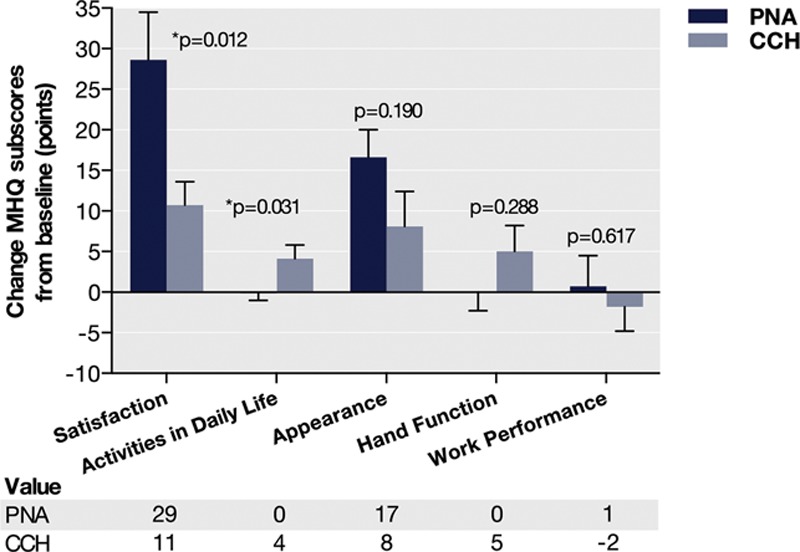
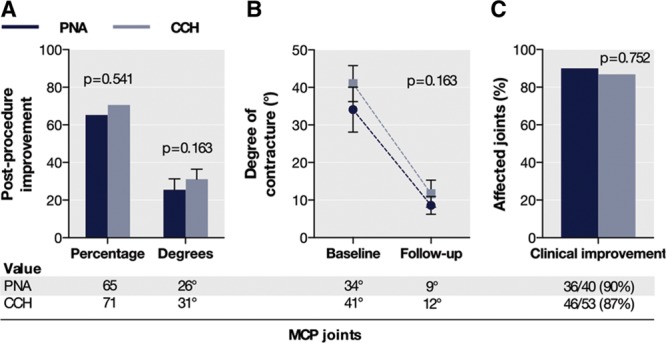
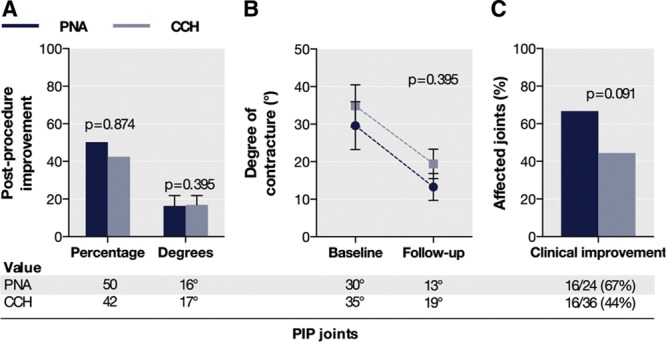
Among 130 matched patients (93% Tubiana I or II) undergoing PNA (n = 46) and CCH (n = 84), improvement in contracture was similar: 26 degrees (65% improvement from baseline) for PNA versus 31 degrees (71%) for CCH for affected metacarpophalangeal joints ( = 0.163). This was 16 degrees (50% improvement) versus 17 degrees (42%) for affected proximal interphalangeal joints ( = 0.395), respectively. No serious adverse effects occurred in either of the 2 treatment groups. Of the mild adverse effects, only skin fissures and sensory disturbances were seen in both groups. Through 1-year follow-up, patients reported similar improvements in the overall Michigan Hand Questionnaire score (PNA 5.3 points versus CCH 4.9 points; = 0.912).
In patients with mild contractures (Tubiana I or II), CCH was as effective as PNA in reducing contractures. Both treatments were safe and improved hand function to a similar extent in daily practice.
尽管随机临床试验已证实溶组织梭状芽孢杆菌胶原酶(CCH)注射的疗效,但CCH的相对有效性仍不确定。我们的目的是在日常临床实践中比较CCH与经皮针状腱膜切开术(PNA)的治疗效果。
我们分析了2011年至2014年期间在荷兰7个医疗机构接受PNA或CCH治疗的患者数据。我们检查了手术或最后一次注射后6至12周时挛缩改善程度和不良反应情况。此外,我们邀请患者在术前及6至12个月随访时完成密歇根手部问卷。为尽量减少偏倚风险,我们采用了倾向得分匹配法。
在130例匹配患者(93%为图比亚纳I型或II型)中,接受PNA治疗的患者有46例,接受CCH治疗的患者有84例,挛缩改善情况相似:受累掌指关节,PNA组改善26度(较基线改善65%),CCH组改善31度(71%)(P = 0.163)。受累近端指间关节分别为16度(改善50%)和17度(改善42%)(P = 0.395)。两个治疗组均未发生严重不良反应。在轻微不良反应中,两组均仅出现皮肤皲裂和感觉障碍。经过1年随访,患者报告密歇根手部问卷总体评分的改善情况相似(PNA组5.3分,CCH组4.9分;P = 0.912)。
在轻度挛缩(图比亚纳I型或II型)患者中,CCH在减轻挛缩方面与PNA效果相当。在日常实践中,两种治疗方法均安全,且在改善手部功能方面程度相似。