Azimi Fashi Yazdan, Mesripour Azadeh, Hajhashemi Valiollah
Department of Pharmacology and Toxicology, School of Pharmacy and Pharmaceutical sciences, Isfahan university of Medical Sciences, Isfahan, Iran.
Isfahan Pharmaceutical Sciences Research Center, School of Pharmacy and Pharmaceutical sciences, Isfahan university of Medical Sciences, Isfahan, Iran.
Avicenna J Phytomed. 2017 Sep-Oct;7(5):436-443.
Interferon-α (IFN) therapy can cause depressive symptom which may lead to drug discontinuation. By interfering with tryptophan pathway, the available level of tryptophan required for serotonin synthesis decreases which could be related to depression. The aim of this study was to evaluate whether soybean diet could improve IFN-induced depression.
Male mice weighing 28±3 g were used in the forced swimming test (FST) as an animal model of depression; also, locomotor activity was recorded. IFN 16×10 IU/kg was injected subcutaneously for 6 days. Animals were fed with regular diet or soybean diet at 3 concentrations throughout the experiment. Fluoxetine was the reference drug. To check whether the tryptophan content in the soy bean diet was effective, a group of animals was injected with a single dose of tryptophan on the test day.
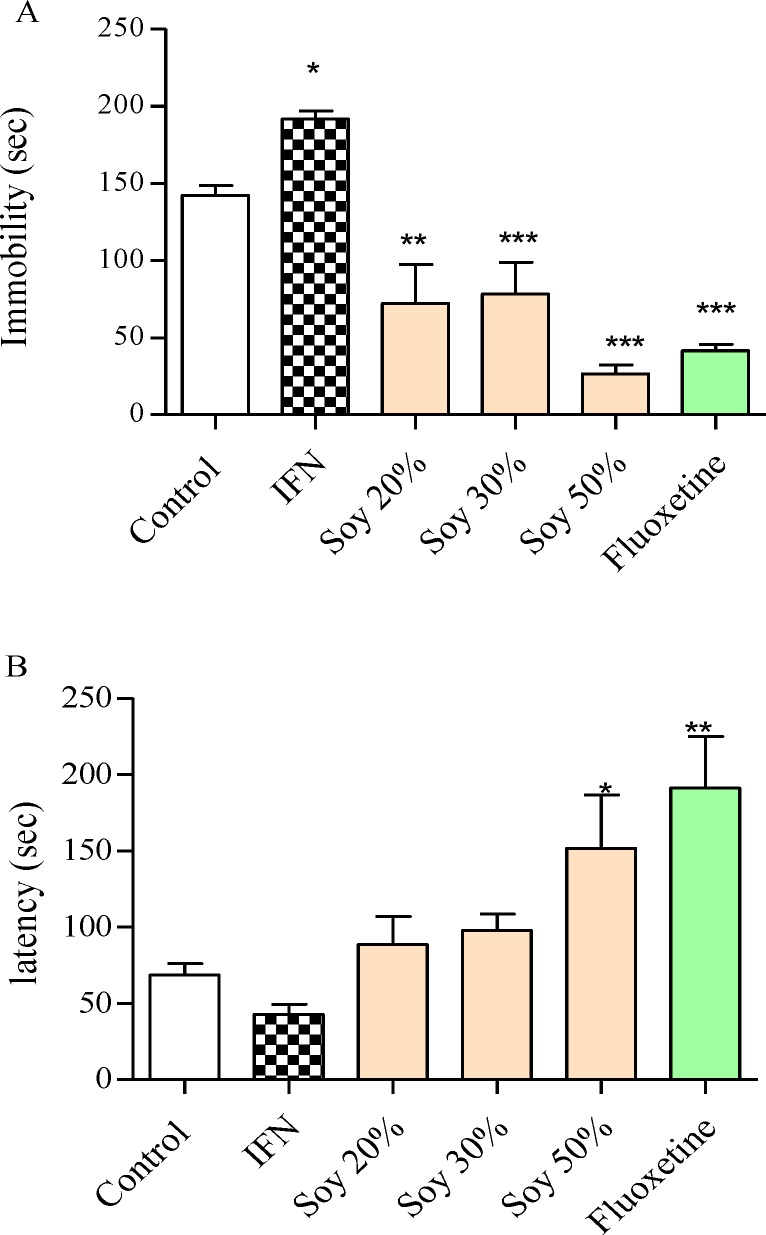
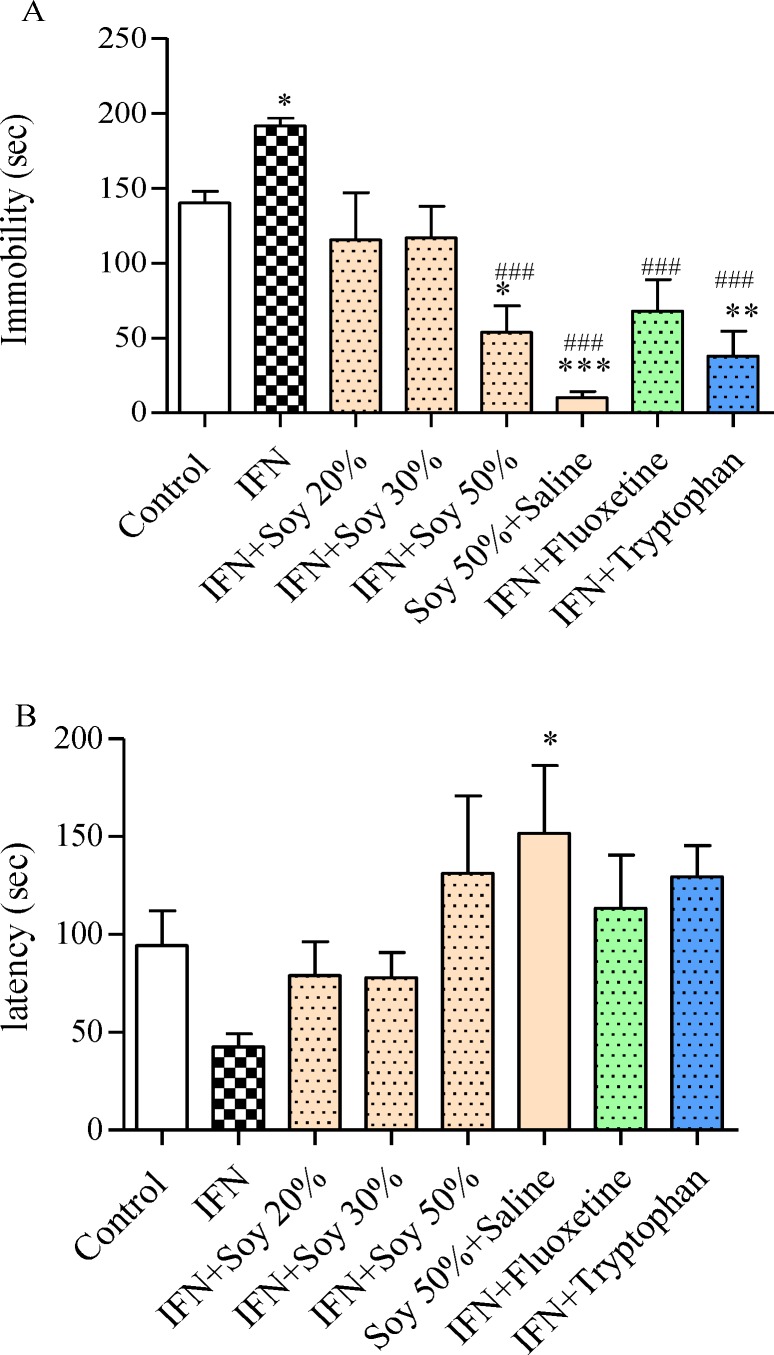
IFN-α increased the immobility time in the FST (192 sec ± 5.4), that denotes depression in mice. Soybean diets caused less immobility that was more profound with 50% soybean (26.4 sec ± 6). This diet overcame the depression caused by IFN in the FST (54 sec±18). This result was parallel with that of tryptophan injected to animals (38 sec±17). All the animals showed normal locomotor activity.
For the first time, we showed that soybean diet could counteract with depression caused by IFN-α. Since tryptophan therapy had similar effects, possibly the tryptophan content of soybean had induced the serotonin synthesis. Thus, not only less harmful kynurenine was produced but also more serotonin was available in the brain to overcome depression. However, this interpretation needs further evaluations.
α干扰素(IFN)治疗可引发抑郁症状,这可能导致停药。通过干扰色氨酸途径,血清素合成所需的色氨酸可用水平降低,这可能与抑郁症有关。本研究的目的是评估大豆饮食是否能改善IFN诱导的抑郁症。
体重28±3 g的雄性小鼠用于强迫游泳试验(FST),作为抑郁症动物模型;同时记录运动活性。皮下注射IFN 16×10 IU/kg,持续6天。在整个实验过程中,动物分别喂食常规饮食或3种浓度的大豆饮食。氟西汀为参比药物。为检查大豆饮食中的色氨酸含量是否有效,在试验当天给一组动物注射单剂量色氨酸。
α干扰素增加了FST中的不动时间(192秒±5.4),这表明小鼠出现了抑郁。大豆饮食导致的不动时间减少,其中50%大豆饮食的效果更显著(26.4秒±6)。这种饮食克服了FST中由IFN引起的抑郁(54秒±18)。这一结果与给动物注射色氨酸的结果(38秒±17)相似。所有动物的运动活性均正常。
我们首次表明,大豆饮食可对抗α干扰素引起的抑郁。由于色氨酸治疗有类似效果,可能大豆中的色氨酸含量诱导了血清素合成。因此,不仅产生的犬尿氨酸危害较小,而且大脑中可利用的血清素更多,从而克服抑郁。然而,这一解释需要进一步评估。