Sultana Marufa, Mahumud Rashidul Alam, Sarker Abdur Razzaque
Health Economics and Financing Research, Health Systems and Population Studies Division, International Centre for Diarrhoeal Disease Research, Bangladesh (icddr'b), Dhaka, Bangladesh.
University of Strathclyde, Glasgow, United Kingdom.
Chronic Dis Transl Med. 2017 Apr 17;3(2):112-122. doi: 10.1016/j.cdtm.2017.02.001. eCollection 2017 Jun 25.
The purpose of this study was to investigate the distribution of chronic illness and associated disability, out-of-pocket payment (OOPP), and other related factors using survey data from Bangladesh.
This study analyzed Bangladesh Household Income and Expenditure Survey data that include socio-economic and demographic data, such as consumption, expenditures, and assets, along with information regarding chronic illness and disability. Multiple linear regression models were used to identify factors significantly associated with OOPP. Furthermore, a binary Logistic regression model was employed to assess the association of the explanatory variables with disability status.
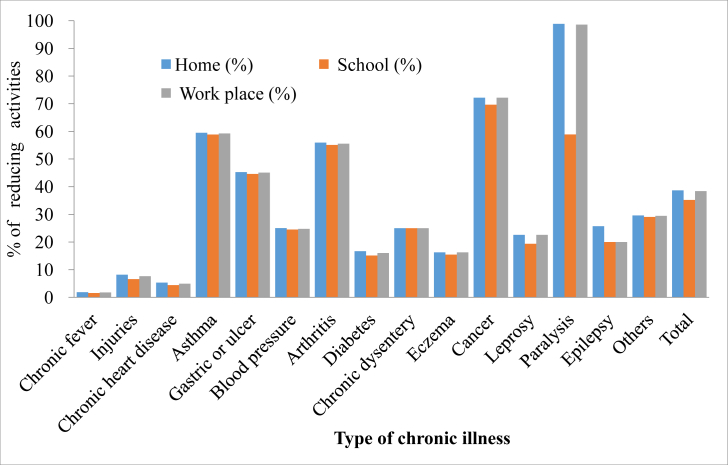
A higher prevalence of chronic illness was found for those with chronic gastritis (18.70%), and 41.92% of the population had at least one side disability. The average OOPP healthcare expenditure for chronic illness was estimated to be US$7.59. Higher OOPP was found among the upper 2 wealth quintiles. Overall OOPP health expenditure was significantly higher among individuals with an associated disability ( < 0.001). The likelihood of having an associated disability was higher among those individuals with a lower education level ( = 2.36, 95% : 1.95-4.06), those who not earning an income ( = 2.85, 95% : 2.53-3.21), those who did not seek care ( = 1.73, 95% : 1.57-1.90), those who sought care from a pharmacy ( = 8.91, 95% : 7.38-10.74), and those in the lowest wealth quintile ( = 7.21, 95% : 6.41-8.12).
The high OOPP illustrates the necessity of financial risk protection for the population at low socio-economic status. Therefore, we recommend that the government strengthen the healthcare system with appropriate support directed to the rural and elderly populations.
本研究旨在利用孟加拉国的调查数据,调查慢性病及相关残疾的分布情况、自付费用(OOPP)以及其他相关因素。
本研究分析了孟加拉国家庭收入和支出调查数据,这些数据包括社会经济和人口统计数据,如消费、支出和资产,以及有关慢性病和残疾的信息。使用多元线性回归模型来确定与自付费用显著相关的因素。此外,采用二元逻辑回归模型来评估解释变量与残疾状况之间的关联。
发现慢性胃炎患者的慢性病患病率较高(18.70%),41.92%的人口至少有一侧残疾。慢性病的平均自付医疗费用估计为7.59美元。在最富有的两个财富五分位数人群中,自付费用较高。有相关残疾的个体的总体自付医疗费用显著更高(<0.001)。在教育水平较低的个体(=2.36,95%置信区间:1.95 - 4.06)、没有收入的个体(=2.85,95%置信区间:2.53 - 3.21)、未寻求医疗护理的个体(=1.73,95%置信区间:1.57 - 1.90)、从药店寻求医疗护理的个体(=8.91,95%置信区间:7.38 - 10.74)以及最贫穷财富五分位数的个体(=7.21,95%置信区间:6.41 - 8.12)中,有相关残疾的可能性更高。
高额的自付费用表明有必要为社会经济地位较低的人群提供财务风险保护。因此,我们建议政府加强医疗保健系统,并向农村和老年人口提供适当支持。