Erasmus MC Cancer Institute, Department of Medical Oncology and Cancer Genomics Netherlands, Erasmus University Medical Center, Rotterdam, The Netherlands.
Department of Clinical and Molecular Medicine, University of Catania, Italy.
Mol Oncol. 2018 Jan;12(1):48-57. doi: 10.1002/1878-0261.12147. Epub 2017 Nov 17.
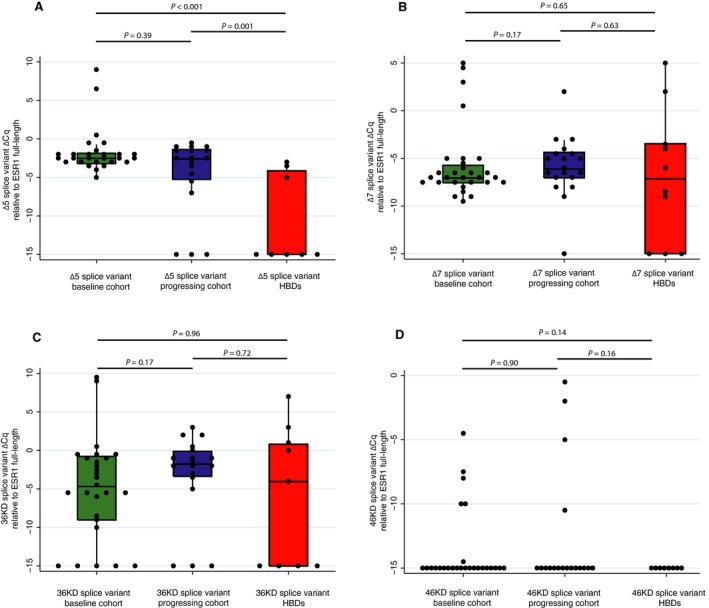
Mutations and splice variants in the estrogen receptor (ER) gene, ESR1, may yield endocrine resistance in metastatic breast cancer (MBC) patients. These putative endocrine resistance markers are likely to emerge during treatment, and therefore, its detection in liquid biopsies, such as circulating tumor cells (CTCs) and cell-free DNA (cfDNA), is of great interest. This research aimed to determine whether ESR1 mutations and splice variants occur more frequently in CTCs of MBC patients progressing on endocrine treatment. In addition, the presence of ESR1 mutations was evaluated in matched cfDNA and compared to CTCs. CellSearch-enriched CTC fractions (≥5/7.5 mL) of two MBC cohorts were evaluated, namely (a) patients starting first-line endocrine therapy (n = 43, baseline cohort) and (b) patients progressing on any line of endocrine therapy (n = 40, progressing cohort). ESR1 hotspot mutations (D538G and Y537S/N/C) were evaluated in CTC-enriched DNA using digital PCR and compared with matched cfDNA (n = 18 baseline cohort; n = 26 progressing cohort). Expression of ESR1 full-length and 4 of its splice variants (∆5, ∆7, 36 kDa, and 46 kDa) was evaluated in CTC-enriched mRNA. It was observed that in the CTCs, the ESR1 mutations were not enriched in the progressing cohort (8%), when compared with the baseline cohort (5%) (P = 0.66). In the cfDNA, however, ESR1 mutations were more prevalent in the progressing cohort (42%) than in the baseline cohort (11%) (P = 0.04). Three of the same mutations were observed in both CTCs and cfDNA, 1 mutation in CTCs only, and 11 in cfDNA only. Only the ∆5 ESR1 splice variant was CTC-specific expressed, but was not enriched in the progressing cohort. In conclusion, sensitivity for detecting ESR1 mutations in CTC-enriched fractions was lower than for cfDNA. ESR1 mutations detected in cfDNA, rarely present at the start of first-line endocrine therapy, were enriched at progression, strongly suggesting a role in conferring endocrine resistance in MBC.
雌激素受体(ER)基因 ESR1 的突变和剪接变体可能导致转移性乳腺癌(MBC)患者发生内分泌抵抗。这些潜在的内分泌抵抗标志物可能在治疗过程中出现,因此,在液体活检中检测它们,如循环肿瘤细胞(CTC)和无细胞 DNA(cfDNA),非常有意义。本研究旨在确定在接受内分泌治疗的 MBC 患者进展时,CTC 中是否更频繁地出现 ESR1 突变和剪接变体。此外,还评估了匹配的 cfDNA 中 ESR1 突变的存在情况,并与 CTC 进行了比较。评估了两个 MBC 队列的 CellSearch 富集 CTC 分数(≥5/7.5mL),分别为:(a)开始一线内分泌治疗的患者(n=43,基线队列)和(b)任何一线内分泌治疗进展的患者(n=40,进展队列)。使用数字 PCR 评估 CTC 富集 DNA 中的 ESR1 热点突变(D538G 和 Y537S/N/C),并与匹配的 cfDNA 进行比较(n=18 个基线队列;n=26 个进展队列)。评估了 CTC 富集 mRNA 中 ESR1 全长和 4 种剪接变体(∆5、∆7、36kDa 和 46kDa)的表达。结果表明,与基线队列(5%)相比,进展队列(8%)的 CTC 中 ESR1 突变并未富集(P=0.66)。然而,在 cfDNA 中,进展队列中 ESR1 突变更为普遍(42%),而基线队列中则更为罕见(11%)(P=0.04)。在 CTC 和 cfDNA 中观察到了 3 种相同的突变,在 CTC 中仅观察到 1 种突变,而在 cfDNA 中仅观察到 11 种突变。仅 ∆5 ESR1 剪接变体在 CTC 中特异性表达,但在进展队列中并未富集。总之,在 CTC 富集分数中检测 ESR1 突变的敏感性低于 cfDNA。在一线内分泌治疗开始时很少出现的 cfDNA 中检测到的 ESR1 突变在进展时富集,这强烈表明其在赋予 MBC 内分泌抵抗方面发挥作用。