Kurawa Musbahu Sani, Abdu Lawan
Department of Ophthalmology, College of Health Sciences, Bayero University, Kano, Nigeria.
Ann Afr Med. 2017 Oct-Dec;16(4):170-174. doi: 10.4103/aam.aam_123_16.
Objective/Purpose: To describe the demographic and baseline ocular characteristics, prevalence of blindness and visual impairment among patients undergoing extracapsular cataract extraction for age related cataract at the study hospital over a one year period. Materials/Patients: All consecutive patients aged 40 years and above identified with age related cataract in one or both eyes who voluntarily agree to participate were included.
The study adhered to the tenets of the Helsinki declaration. Written informed consent was obtained from all eligible patients. All patients underwent basic eye examination by the ophthalmologist. Visual impairment was determined for each eye according to the standard WHO categorizations. Information obtained also included age, sex and history of previous cataract surgery. Data were recorded in manual tally sheets and on modified computer Cataract Surgery Record forms. Analyses were done using SPSS (version 16, SPSS Inc., Chicago, USA).
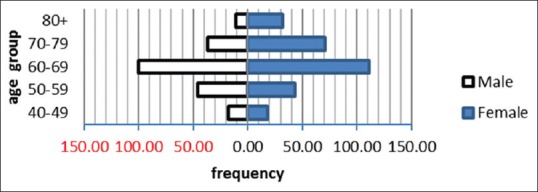
The participation rate was 91.2%. There were 495 eyes of 487 consecutive patients. This include 212 males and 275 females (M:F, 1:1.3). The age range was 40 to 99 years with a mean age of 62.76 ± 10.49 years (61.35 ± 9.75 years in men and 63.85±10.9 years in females). Most of the patients (n = 451; 92.6%, 95% CI: 89.9-94.6%) were aged 50 years and above. Sixty patients (12.3%, 95% CI: 9.6-15.5%) had cataract in both eyes, 427 (87.7%, 95% CI: 84.5-90.3%) were in one eye. Among these, preoperatively 16 (3.3%, 95% CI: 2.0-5.3%) had aphakia, 21 (4.3%, 95% CI: 2.8-6.5%) had uniocular pseudophakia. About 63.2% (95% CI: 58.9-67.4%) of patients had normal vision in the better eye (presenting VA ≥6/18). Overall 9.5% (95% CI: 7.3-12.7%) were bilaterally blind. About 96.8% of eyes (95% CI: 94.5-98.0%) undergoing cataract surgery were blind (presenting VAConclusion: The study highlights preponderance of females and high incidence of blinding cataract. Education and early disease awareness may play an important role in these patients and could improve cataract surgical services in our hospital..
目的/目标:描述在研究医院为期一年的时间里,接受年龄相关性白内障囊外摘除术患者的人口统计学和基线眼部特征、失明和视力损害的患病率。材料/患者:纳入所有年龄在40岁及以上、一只或两只眼睛患有年龄相关性白内障且自愿同意参与的连续患者。
本研究遵循赫尔辛基宣言的原则。获得了所有符合条件患者的书面知情同意书。所有患者均由眼科医生进行基本眼部检查。根据世界卫生组织的标准分类确定每只眼睛的视力损害情况。获得的信息还包括年龄、性别和既往白内障手术史。数据记录在手工计数表和改良的计算机白内障手术记录表格上。使用SPSS(版本16,SPSS公司,美国芝加哥)进行分析。
参与率为91.2%。连续487例患者共495只眼睛。其中男性212例,女性275例(男:女,1:1.3)。年龄范围为40至99岁,平均年龄为62.76±10.49岁(男性为61.35±9.75岁,女性为63.85±10.9岁)。大多数患者(n = 451;92.6%,95%置信区间:89.9 - 94.6%)年龄在50岁及以上。60例患者(12.3%,95%置信区间:9.6 - 15.5%)双眼患有白内障,427例(87.7%,95%置信区间:84.5 - 90.3%)单眼患有白内障。其中,术前16例(3.3%,95%置信区间:2.0 - 5.3%)为无晶状体眼,21例(4.3%,95%置信区间:2.8 - 6.5%)为单眼人工晶状体眼。约63.2%(95%置信区间:58.9 - 67.4%)的患者较好眼视力正常(当前视力≥6/18)。总体而言,9.5%(95%置信区间:7.3 - 12.7%)为双眼失明。接受白内障手术的眼睛中约96.8%(95%置信区间:94.5 - 98.0%)失明(当前视力……结论:该研究突出了女性占多数以及致盲性白内障的高发病率。教育和早期疾病认知可能在这些患者中发挥重要作用,并可改善我院的白内障手术服务。