Molfino Alessio, Beck Gerald J, Li Minwei, Lo Joan C, Kaysen George A
Division of Nephrology, Department of Internal Medicine, University of California, Davis, California, USA.
Department of Clinical Medicine, Sapienza University of Rome, Rome, Italy.
Nephrology (Carlton). 2019 Jan;24(1):81-87. doi: 10.1111/nep.13187.
Correction of metabolic acidosis in patients with chronic kidney disease has been associated with improvement in thyroid function. We examined whether changes in bicarbonate were associated with changes in thyroid function in patients with end-stage renal disease receiving conventional or more frequent haemodialysis.
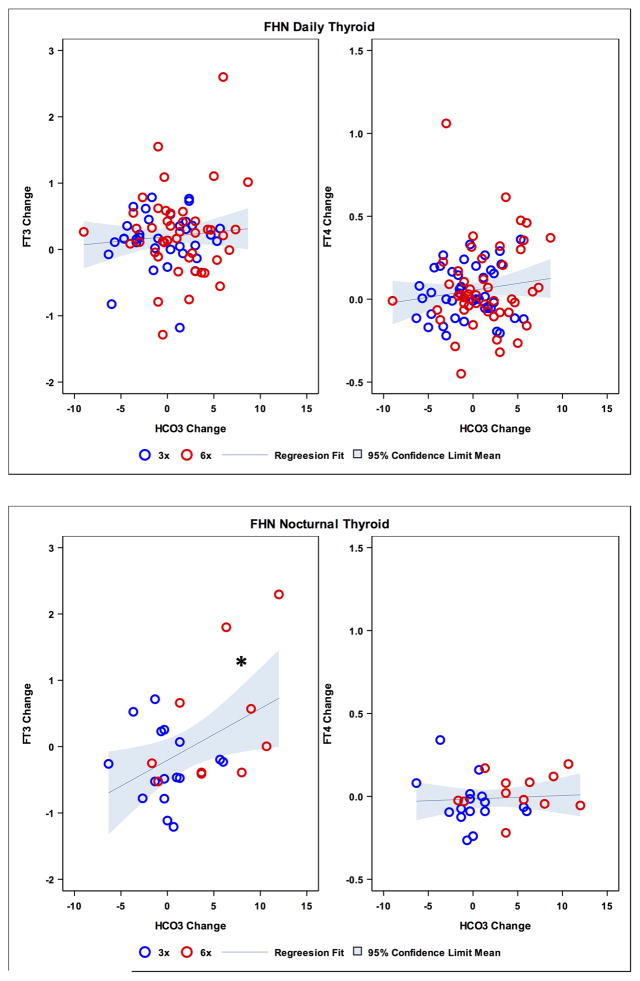
In the Frequent Hemodialysis Network Trials, the relationship between changes in serum bicarbonate, free triiodothyronine (FT3) and free thyroxine (FT4) was examined among 147 and 48 patients with endogenous thyroid function who received conventional (3×/week) or more frequent (6×/week) haemodialysis (Daily Trial) or who received conventional or more frequent nocturnal haemodialysis (Nocturnal Trial). Equilibrated normalized protein catabolic rate (enPCR) was examined to account for nutritional factors affecting both acid load and thyroid function.
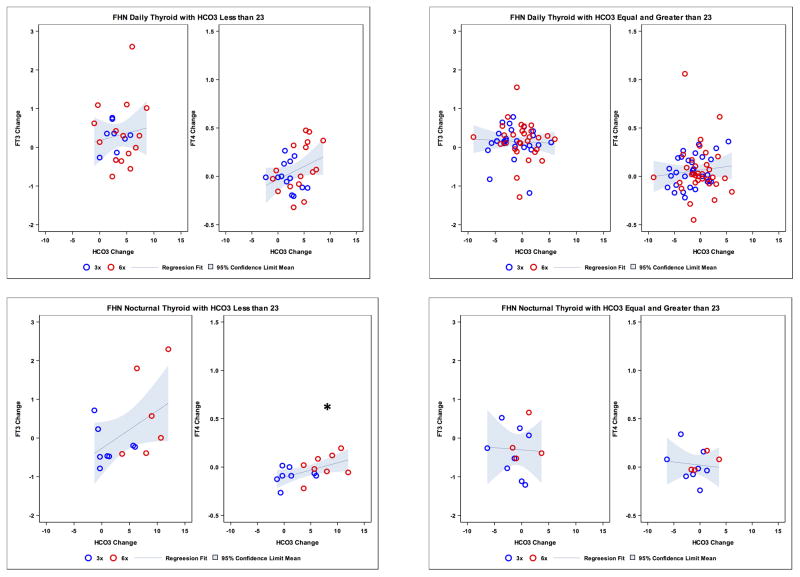
Increasing dialysis frequency was associated with increased bicarbonate level. Baseline bicarbonate level was not associated with baseline FT3 and FT4. Change in bicarbonate level was not associated with changes in FT3 and FT4 in the Daily Trial nor for FT4 in the Nocturnal Trial (r ≤ 0.14, P > 0.21). While, a significant correlation between change in serum bicarbonate and change in FT3 (r = 0.44, P = 0.02) was observed in the Nocturnal Trial; findings were no longer significant after adjusting for change in enPCR (r = 0.37, P = 0.08). For participants with baseline bicarbonate <23 mmol/L, no association between change in bicarbonate and change in thyroid indices were seen in the Daily Trial; for the Nocturnal Trial, findings were also not significant for change in FT3 and the association between change in bicarbonate and change in FT4 (r = 0.54, P = 0.03) was no longer significant after adjusting for enPCR (r = 0.45, P = 0.11).
Changes in bicarbonate were not associated with changes in thyroid hormone levels after adjusting for enPCR, as a marker of nutritional status. Future studies should examine whether improvement in acid base status improves thyroid function in haemodialysis patients with evidence of thyroid hypofunction.
慢性肾病患者代谢性酸中毒的纠正与甲状腺功能改善有关。我们研究了接受常规或更频繁血液透析的终末期肾病患者中,碳酸氢盐变化与甲状腺功能变化是否相关。
在频繁血液透析网络试验中,在147例和48例具有内源性甲状腺功能的患者中,研究了血清碳酸氢盐、游离三碘甲状腺原氨酸(FT3)和游离甲状腺素(FT4)变化之间的关系,这些患者接受常规(每周3次)或更频繁(每周6次)血液透析(每日试验),或接受常规或更频繁的夜间血液透析(夜间试验)。检查平衡归一化蛋白分解代谢率(enPCR)以考虑影响酸负荷和甲状腺功能的营养因素。
透析频率增加与碳酸氢盐水平升高有关。基线碳酸氢盐水平与基线FT3和FT4无关。在每日试验中,碳酸氢盐水平变化与FT3和FT4变化无关,在夜间试验中与FT4变化无关(r≤0.14,P>0.21)。然而,在夜间试验中观察到血清碳酸氢盐变化与FT3变化之间存在显著相关性(r = 0.44,P = 0.02);在调整enPCR变化后,结果不再显著(r = 0.37,P = 0.08)。对于基线碳酸氢盐<23 mmol/L的参与者,在每日试验中未观察到碳酸氢盐变化与甲状腺指标变化之间的关联;对于夜间试验,FT3变化的结果也不显著,在调整enPCR后,碳酸氢盐变化与FT4变化之间的关联(r = 0.54,P = 0.03)不再显著(r = 0.45,P = 0.11)。
调整enPCR(作为营养状况的标志物)后,碳酸氢盐变化与甲状腺激素水平变化无关。未来的研究应检查酸碱状态的改善是否能改善有甲状腺功能减退证据的血液透析患者的甲状腺功能。