Center for Spatial Analysis, Department for Microbiology and Plant Biology, University of Oklahoma, Norman, OK 73019, USA.
Ministry of Education Key Laboratory for Biodiversity Science and Ecological Engineering, Institute of Biodiversity Science, Fudan University, Shanghai 200433, China.
Sci Data. 2017 Oct 24;4:170165. doi: 10.1038/sdata.2017.165.
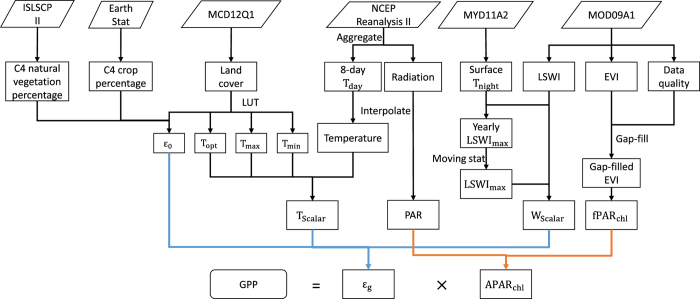
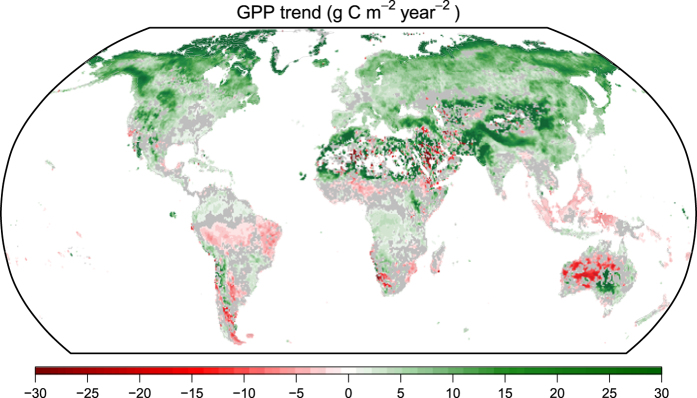
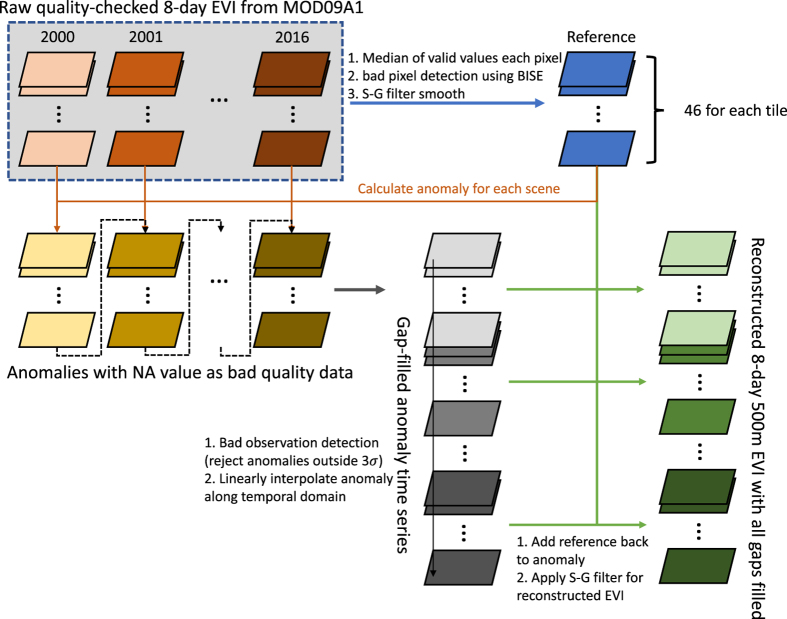
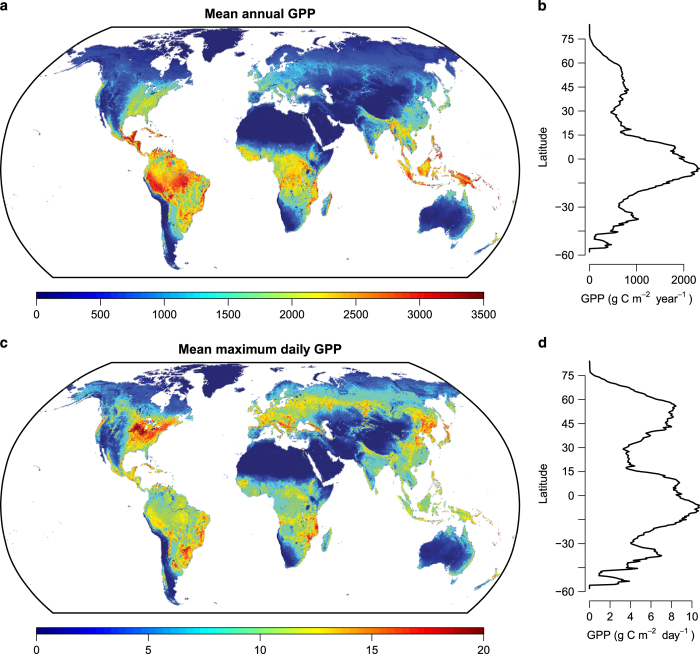
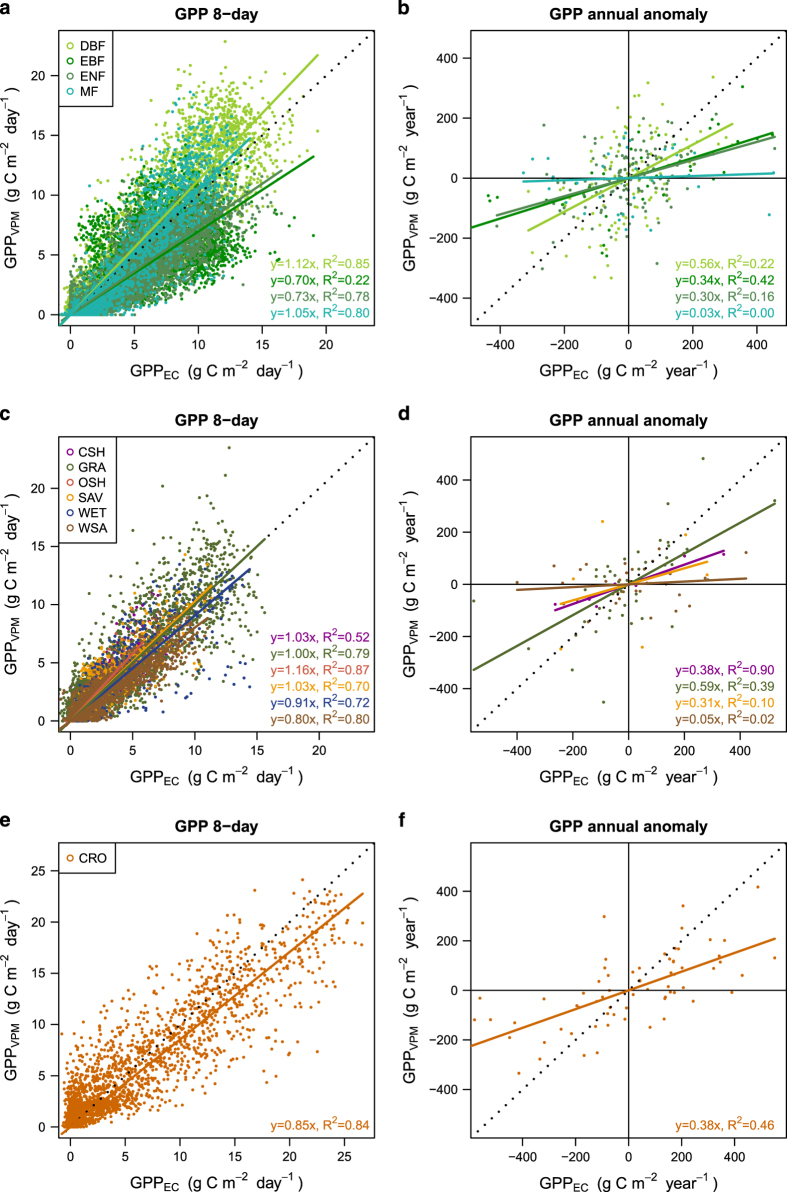
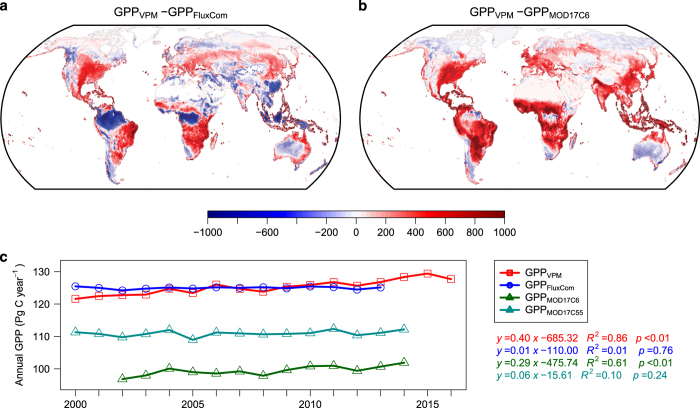
Accurate estimation of the gross primary production (GPP) of terrestrial vegetation is vital for understanding the global carbon cycle and predicting future climate change. Multiple GPP products are currently available based on different methods, but their performances vary substantially when validated against GPP estimates from eddy covariance data. This paper provides a new GPP dataset at moderate spatial (500 m) and temporal (8-day) resolutions over the entire globe for 2000-2016. This GPP dataset is based on an improved light use efficiency theory and is driven by satellite data from MODIS and climate data from NCEP Reanalysis II. It also employs a state-of-the-art vegetation index (VI) gap-filling and smoothing algorithm and a separate treatment for C3/C4 photosynthesis pathways. All these improvements aim to solve several critical problems existing in current GPP products. With a satisfactory performance when validated against in situ GPP estimates, this dataset offers an alternative GPP estimate for regional to global carbon cycle studies.
准确估算陆地植被的总初级生产力(GPP)对于理解全球碳循环和预测未来气候变化至关重要。目前有多种基于不同方法的 GPP 产品,但在与涡度协方差数据估算的 GPP 进行验证时,其性能差异很大。本文提供了一个新的 GPP 数据集,该数据集覆盖全球范围,空间分辨率为 500m,时间分辨率为 8 天,时间跨度为 2000-2016 年。该 GPP 数据集基于改进的光能利用效率理论,由 MODIS 卫星数据和 NCEP Reanalysis II 气候数据驱动。它还采用了最先进的植被指数(VI)填补和平滑算法,以及对 C3/C4 光合作用途径的单独处理。所有这些改进旨在解决当前 GPP 产品中存在的几个关键问题。该数据集在与原位 GPP 估算值进行验证时表现出令人满意的性能,为区域到全球碳循环研究提供了一种替代的 GPP 估算值。