Navarro-Peternella Fabiana Magalhães, Lopes Ana Patrícia A Torquato, de Arruda Guilherme Oliveira, Teston Elen Ferraz, Marcon Sonia Silva
Faculdade Ingá (Uningá), Paraná, Brazil.
Department of Health Sciences, State University of Maringá, Paraná, Brazil.
J Clin Transl Endocrinol. 2016 Oct 13;6:30-36. doi: 10.1016/j.jcte.2016.10.001. eCollection 2016 Dec.
This trial aims to identify differences between genders in relation to factors associated with the risk of diabetic foot in elderly persons.
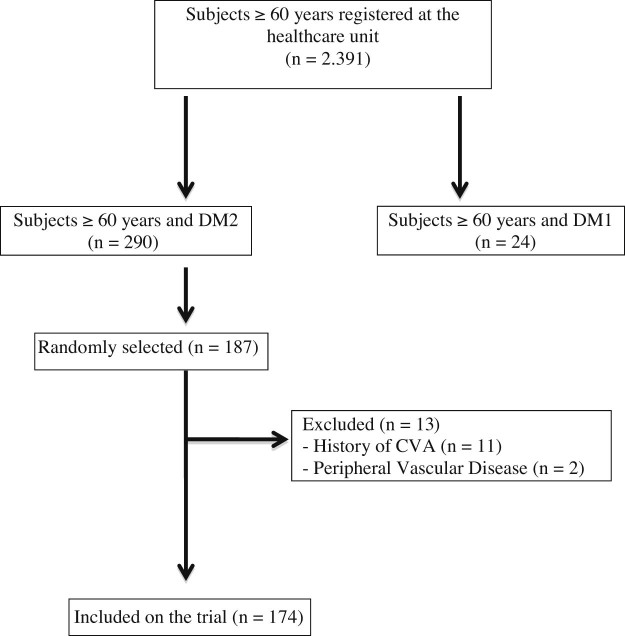
We evaluated 187 older adults diagnosed with diabetes type 2. The variables investigated were sociodemographic data, clinical history of diabetes mellitus and complaints about the feet. The plantar sensitivity was evaluated on both feet, with the use of Semmes-Weinstein monofilaments. For data analysis we used chi-square test and binary logistic regression (p < 0.05; 95% CI).
We included 174 elderly people who had no history of stroke and peripheral vascular disease. Most (58.6%) were female and among them the risk factors for diabetic foot were older age (p < 0.021; OR 6.0), presence of calluses (p < 0.046; OR 2.83) and claw toes (p < 0.041; OR 3.18). And among men, the risk factors for diabetic foot were insulin use (p < 0.008; OR 5.22), presence of sensory comorbidities (p < 0.007; OR 5.0), ulcers (p < 0.001), numbness (p < 0.002; OR 6.6) and stiffness in the feet (p < 0.009; OR 5.44).
The factors associated with the development of diabetic foot were presented differently in women and men, so a targeted and more specific preventive approach is required.
本试验旨在确定老年人糖尿病足风险相关因素在性别方面的差异。
我们评估了187名被诊断为2型糖尿病的老年人。所调查的变量包括社会人口统计学数据、糖尿病临床病史以及足部相关症状。使用Semmes-Weinstein单丝对双脚的足底感觉进行评估。数据分析采用卡方检验和二元逻辑回归(p < 0.05;95%置信区间)。
我们纳入了174名无中风和外周血管疾病病史的老年人。大多数(58.6%)为女性,其中糖尿病足的危险因素为年龄较大(p < 0.021;比值比6.0)、存在胼胝(p < 0.046;比值比2.83)和爪形趾(p < 0.041;比值比3.18)。而在男性中,糖尿病足的危险因素为使用胰岛素(p < 0.008;比值比5.22)、存在感觉合并症(p < 0.007;比值比5.0)、溃疡(p < 0.001)、麻木(p < 0.002;比值比6.6)和足部僵硬(p < 0.009;比值比5.44)。
糖尿病足发生相关因素在女性和男性中表现不同,因此需要一种有针对性且更具体的预防方法。