Chappell Phillip, Dubrava Sarah, Stewart Michelle, Hartley Dean M, Alphs Larry, Brashear H Robert, Conwell Yeates, Miller David, Schindler Rachel J, Siemers Eric R, Yaffe Kristine
Pfizer, Groton, CT, USA.
Alzheimer's Association, Chicago, IL, USA.
Alzheimers Dement (N Y). 2016 Feb 23;2(1):60-68. doi: 10.1016/j.trci.2016.02.002. eCollection 2016 Jan.
The AARR task force on suicidal ideation and behavior (SI/SB) in dementia conducted an online survey on the extent of SI/SB in individuals diagnosed with mild cognitive impairment (MCI) or dementia who were participating in clinical trials.
Investigators with experience in conducting SI/SB assessments in clinical trial subjects with MCI or dementia were invited to complete a global 19-item online survey.
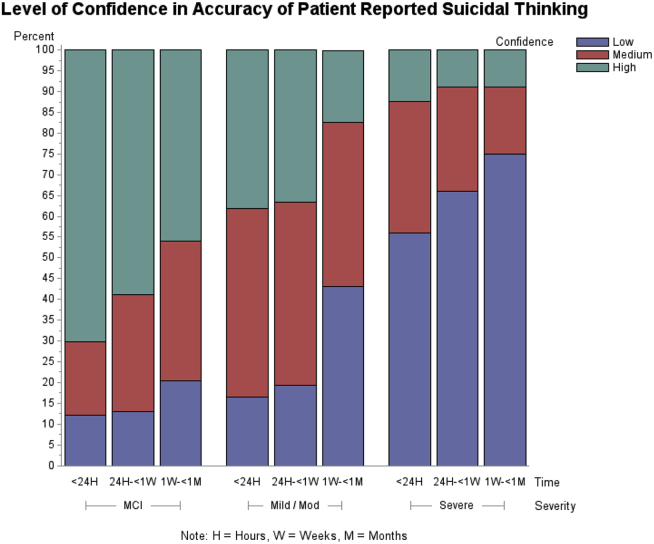
A total of 204 evaluable responses were collected with the majority from North America and Europe (83.4%) and the remainder from Asia, Latin America, and Mideast/Africa. The mean (SD) number of subjects personally assessed by the respondents in the past year with MCI, mild-moderate dementia, or severe dementia was 12.8 (26.2), 31.2 (39.6), and 10.1 (34.7), respectively. The mean number of subjects in each diagnostic group with suicidal ideation (SI), suicidal behavior (SB), or completed suicide (CS) was on average quite low (0.3 to 1.1 for SI, 0.1 to 0.2 for SB, and 0.0 to 0.2 for CS). Confidence in subject self-reports of SI/SB over different time periods declined with increasing severity of cognitive impairment and with increasing duration of the recall time period assessed. Of respondents, 56% and 75% had low confidence in self-ratings of SI/SB from subjects with severe dementia over the past 24 hours and the past week to 1 month, respectively. Ratings of the reliability of information collected on SI/SB also decreased with increasing severity of cognitive impairment. Approximately 70% of respondents rated the reliability of the information they obtained from all sources (patient, caregiver, and others) for subjects with MCI as high, but only about half (42.0% to 55.3%) and less than a quarter (17.4% to 24.3%) rated the reliability of information obtained for subjects with mild to moderate dementia or severe dementia as high, respectively.
These results support the usefulness of prospective SI/SB assessments in MCI and mild dementia, raise questions about the reliability of assessments in moderate dementia, and confirm their lack of clinical utility in severe dementia. The results highlight the need for development of validated assessment instruments adapted to the stage of cognitive decline of the patients under study and may be the most effective in the earliest stages of the disease.
痴呆症自杀意念与行为(SI/SB)特别行动小组对参与临床试验的轻度认知障碍(MCI)或痴呆症患者的SI/SB程度进行了在线调查。
邀请了在对患有MCI或痴呆症的临床试验受试者进行SI/SB评估方面有经验的研究人员完成一项包含19个项目的全球在线调查。
共收集到204份可评估的回复,其中大部分来自北美和欧洲(83.4%),其余来自亚洲、拉丁美洲以及中东/非洲。在过去一年中,受访者亲自评估的患有MCI、轻度至中度痴呆症或重度痴呆症的受试者的平均(标准差)人数分别为12.8(26.2)、31.2(39.6)和10.1(34.7)。每个诊断组中出现自杀意念(SI)、自杀行为(SB)或自杀身亡(CS)的受试者平均人数相当低(SI为0.3至1.1,SB为0.1至0.2,CS为0.0至0.2)。随着认知障碍严重程度的增加以及所评估的回忆时间段的延长,对受试者在不同时间段内SI/SB自我报告的信心下降。在受访者中,分别有56%和75%的人对重度痴呆症患者在过去24小时以及过去一周至1个月内SI/SB的自我评级信心较低。关于SI/SB所收集信息的可靠性评级也随着认知障碍严重程度的增加而降低。约70%的受访者将他们从所有来源(患者、护理人员及其他人)获取的MCI受试者信息的可靠性评为高,但只有约一半(42.0%至55.3%)以及不到四分之一(17.4%至24.3%)的受访者将轻度至中度痴呆症或重度痴呆症受试者信息的可靠性评为高。
这些结果支持了对MCI和轻度痴呆症进行前瞻性SI/SB评估的有用性,对中度痴呆症评估的可靠性提出了疑问,并证实了其在重度痴呆症中缺乏临床实用性。结果凸显了开发适用于所研究患者认知衰退阶段的经过验证的评估工具的必要性,且这些工具可能在疾病的最早阶段最为有效。