Division of Endocrinology and Metabolism, Department of Internal Medicine, Yeouido St. Mary's Hospital, College of Medicine, The Catholic University of Korea, #10, 63-ro, Yeongdeungpo-gu, 07345 Seoul, Korea.
Department of Medical Statistics, College of Medicine, The Catholic University of Korea, #222 Banpo-daero, Seocho-gu, 06591 Seoul, Korea.
Eur Heart J. 2017 Dec 21;38(48):3560-3566. doi: 10.1093/eurheartj/ehx585.
A high visit-to-visit variability in cholesterol levels has been suggested to be an independent predictor of major adverse cardiovascular events in patients with coronary artery disease (CAD). Because whether this notion applies to general population is not known, we aimed to investigate the associations between total cholesterol (TC) variability and the risk of all-cause mortality, myocardial infarction (MI), and stroke.
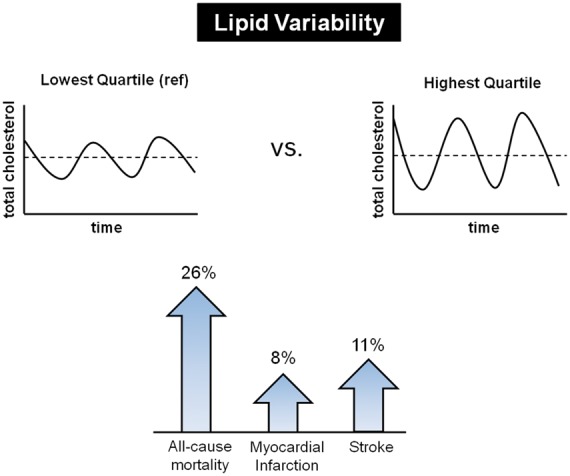
We identified 3 656 648 subjects without a history of MI and stroke who underwent ≥3 health examinations from 2002 to 2007 in the Korean National Health Insurance System cohort. Total cholesterol variability was measured using the coefficient of variation (CV), standard deviation (SD), and variability independent of the mean (VIM). There were 84 625 deaths (2.3%), 40 991 cases of MI (1.1%), and 42 861 cases of stroke (1.2%) during the median follow-up of 8.3 years. There was a linear association between higher TC variability and outcome measures. In the multivariable adjusted model, the hazard ratios and 95% confidence intervals comparing the highest vs. lowest quartiles of CV of TC were 1.26 (1.24-1.28) for all-cause mortality, 1.08 (1.05-1.11) for MI, and 1.11 (1.08-1.14) for stroke, which was independent of mean TC levels and the use of lipid-lowering agents. The results were consistent when modelling variability of TC using SD and VIM, and in various sensitivity analyses.
High variability in lipid levels is associated with adverse health-related outcomes. These findings suggest that lipid variability is an important risk factor in the general population.
胆固醇水平的就诊间变异性高已被认为是冠心病患者发生主要不良心血管事件的独立预测因子。由于尚不清楚这一概念是否适用于一般人群,我们旨在研究总胆固醇(TC)变异性与全因死亡率、心肌梗死(MI)和卒中风险之间的关系。
我们从韩国国家健康保险系统队列中确定了 3656648 例无 MI 和卒中病史且在 2002 年至 2007 年间接受了≥3 次健康检查的患者。TC 变异性采用变异系数(CV)、标准差(SD)和均值独立变异(VIM)来测量。中位随访 8.3 年后,发生 84625 例死亡(2.3%)、40991 例 MI(1.1%)和 42861 例卒中(1.2%)。TC 变异性越高与结局指标之间呈线性相关。在多变量调整模型中,与 TC 的 CV 最高四分位与最低四分位相比,全因死亡率的危险比和 95%置信区间为 1.26(1.24-1.28)、MI 为 1.08(1.05-1.11)、卒中为 1.11(1.08-1.14),这与平均 TC 水平和降脂药物的使用无关。当使用 SD 和 VIM 对 TC 的变异性进行建模时,以及在各种敏感性分析中,结果都是一致的。
脂质水平的高变异性与不良健康相关结局相关。这些发现提示脂质变异性是一般人群中的一个重要危险因素。