Wessel Karen, Suleiman Jehan, Khalaf Tamam E, Kishore Shivendra, Rolfs Arndt, El-Hattab Ayman W
Centogene AG, Schillingallee, Rostock, Germany.
Albrecht-Kossel-Institute for Neuroregeneration, Medical University Rostock, Gehlsheimer Straße, Rostock, Germany.
BMC Med Genet. 2017 Oct 25;18(1):119. doi: 10.1186/s12881-017-0479-3.
Chromosomal rearrangements involving 17q23 have been described rarely. Deletions at 17q23.1q23.2 have been reported in individuals with developmental delay and growth retardation, whereas duplications at 17q23.1q23.2 appear to segregate with clubfoot. Dosage alterations in the TBX2 and TBX4 genes, located in 17q23.2, have been proposed to be responsible for the phenotypes observed in individuals with 17q23.1q23.2 deletions and duplications. In this report, we present the clinical phenotype of a child with a previously unreported de novo duplication at 17q23.2q23.3 located distal to the TBX2 and TBX4 region.
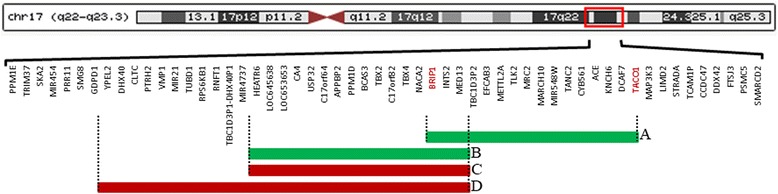
We report a 7.5-year-old boy with speech and language disorder, learning difficulties, incoordination, fine motor skill impairment, infrequent seizures with abnormal EEG, and behavior disturbances (mild self-inflicted injuries, hyperactivity-inattention, and stereotyped hand movements). Chromosomal microarray revealed a 2-Mb duplication of chromosome 17q23.2q23.3. Both parents did not have the duplication indicating that this duplication is de novo in the child.
The duplicated region encompasses 16 genes. It is possible that increased dosage of one or more genes in this region is responsible for the observed phenotype. The TANC2 gene is one of the genes in the duplicated region.It encodes a member of the TANC (tetratricopeptide repeat, ankyrin repeat and coiled-coil containing) family which includes TANC1 and TANC2. These proteins are highly expressed in brain and play major roles in synapsis regulation. Hence, it is suggestive that TANC2 is the likely candidate gene responsible for the observed phenotype as an increased TANC2 dosage can potentially alter synapsis, resulting in neuronal dysfunction and the neurobehavioral phenotype observed in this child with 17q23.2q23.3 duplication.
涉及17q23的染色体重排鲜有报道。17q23.1q23.2区域的缺失在发育迟缓及生长发育障碍个体中已有报道,而17q23.1q23.2区域的重复似乎与马蹄内翻足相关。位于17q23.2的TBX2和TBX4基因的剂量改变被认为是17q23.1q23.2缺失和重复个体中所观察到的表型的原因。在本报告中,我们呈现了一名儿童的临床表型,该儿童在17q23.2q23.3区域存在先前未报道的新发重复,该区域位于TBX2和TBX4区域的远端。
我们报告一名7.5岁男孩,有言语和语言障碍、学习困难、共济失调、精细运动技能受损、伴有异常脑电图的偶发性癫痫发作以及行为障碍(轻度自伤行为、多动-注意力不集中和刻板手部动作)。染色体微阵列显示17q23.2q23.3区域有2兆碱基的重复。父母双方均无此重复,表明该重复是患儿新发的。
重复区域包含16个基因。该区域中一个或多个基因剂量增加可能是所观察到的表型的原因。TANC2基因是重复区域中的基因之一。它编码TANC(包含四肽重复序列、锚蛋白重复序列和卷曲螺旋结构)家族的一个成员,该家族包括TANC1和TANC2。这些蛋白质在大脑中高度表达,并在突触调节中起主要作用。因此,提示TANC2可能是导致所观察到的表型的候选基因,因为TANC2剂量增加可能会改变突触,导致神经元功能障碍以及在这名17q23.2q23.3重复患儿中观察到的神经行为表型。