Unit of Experimental Rheumatology, Department of Medicine, Karolinska University Hospital, Karolinska Institutet, Stockholm, Sweden.
Unit of Neuroimmunology, Department of Clinical Neuroscience, Karolinska University Hospital, Karolinska Institutet, Stockholm, Sweden.
Biol Sex Differ. 2017 Oct 25;8(1):34. doi: 10.1186/s13293-017-0153-7.
Systemic lupus erythematosus (SLE) and primary Sjögren's syndrome (pSS) are autoimmune disorders characterized by autoantibodies, dysregulated B cells, and notably high female-to-male incidence ratios. Genome-wide association studies have identified several susceptibility SNPs for both diseases. Many SNPs in the genome are expression quantitative trait loci (eQTLs), with context-dependent effects. Assuming that sex is a biological context, we investigated whether SLE/pSS SNPs act as eQTLs in B cells and used a disease-targeted approach to understand if they display sex-specific effects.
We used genome-wide genotype and gene expression data from primary B cells from 125 males and 162 females. The MatrixEQTL R package was used to identify eQTLs within a genomic window of 2 Mb centered on each of 22 established SLE and/or pSS susceptibility SNPs. To find sex-specific eQTLs, we used a linear model with a SNP * sex interaction term.
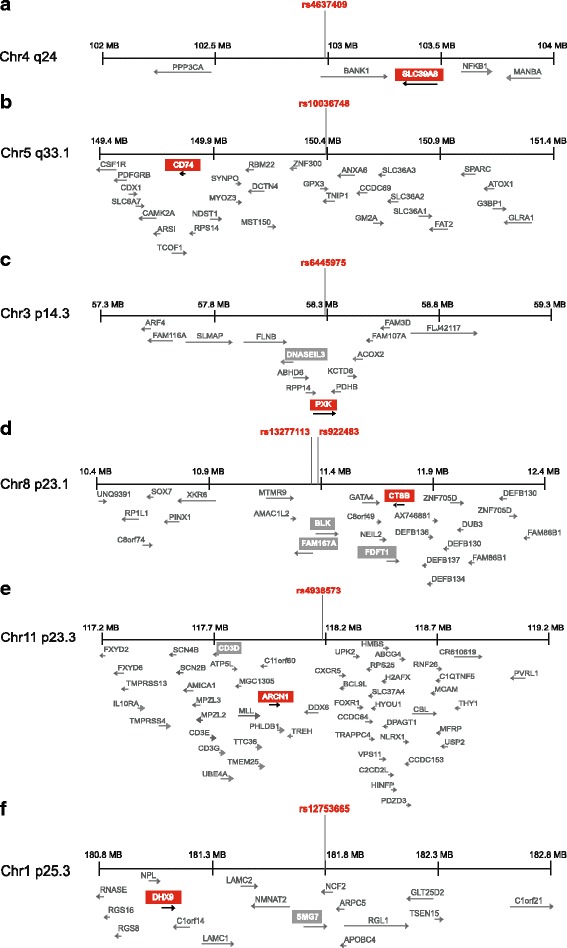
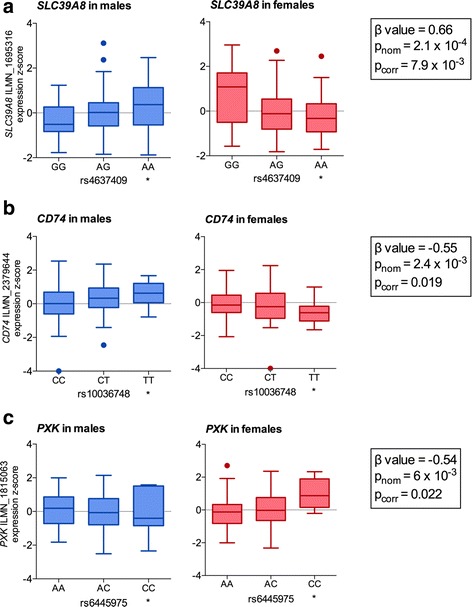
We found ten SNPs affecting the expression of 16 different genes (FDR < 0.05). rs7574865-INPP1, rs7574865-MYO1B, rs4938573-CD3D, rs11755393-SNRPC, and rs4963128-PHRF1 were novel observations for the immune compartment and B cells. By analyzing the SNP * sex interaction terms, we identified six genes with differentially regulated expression in females compared to males, depending on the genotype of SLE/pSS-associated SNPs: SLC39A8 (BANK1 locus), CD74 (TNIP1 locus), PXK, CTSB (BLK/FAM167A locus), ARCN1 (CXCR5 locus), and DHX9 (NCF2 locus).
We identified several unknown sex-specific eQTL effects of SLE/pSS-associated genetic polymorphisms and provide novel insight into how gene-sex interactions may contribute to the sex bias in systemic autoimmune diseases.
系统性红斑狼疮(SLE)和原发性干燥综合征(pSS)是自身免疫性疾病,其特征为自身抗体、失调的 B 细胞以及显著的女性比男性发病率比值。全基因组关联研究已鉴定出这两种疾病的多个易感 SNP。基因组中的许多 SNP 是表达数量性状基因座(eQTLs),具有上下文依赖性效应。假设性别是一种生物学背景,我们研究了 SLE/pSS SNP 是否作为 B 细胞中的 eQTL,并采用疾病靶向方法来了解它们是否表现出性别特异性效应。
我们使用来自 125 名男性和 162 名女性的原发性 B 细胞的全基因组基因型和基因表达数据。使用 MatrixEQTL R 包在以 22 个已建立的 SLE 和/或 pSS 易感性 SNP 为中心的 2 Mb 基因组窗口内鉴定 eQTL。为了找到性别特异性 eQTL,我们使用带有 SNP*性别相互作用项的线性模型。
我们发现了十个影响 16 个不同基因表达的 SNP(FDR<0.05)。rs7574865-INPP1、rs7574865-MYO1B、rs4938573-CD3D、rs11755393-SNRPC 和 rs4963128-PHRF1 是免疫区室和 B 细胞的新观察结果。通过分析 SNP*性别相互作用项,我们确定了六个在女性中与男性相比根据 SLE/pSS 相关 SNP 的基因型表现出差异调节表达的基因:SLC39A8(BANK1 基因座)、CD74(TNIP1 基因座)、PXK、CTSB(BLK/FAM167A 基因座)、ARCN1(CXCR5 基因座)和 DHX9(NCF2 基因座)。
我们鉴定了几个 SLE/pSS 相关遗传多态性的未知性别特异性 eQTL 效应,并提供了关于基因-性别相互作用如何导致系统性自身免疫性疾病的性别偏倚的新见解。