Castelhano João, Duarte Isabel C, Abuhaiba Sulaiman I, Rito Manuel, Sales Francisco, Castelo-Branco Miguel
CIBIT, ICNAS, University of Coimbra, Coimbra Portugal.
IBILI, Faculty of Medicine, University of Coimbra, Coimbra, Portugal.
PLoS One. 2017 Oct 26;12(10):e0186428. doi: 10.1371/journal.pone.0186428. eCollection 2017.
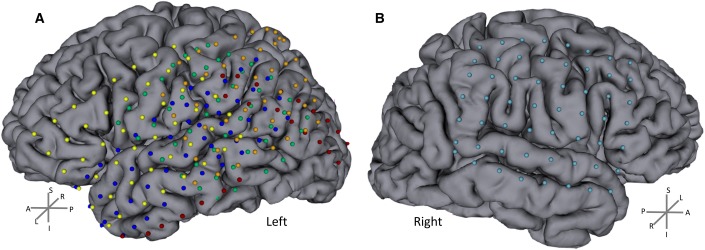
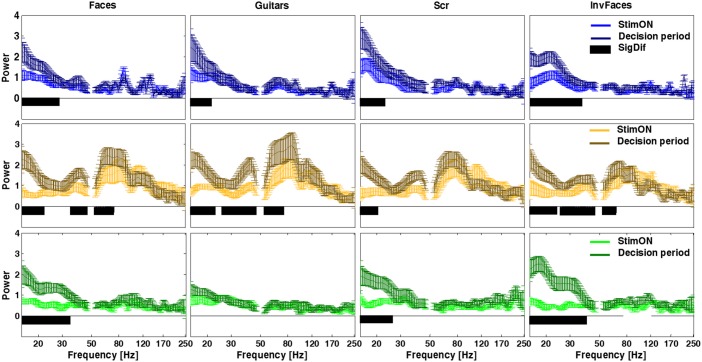
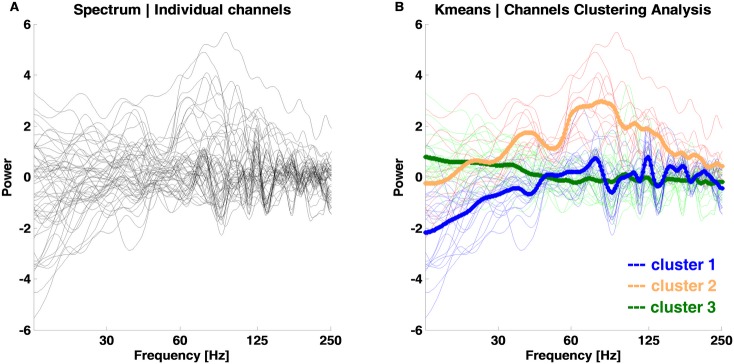
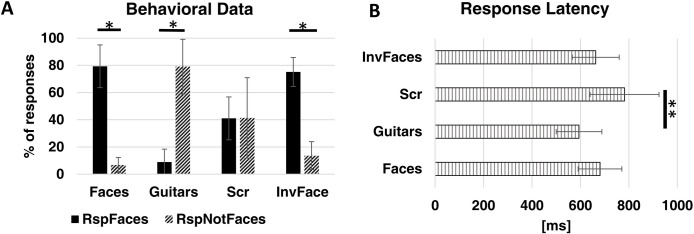
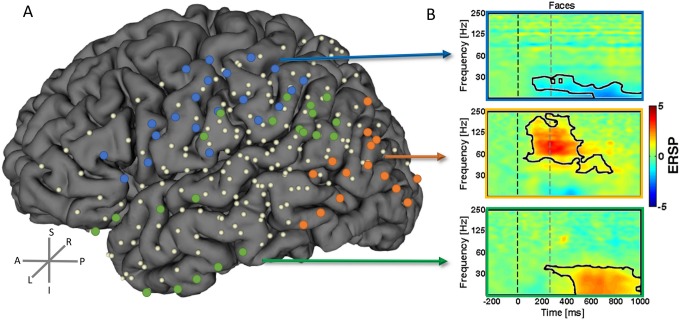
High-frequency activity (HFA) is believed to subserve a functional role in cognition, but these patterns are often not accessible to scalp EEG recordings. Intracranial studies provide a unique opportunity to link the all-encompassing range of high-frequency patterns with holistic perception. We tested whether the functional topography of HFAs (up to 250Hz) is related to perceptual decision-making. Human intracortical data were recorded (6 subjects; >250channels) during an ambiguous object-recognition task. We found a spatial topography of HFAs reflecting processing anterior dorsal and ventral streams, linked to decision independently of the type of processed object/stimulus category. Three distinct regional fingerprints could be identified, with lower gamma frequency patterns (<45Hz) dominating in the anterior semantic ventral object processing and dorsoventral integrating networks and evolving later, during perceptual decision phases, than early sensory posterior patterns (60-250Hz). This suggests that accurate object recognition/perceptual decision-making is related to distinct spatiotemporal signatures in the low gamma frequency range.
高频活动(HFA)被认为在认知中发挥功能性作用,但这些模式通常无法通过头皮脑电图记录获得。颅内研究提供了一个独特的机会,将全方位的高频模式与整体感知联系起来。我们测试了高达250Hz的高频活动的功能地形图是否与感知决策有关。在一个模糊物体识别任务中记录了人类皮层内数据(6名受试者;超过250个通道)。我们发现高频活动的空间地形图反映了前背侧和腹侧流的处理过程,与决策相关,且与所处理物体的类型/刺激类别无关。可以识别出三种不同的区域特征,较低的伽马频率模式(<45Hz)在前语义腹侧物体处理和背腹整合网络中占主导地位,并且在感知决策阶段比早期感觉后模式(60 - 250Hz)发展得更晚。这表明准确的物体识别/感知决策与低伽马频率范围内不同的时空特征有关。