Mary Kirkland Center for Lupus Research, Hospital for Special Surgery, Weill Medical College of Cornell University, New York, NY 10021, USA; Department of Physiology, School of Medicine, National and Kapodistrian University of Athens, Athens, Greece; Department of Pathophysiology, School of Medicine, National and Kapodistrian University of Athens, Athens, Greece; Joint Academic Rheumatology Program, School of Medicine, National and Kapodistrian University of Athens, Athens, Greece.
Department of Physiology, School of Medicine, National and Kapodistrian University of Athens, Athens, Greece.
J Autoimmun. 2018 Mar;88:75-82. doi: 10.1016/j.jaut.2017.10.004. Epub 2017 Oct 23.
To investigate whether altered DNA methylation contributes to the inappropriate expression of LINE-1 (L1) retroelements in primary Sjogren's syndrome (SS) and systemic lupus erythematosus (SLE).
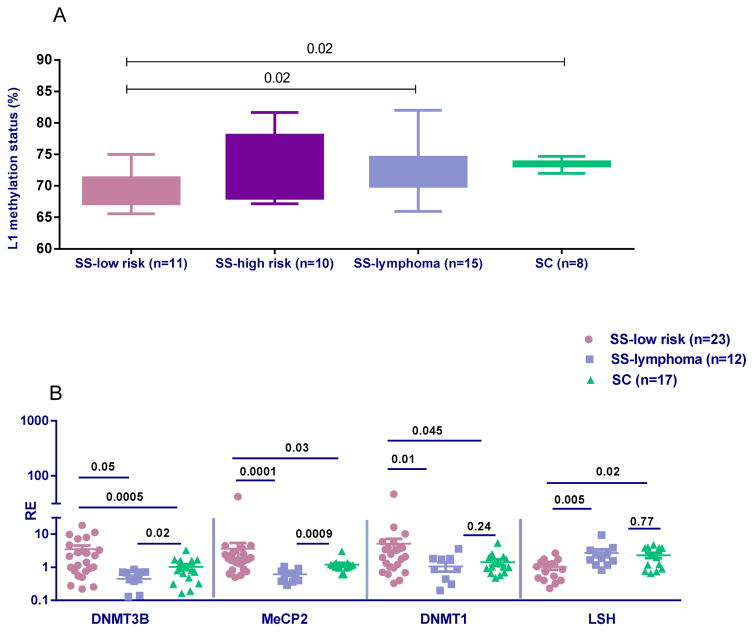
Minor salivary glands (MSG) were obtained from 42 patients with primary SS [23 without adverse predictors for lymphoma development (SS-low risk), 7 SS-high risk and 12 complicated by B-cell lymphoma (SS-lymphoma)] and 17 sicca controls (SC). Additionally, kidney biopsy specimens and PBMCs were obtained from 23 and 73 lupus patients, respectively. Relative mRNA expression was quantified for full-length L1 transcripts, along with mediators of methylation. In an independent set of 44 MSG samples (11 SS-low risk, 10 SS-high risk, 15 SS-lymphoma and 8 SC), methylation levels of the L1 promoter were determined by bisulphite pyrosequencing.
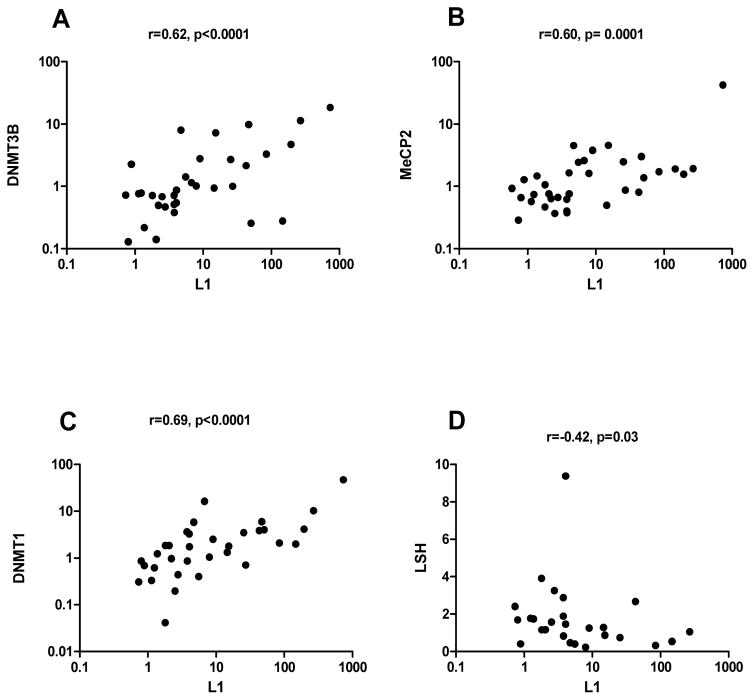
A strong positive correlation was demonstrated between L1 transcripts and gene products that mediate de novo and constitutive DNA methylation, DNA methyltransferase (DNMT)3B, DNMT1, and methyl CpG binding protein 2 (MeCP2), in both SS MSG and lupus renal tissues. A significant negative correlation was observed between expression of L1 and lymphoid-specific helicase (LSH, encoded by HELLS) in both SS MSG and SLE kidney tissues, as well as between DNMT3A transcripts and L1 expression in SLE kidney tissues and PBMCs. Reduced levels of L1 promoter methylation along with increased DNMT3B, DNMT1, and MeCP2, but reduced LSH levels were detected in SS-low risk patients compared to both SS-lymphoma and SC. The SS-lymphoma group was also characterized by a profound decrease of MeCP2 and DNMT3B compared to SC.
Our data support a contributory role of altered methylation mechanisms in the pathogenesis of systemic autoimmune disorders and related lymphoproliferative processes and suggest that LSH and DNMT3A should be investigated as candidate upstream mediators of decreased L1 promoter methylation and increased L1 expression.
研究 DNA 甲基化的改变是否导致原发性干燥综合征 (SS) 和系统性红斑狼疮 (SLE) 中 LINE-1 (L1) 反转录元件的异常表达。
从 42 例原发性 SS 患者(23 例无淋巴瘤发展不良预测因子(SS 低危)、7 例 SS 高危和 12 例合并 B 细胞淋巴瘤(SS-淋巴瘤))和 17 例干燥综合征对照者(SC)中获取小唾液腺 (MSG)。此外,从 23 例狼疮患者和 73 例狼疮患者中分别获取肾活检标本和 PBMC。定量检测全长 L1 转录物以及甲基化调节剂的相对 mRNA 表达。在另一组 44 例 MSG 样本(11 例 SS 低危、10 例 SS 高危、15 例 SS-淋巴瘤和 8 例 SC)中,通过亚硫酸氢盐焦磷酸测序法测定 L1 启动子的甲基化水平。
在 SS MSG 和狼疮肾组织中,L1 转录物与介导从头和组成性 DNA 甲基化的基因产物(DNMT3B、DNMT1 和甲基 CpG 结合蛋白 2 [MeCP2])之间存在强烈的正相关。在 SS MSG 和 SLE 肾组织中,L1 表达与淋巴特异性解旋酶 (HELLS 编码的 LSH) 之间存在显著负相关,在 SLE 肾组织和 PBMC 中,DNMT3A 转录物与 L1 表达之间也存在显著负相关。与 SS-淋巴瘤和 SC 相比,SS 低危患者的 L1 启动子甲基化水平降低,DNMT3B、DNMT1 和 MeCP2 水平升高,LSH 水平降低。SS-淋巴瘤组与 SC 相比,MeCP2 和 DNMT3B 水平显著降低。
我们的数据支持改变的甲基化机制在系统性自身免疫疾病及其相关淋巴增生过程中的致病作用,并表明 LSH 和 DNMT3A 应作为降低 L1 启动子甲基化和增加 L1 表达的候选上游调节剂进行研究。