Sturgeon John A, Ziadni Maisa S, Trost Zina, Darnall Beth D, Mackey Sean C
University of Washington School of Medicine, Department of Anesthesiology and Pain Medicine, Seattle, WA 98102, USA.
Stanford Systems Neuroscience and Pain Laboratory, Department of Anesthesia, Perioperative, and Pain Medicine, Stanford University School of Medicine, Palo Alto, CA, USA.
Scand J Pain. 2017 Oct;17:390-396. doi: 10.1016/j.sjpain.2017.09.020. Epub 2017 Oct 23.
Previous research has highlighted the importance of cognitive appraisal processes in determining the nature and effectiveness of coping with chronic pain. Two of the key variables implicated in appraisal of pain are catastrophizing and perceived injustice, which exacerbate the severity of pain-related distress and increase the risk of long-term disability through maladaptive behavioural responses. However, to date, the influences of these phenomena have not been examined concurrently, nor have they been related specifically to quality of life measures, such as life satisfaction.
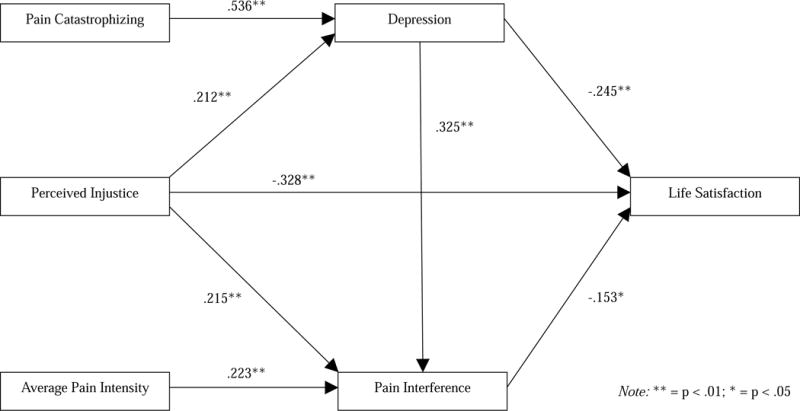
Using data from an online survey of 330 individuals with chronic pain, structural path modelling techniques were used to examine the independent effects of pain catastrophizing, perceived injustice, and average pain intensity on life satisfaction. Two potential mediators of these relationships were examined: depressive symptoms and pain-related interference.
Results indicated that depressive symptoms fully mediated the relationship between pain catastrophizing and life satisfaction, and pain interference fully mediated the relationship between pain intensity and life satisfaction. Both depressive symptoms and pain interference were found to significantly mediate the relationship between perceived injustice and life satisfaction, but perceived injustice continued to demonstrate a significant and negative relationship with life satisfaction, above and beyond the other study variables.
The current findings highlight the distinct affective and behavioural mediators of pain and maladaptive cognitive appraisal processes in chronic pain, and highlight their importance in both perceptions of pain-related interference and longer-term quality of life.
先前的研究强调了认知评估过程在确定应对慢性疼痛的本质和效果方面的重要性。与疼痛评估相关的两个关键变量是灾难化思维和感知到的不公正,它们会加剧与疼痛相关的痛苦程度,并通过适应不良的行为反应增加长期残疾的风险。然而,迄今为止,尚未同时考察这些现象的影响,它们也未与生活满意度等生活质量指标具体关联起来。
利用对330名慢性疼痛患者进行在线调查所获得的数据,采用结构路径建模技术来检验疼痛灾难化思维、感知到的不公正以及平均疼痛强度对生活满意度的独立影响。考察了这些关系的两个潜在中介变量:抑郁症状和与疼痛相关的干扰。
结果表明,抑郁症状完全中介了疼痛灾难化思维与生活满意度之间的关系,疼痛干扰完全中介了疼痛强度与生活满意度之间的关系。抑郁症状和疼痛干扰均被发现显著中介了感知到的不公正与生活满意度之间的关系,但感知到的不公正与生活满意度之间在其他研究变量之外仍呈现出显著的负相关关系。
当前的研究结果凸显了慢性疼痛中疼痛及适应不良认知评估过程的不同情感和行为中介变量,并强调了它们在疼痛相关干扰感知和长期生活质量方面的重要性。