
协作健康结果信息注册库人体图谱的开发与验证
Development and validation of the Collaborative Health Outcomes Information Registry body map.
作者信息
Scherrer Kristen Hymel, Ziadni Maisa S, Kong Jiang-Ti, Sturgeon John A, Salmasi Vafi, Hong Juliette, Cramer Eric, Chen Abby L, Pacht Teresa, Olson Garrick, Darnall Beth D, Kao Ming-Chih, Mackey Sean
机构信息
Division of Pain Management, Stanford University School of Medicine, Palo Alto, CA, USA.
Department of Cell Biology and Physiology, University of North Carolina at Chapel Hill School of Medicine, Chapel Hill, NC, USA.
出版信息
Pain Rep. 2021 Jan 15;6(1):e880. doi: 10.1097/PR9.0000000000000880. eCollection 2021 Jan-Feb.
INTRODUCTION
Critical for the diagnosis and treatment of chronic pain is the anatomical distribution of pain. Several body maps allow patients to indicate pain areas on paper; however, each has its limitations.
OBJECTIVES
To provide a comprehensive body map that can be universally applied across pain conditions, we developed the electronic Collaborative Health Outcomes Information Registry (CHOIR) self-report body map by performing an environmental scan and assessing existing body maps.
METHODS
After initial validation using a Delphi technique, we compared (1) pain location questionnaire responses of 530 participants with chronic pain with (2) their pain endorsements on the CHOIR body map (CBM) graphic. A subset of participants (n = 278) repeated the survey 1 week later to assess test-retest reliability. Finally, we interviewed a patient cohort from a tertiary pain management clinic (n = 28) to identify reasons for endorsement discordances.
RESULTS
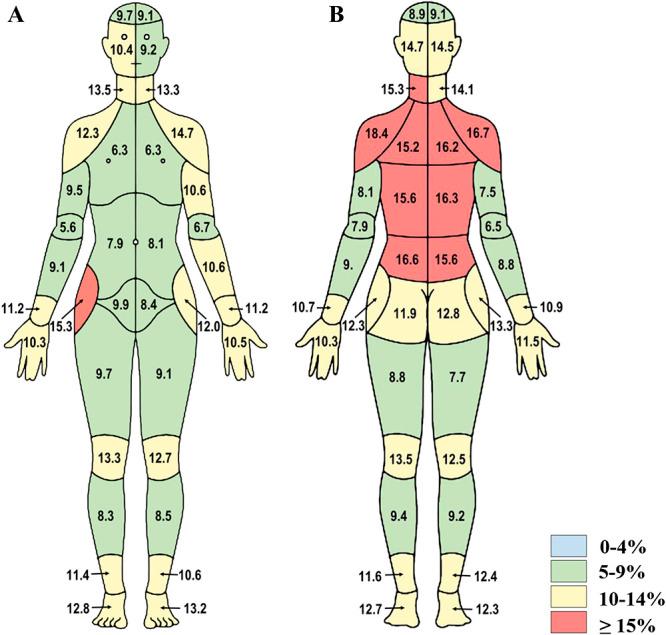
The intraclass correlation coefficient between the total number of body areas endorsed on the survey and those from the body map was 0.86 and improved to 0.93 at follow-up. The intraclass correlation coefficient of the 2 body map graphics separated by 1 week was 0.93. Further examination demonstrated high consistency between the questionnaire and CBM graphic (<10% discordance) in most body areas except for the back and shoulders (≈15-19% discordance). Participants attributed inconsistencies to misinterpretation of body regions and laterality, the latter of which was addressed by modifying the instructions.
CONCLUSIONS
Our data suggest that the CBM is a valid and reliable instrument for assessing the distribution of pain.
引言
疼痛的解剖分布对于慢性疼痛的诊断和治疗至关重要。有几种身体图谱可让患者在纸上指出疼痛区域;然而,每种都有其局限性。
目的
为了提供一种可普遍应用于各种疼痛状况的综合身体图谱,我们通过进行环境扫描并评估现有的身体图谱,开发了电子协作健康结果信息注册库(CHOIR)自我报告身体图谱。
方法
在使用德尔菲技术进行初步验证后,我们将530名慢性疼痛参与者的疼痛位置问卷回答与(2)他们在CHOIR身体图谱(CBM)图形上的疼痛标注进行了比较。一部分参与者(n = 278)在1周后重复了调查,以评估重测信度。最后,我们采访了一家三级疼痛管理诊所的患者队列(n = 28),以确定标注不一致的原因。
结果
调查中认可的身体区域总数与身体图谱上认可的区域总数之间的组内相关系数为0.86,随访时提高到0.93。相隔1周的两个身体图谱图形的组内相关系数为0.93。进一步检查表明,除背部和肩部外(不一致率约为15 - 19%),在大多数身体区域,问卷与CBM图形之间具有高度一致性(不一致率<10%)。参与者将不一致归因于对身体区域和左右侧的误解,后者通过修改说明得到了解决。
结论
我们的数据表明,CBM是一种评估疼痛分布的有效且可靠的工具。




 Zotero 插件