Walker Bruce F, Armson Anthony, Hodgetts Christopher, Jacques Angela, Chin Fu En, Kow Garret, Lee Hyung Jin, Wong Mui Kee, Wright Anthony
School of Health Professions, Murdoch University, Perth, WA Australia.
School of Physiotherapy and Exercise Science, Curtin University, Perth, WA Australia.
Chiropr Man Therap. 2017 Oct 17;25:29. doi: 10.1186/s12998-017-0160-0. eCollection 2017.
Complementary and alternative medicine (CAM) is becoming more widely used in the community however there are differences in knowledge and attitudes among and within the various health professions. Chiropractic and nursing students represent a future generation of two health profession groups who may have differing views on CAM. The objectives of this study were to investigate the knowledge, attitudes and beliefs of nursing and chiropractic students about CAM. To investigate the factors that influence their attitudes and beliefs and their likelihood of recommending CAM; and to compare the findings between nursing and chiropractic students to determine similarities and differences.
A modified and pre-tested survey including a previously validated 10-item CAM Health Belief Questionnaire (CHBQ) was administered to nursing and chiropractic students at Murdoch University. Student's demographics were collected as well as other information regarding knowledge, attitudes, influences and use of CAM.
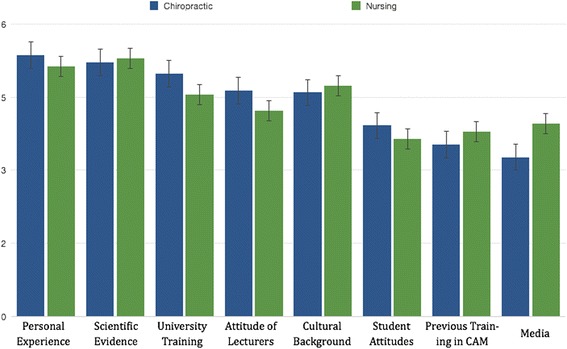
Three hundred twenty-one nursing and 227 chiropractic students responded with a 91% response rate. The CHBQ overall mean scores for nursing and chiropractic students were 47.6 and 47.4 out of possible 70 respectively, confirming positive attitudes toward CAM in both groups. Nursing and chiropractic students also demonstrated similar knowledge levels. Factors that were most influential in shaping both chiropractic and nursing students' attitudes and beliefs towards CAM were personal experience and the influence of external peers. Nursing students would not dissuade future patients from CAM, however chiropractic students were more likely to recommend CAM to their future patients.
Nursing and chiropractic students demonstrate relatively positive attitudes and beliefs towards CAM despite, their limited knowledge concerning CAM modalities generally.
补充和替代医学(CAM)在社区中的使用越来越广泛,然而,不同健康专业之间以及各专业内部在知识和态度上存在差异。脊椎按摩疗法专业学生和护理专业学生代表了两个健康专业群体的未来一代,他们对补充和替代医学可能有不同的看法。本研究的目的是调查护理专业和脊椎按摩疗法专业学生对补充和替代医学的知识、态度和信念。调查影响他们态度和信念的因素以及他们推荐补充和替代医学的可能性;并比较护理专业和脊椎按摩疗法专业学生的调查结果,以确定异同。
对莫道克大学的护理专业和脊椎按摩疗法专业学生进行了一项经过修改和预测试的调查,其中包括一份先前经过验证的10项补充和替代医学健康信念问卷(CHBQ)。收集了学生的人口统计学信息以及其他有关补充和替代医学的知识、态度、影响因素和使用情况的信息。
321名护理专业学生和227名脊椎按摩疗法专业学生做出了回应,回应率为91%。护理专业和脊椎按摩疗法专业学生的CHBQ总体平均得分分别为47.6分(满分70分)和47.4分,证实两组对补充和替代医学都持积极态度。护理专业和脊椎按摩疗法专业学生的知识水平也相似。对脊椎按摩疗法专业和护理专业学生对补充和替代医学的态度和信念形成最有影响的因素是个人经历和外部同伴的影响。护理专业学生不会劝阻未来的患者使用补充和替代医学,然而,脊椎按摩疗法专业学生更有可能向未来的患者推荐补充和替代医学。
护理专业和脊椎按摩疗法专业学生对补充和替代医学表现出相对积极的态度和信念,尽管他们对补充和替代医学模式的了解普遍有限。