Usher Institute of Population Health Sciences and Informatics, The University of Edinburgh, Medical School, Teviot Place, Edinburgh, EH8 9AG, UK.
Institute of Genetics and Molecular Medicine, The University of Edinburgh, Edinburgh, UK.
Diabetologia. 2018 Jan;61(1):108-116. doi: 10.1007/s00125-017-4478-x. Epub 2017 Oct 26.
AIMS/HYPOTHESIS: The aim of this study was to assess the role of socioeconomic status (SES) in the associations between type 2 diabetes and life expectancy in a complete national population.
An observational population-based cohort study was performed using the Scottish Care Information - Diabetes database. Age-specific life expectancy (stratified by SES) was calculated for all individuals with type 2 diabetes in the age range 40-89 during the period 2012-2014, and for the remaining population of Scotland aged 40-89 without type 2 diabetes. Differences in life expectancy between the two groups were calculated.
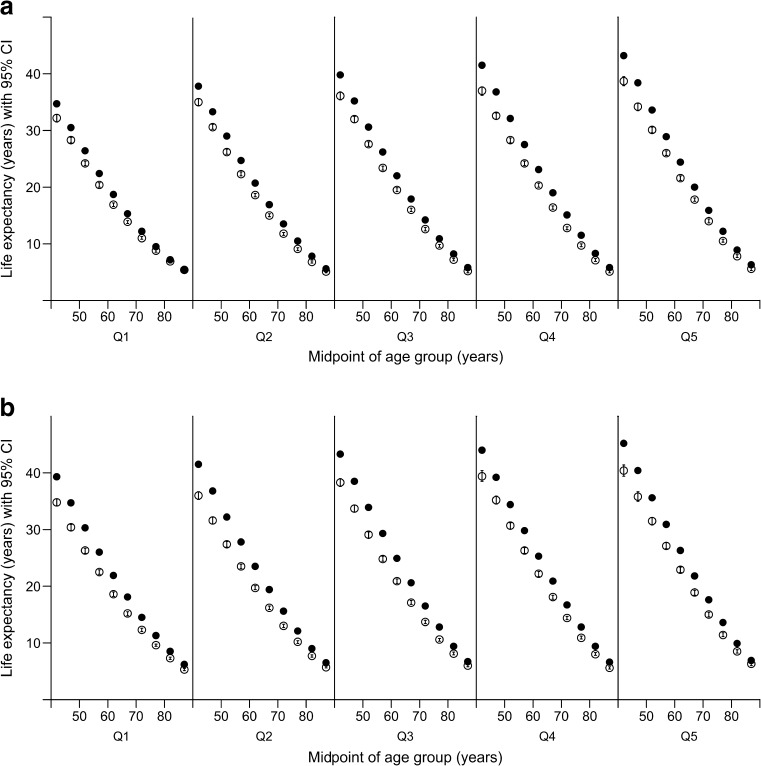
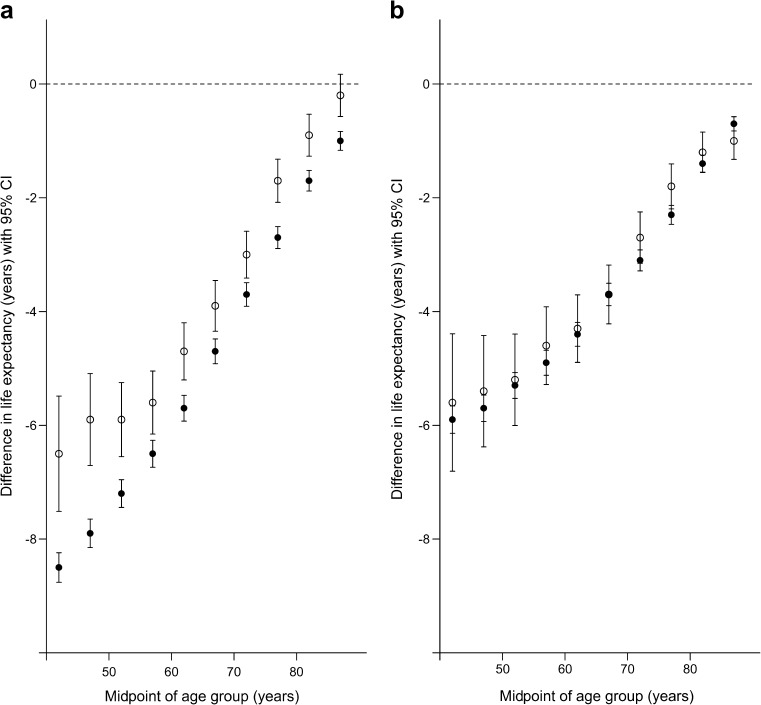
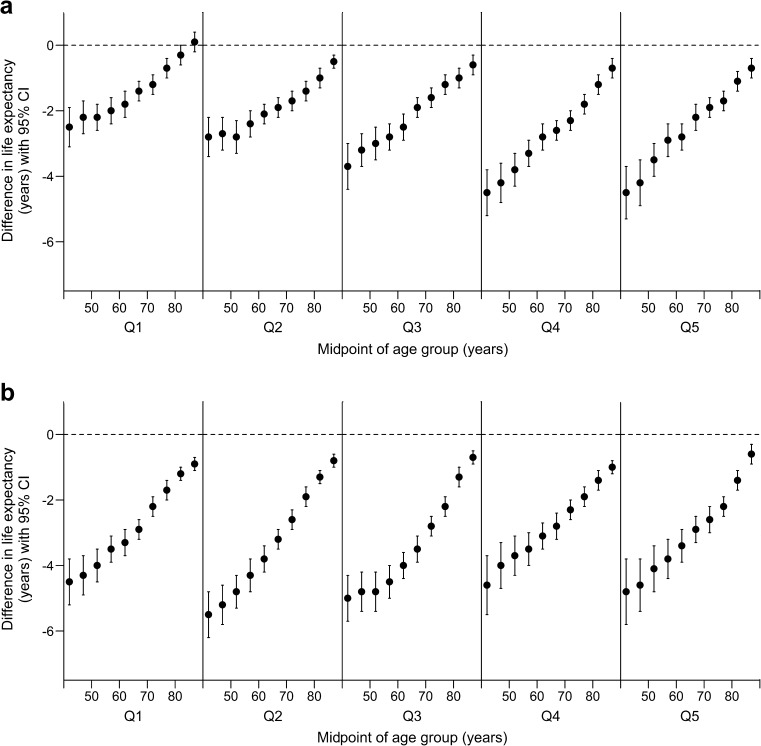
Results were based on 272,597 individuals with type 2 diabetes and 2.75 million people without type 2 diabetes (total for 2013, the middle calendar year of the study period). With the exception of deprived men aged 80-89, life expectancy in people with type 2 diabetes was significantly reduced (relative to the type 2 diabetes-free population) at all ages and levels of SES. Differences in life expectancy ranged from -5.5 years (95% CI -6.2, -4.8) for women aged 40-44 in the second most-deprived quintile of SES, to 0.1 years (95% CI -0.2, 0.4) for men aged 85-89 in the most-deprived quintile of SES. Observed life-expectancy deficits in those with type 2 diabetes were generally greater in women than in men.
CONCLUSIONS/INTERPRETATION: Type 2 diabetes is associated with reduced life expectancy at almost all ages and levels of SES. Elimination of life-expectancy deficits in individuals with type 2 diabetes will require prevention and management strategies targeted at all social strata (not just deprived groups).
目的/假设:本研究旨在评估社会经济地位(SES)在 2 型糖尿病与预期寿命之间关联中的作用,研究对象为一个完整的全国人群。
本研究采用苏格兰护理信息-糖尿病数据库进行了一项观察性基于人群的队列研究。在 2012-2014 年期间,计算了所有年龄在 40-89 岁之间患有 2 型糖尿病的个体的特定年龄预期寿命(按 SES 分层),并计算了苏格兰年龄在 40-89 岁之间无 2 型糖尿病的剩余人群的预期寿命。计算了两组之间预期寿命的差异。
结果基于 272597 名 2 型糖尿病患者和 275 万名无 2 型糖尿病患者(2013 年的总人数,即研究期间的中间日历年)。除了贫困的 80-89 岁男性外,所有年龄段和 SES 水平的 2 型糖尿病患者的预期寿命均显著缩短(与无 2 型糖尿病人群相比)。预期寿命的差异范围从 SES 最贫困五分位数中年龄在 40-44 岁的女性的 -5.5 岁(95%CI-6.2,-4.8)到 SES 最贫困五分位数中年龄在 85-89 岁的男性的 0.1 岁(95%CI-0.2,0.4)。2 型糖尿病患者观察到的预期寿命缺陷通常在女性中比男性中更为严重。
结论/解释:2 型糖尿病几乎与所有年龄段和 SES 水平的预期寿命缩短有关。要消除 2 型糖尿病患者的预期寿命缺陷,需要针对所有社会阶层(不仅是贫困群体)制定预防和管理策略。