Department of Pathophysiology, Tokyo Medical University, 6-1-1 Shinjuku, Shinjuku, Tokyo, Japan.
Department of Life Sciences, Graduate School of Arts and Sciences, The University of Tokyo, 3-8-1 Komaba, Meguro, Tokyo, Japan.
Skelet Muscle. 2017 Oct 27;7(1):23. doi: 10.1186/s13395-017-0140-z.
Chronic increases in the levels of the inflammatory cytokine interleukin-6 (IL-6) in serum and skeletal muscle are thought to contribute to the progression of muscular dystrophy. Dystrophin/utrophin double-knockout (dKO) mice develop a more severe and progressive muscular dystrophy than the mdx mice, the most common murine model of Duchenne muscular dystrophy (DMD). In particular, dKO mice have smaller body sizes and muscle diameters, and develop progressive kyphosis and fibrosis in skeletal and cardiac muscles. As mdx mice and DMD patients, we found that IL-6 levels in the skeletal muscle were significantly increased in dKO mice. Thus, in this study, we aimed to analyze the effects of IL-6 receptor (IL-6R) blockade on the muscle pathology of dKO mice.
Male dKO mice were administered an initial injection (200 mg/kg intraperitoneally (i.p.)) of either the anti-IL-6R antibody MR16-1 or an isotype-matched control rat IgG at the age of 14 days, and were then given weekly injections (25 mg/kg i.p.) until 90 days of age.
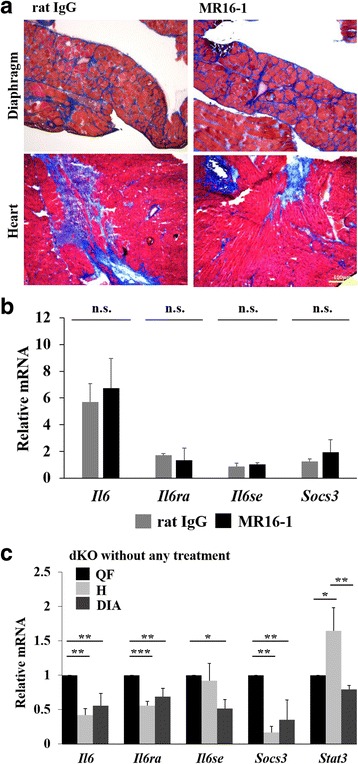
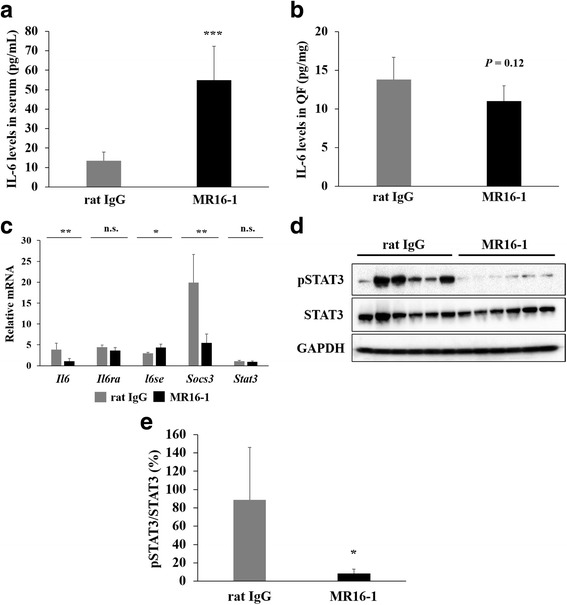
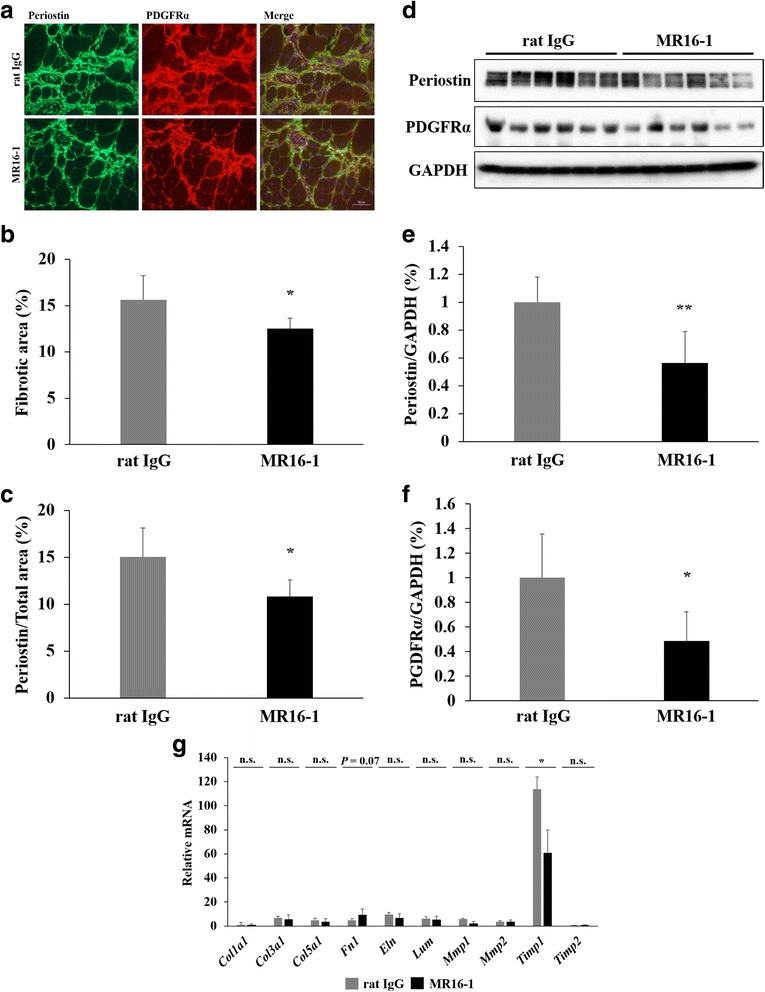
Treatment of dKO mice with the MR16-1 antibody successfully inhibited the IL-6 pathway in the skeletal muscle and resulted in a significant reduction in the expression levels of phosphorylated signal transducer and activator of transcription 3 in the skeletal muscle. Pathologically, a significant increase in the area of embryonic myosin heavy chain-positive myofibers and muscle diameter, and reduced fibrosis in the quadriceps muscle were observed. These results demonstrated the therapeutic effects of IL-6R blockade on promoting muscle regeneration. Consistently, serum creatine kinase levels were decreased. Despite these improvements observed in the limb muscles, degeneration of the diaphragm and cardiac muscles was not ameliorated by the treatment of mice with the MR16-1 antibody.
As no adverse effects of treatment with the MR16-1 antibody were observed, our results indicate that the anti-IL-6R antibody is a potential therapy for muscular dystrophy particularly for promoting skeletal muscle regeneration.
人们认为,血清和骨骼肌中炎症细胞因子白细胞介素 6(IL-6)水平的慢性增加会导致肌肉萎缩症的进展。与最常见的杜氏肌营养不良症(DMD)的小鼠模型 mdx 相比,肌营养不良蛋白/utrophin 双重敲除(dKO)小鼠发展出更严重和进行性的肌肉萎缩症。特别是,dKO 小鼠的体型较小,肌肉直径较小,并且在骨骼和心肌中出现进行性脊柱后凸和纤维化。与 mdx 小鼠和 DMD 患者一样,我们发现 dKO 小鼠骨骼肌中的 IL-6 水平显着增加。因此,在这项研究中,我们旨在分析 IL-6 受体(IL-6R)阻断对 dKO 小鼠肌肉病理学的影响。
雄性 dKO 小鼠在 14 天大时接受初始注射(腹膜内 200mg/kg)抗 IL-6R 抗体 MR16-1 或同种型匹配的对照大鼠 IgG,然后每周注射(25mg/kg 腹膜内)直至 90 天大。
用 MR16-1 抗体治疗 dKO 小鼠成功抑制了骨骼肌中的 IL-6 途径,并导致骨骼肌中磷酸化信号转导和转录激活因子 3 的表达水平显着降低。病理上,观察到胚胎肌球蛋白重链阳性肌纤维的面积和肌肉直径显着增加,以及股四头肌纤维化减少。这些结果表明 IL-6R 阻断对促进肌肉再生具有治疗作用。一致地,血清肌酸激酶水平降低。尽管用 MR16-1 抗体治疗观察到四肢肌肉的这些改善,但膈肌和心肌的退化未得到改善。
由于未观察到用 MR16-1 抗体治疗的不良反应,我们的结果表明抗 IL-6R 抗体是肌肉萎缩症的一种潜在治疗方法,特别是可促进骨骼肌再生。