Department of Anesthesiology, Beijing Friendship Hospital, Capital Medical University, Beijing, China (mainland).
Division of Liver Transplantation Surgery, Department of Surgery, Beijing Friendship Hospital, Capital Medical University, Beijing, China (mainland).
Med Sci Monit. 2017 Oct 29;23:5158-5167. doi: 10.12659/msm.907132.
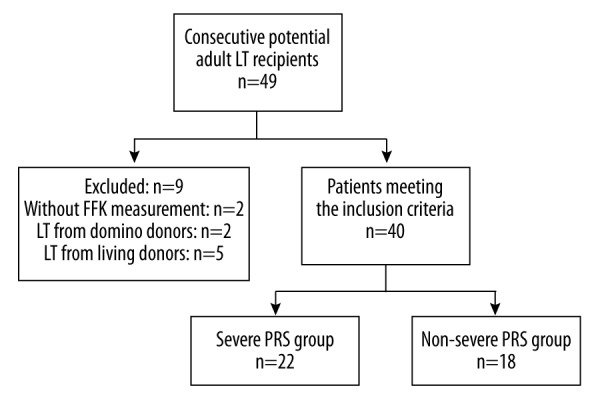
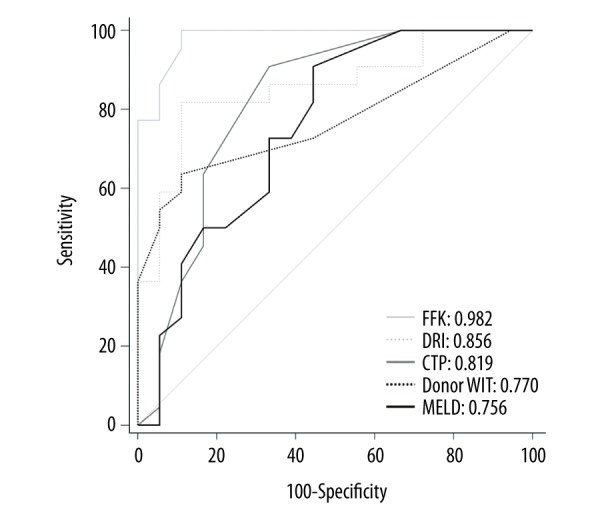
BACKGROUND Predicting the occurrence of severe postreperfusion syndrome (PRS) is clinically challenging. We investigated whether the flushed fluid potassium concentration (FFK) was associated with severe PRS in deceased donor liver transplantation (DDLT). MATERIAL AND METHODS Forty adult DDLT recipients were enrolled in this retrospective study. Effluent solution samples were collected at the end of the portal vein flush, and the FFK was determined using a point-of-care blood gas analyzer. The risk factors associated with severe PRS and the clinical outcomes in 2 groups were compared. RESULTS Severe PRS occurred in 22 out of 40 patients (55.0%). The FFK of the severe PRS group was significantly higher than that of the non-severe PRS group (median, 9.6 vs. 5.8, P<0.001). Other variables associated with severe PRS included the donor risk index (DRI), Child-Turcotte-Pugh score, donor type, donor warm ischemia time, and Model for End-stage Liver Disease score. The area under the receiver operator characteristic curve for the FFK was 0.982, and the best cut-off value of the FFK for predicting severe PRS was 6.75 mmol/L (100.0% sensitivity and 88.9% specificity). A significant positive correlation was observed between the FFK and DRI (R=0.714). Patients who experienced severe PRS had a higher early allograft dysfunction rate (63.6% vs. 22.2%, P=0.019) and a longer hospital stay (median, 33.0 vs. 24.0, P=0.034). CONCLUSIONS Both the severity of the recipient's liver disease and the donor graft factors play an important role in the development of severe PRS in DDLT. An FFK of more than 6.75 mmol/L was associated with severe PRS after reperfusion.
预测严重再灌注后综合征(PRS)的发生具有临床挑战性。我们研究了死亡供体肝移植(DDLT)中冲洗液钾浓度(FFK)是否与严重 PRS 相关。
本回顾性研究纳入了 40 例成年 DDLT 受者。在门静脉冲洗结束时采集流出液样本,并使用即时检验血气分析仪测定 FFK。比较了两组中与严重 PRS 相关的危险因素和临床结局。
40 例患者中有 22 例(55.0%)发生严重 PRS。严重 PRS 组的 FFK 明显高于非严重 PRS 组(中位数,9.6 与 5.8mmol/L,P<0.001)。其他与严重 PRS 相关的变量包括供者风险指数(DRI)、Child-Turcotte-Pugh 评分、供者类型、供者热缺血时间和终末期肝病模型评分。FFK 的受试者工作特征曲线下面积为 0.982,FFK 预测严重 PRS 的最佳截断值为 6.75mmol/L(100.0%敏感性和 88.9%特异性)。FFK 与 DRI 呈显著正相关(R=0.714)。发生严重 PRS 的患者早期移植物功能障碍发生率更高(63.6%与 22.2%,P=0.019),住院时间更长(中位数,33.0 与 24.0d,P=0.034)。
受者肝病严重程度和供者移植物因素均在 DDLT 中严重 PRS 的发生中起重要作用。再灌注后 FFK 大于 6.75mmol/L 与严重 PRS 相关。