Institute of Psychiatry, Psychology and Neuroscience, King's College London, BRC Neucleus, Mapother House, De Crespigny Park, London, SE5 8AF, UK.
South London and Maudsley NHS Foundation Trust, London, UK.
Psychopharmacology (Berl). 2018 Jan;235(1):281-289. doi: 10.1007/s00213-017-4767-6. Epub 2017 Oct 28.
The aim of this study was to determine if there was an association between being discharged on antipsychotic polypharmacy (APP) and risk of readmission into secondary mental health care.
Using data from the South London and Maudsley (SLAM) case register, service users with serious mental illness (SMI), discharged between 1st January 2007 and 31th December 2014, were followed up for 6 months. Patients were classified as receiving either monotherapy or polypharmacy at index discharge. Multivariable Cox regression models were constructed, adjusting for sociodemographic, socioeconomic, clinical and service use factors.
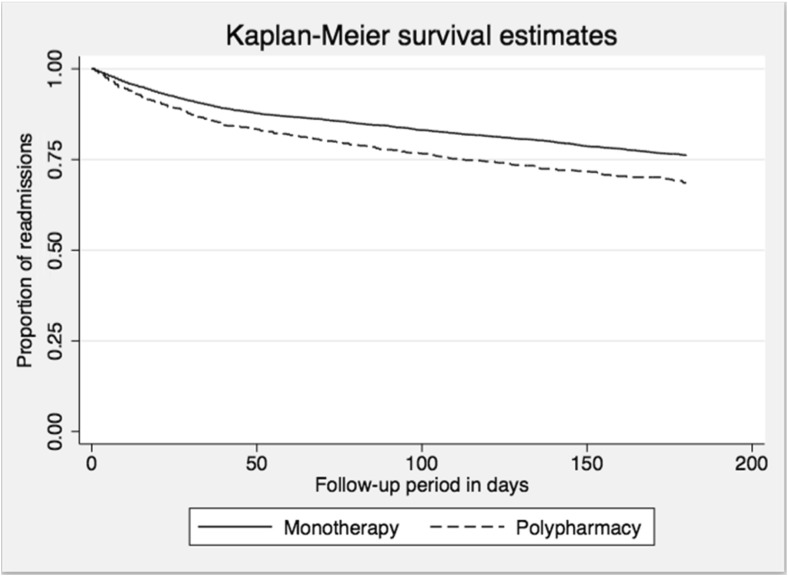
We identified 5523 adults who had been admitted at least once to SLAM, of whom 1355 (24.5%) were readmitted into secondary mental health care. In total, 15% (n = 826) of patients were discharged on APP and 85% (n = 4697) on monotherapy. Of these, 30.9% (n = 255) and 23.4% (n = 1100) were readmitted respectively. Being discharged on APP was associated with a significantly increased risk of readmission, in comparison to patients discharged on monotherapy (HR = 1.4, 1.2-1.7, p < 0.001). This association was maintained in the fully adjusted model and following several sensitivity analyses. We further established that patients receiving clozapine APP (n = 200) were at a significantly increased risk for readmission in comparison to patients on clozapine monotherapy (HR = 1.8, 1.2-2.6, p = 0.008).
Our results suggest that patients discharged on APP are more likely to be readmitted into hospital within 6 months in comparison to those discharged on monotherapy. This needs to be considered in treatment decisions and the reasons for the association clarified.
本研究旨在确定抗精神病药联合用药(APP)出院与再次进入二级精神卫生保健机构的风险之间是否存在关联。
利用南伦敦和莫兹利(SLAM)病例登记处的数据,对 2007 年 1 月 1 日至 2014 年 12 月 31 日期间出院的患有严重精神疾病(SMI)的服务使用者进行了为期 6 个月的随访。患者在指数出院时被分为接受单一疗法或联合用药。使用多变量 Cox 回归模型,调整社会人口统计学、社会经济学、临床和服务使用因素。
我们确定了 5523 名至少一次入住 SLAM 的成年人,其中 1355 人(24.5%)再次进入二级精神卫生保健机构。总共,15%(n=826)的患者出院时使用 APP,85%(n=4697)的患者出院时使用单一疗法。其中,分别有 30.9%(n=255)和 23.4%(n=1100)的患者再次入院。与接受单一疗法的患者相比,接受 APP 治疗的患者再次入院的风险显著增加(HR=1.4,1.2-1.7,p<0.001)。在完全调整的模型和几项敏感性分析中,这种关联仍然存在。我们进一步发现,与接受氯氮平单一疗法的患者相比,接受氯氮平 APP 治疗的患者(n=200)再次入院的风险显著增加(HR=1.8,1.2-2.6,p=0.008)。
我们的研究结果表明,与接受单一疗法的患者相比,接受 APP 治疗的患者在 6 个月内再次入院的可能性更高。在治疗决策中需要考虑这一点,并阐明这种关联的原因。