Peng Rui, Zhang Hong, Zhang Ying, Wei Dan-Yun
Department of Pharmacy, Renmin Hospital of Wuhan University, Wuhan 430060, China.
Med Sci (Basel). 2015 Dec 1;3(4):124-137. doi: 10.3390/medsci3040124.
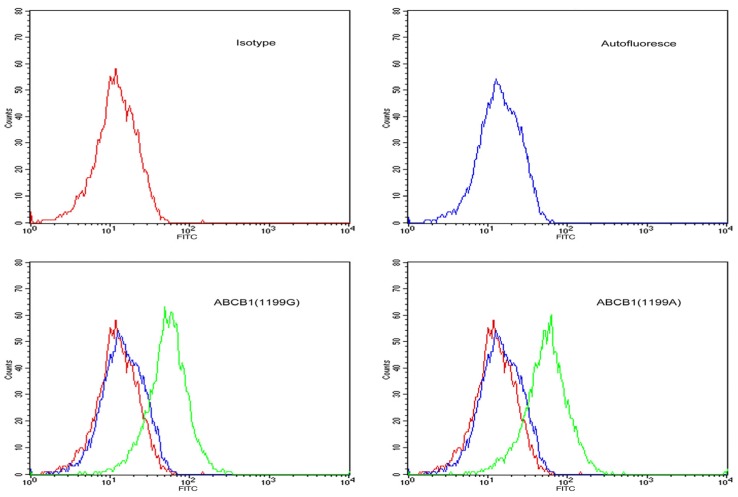
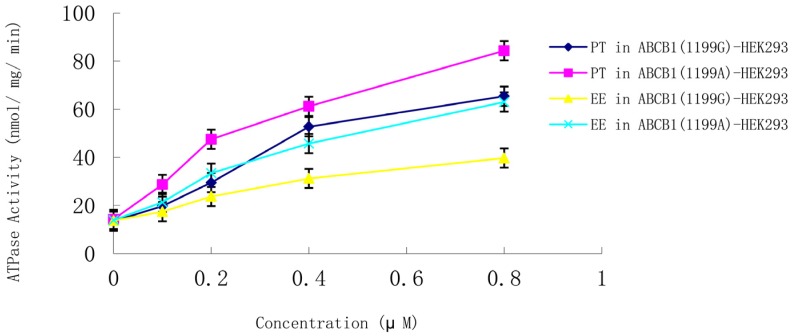
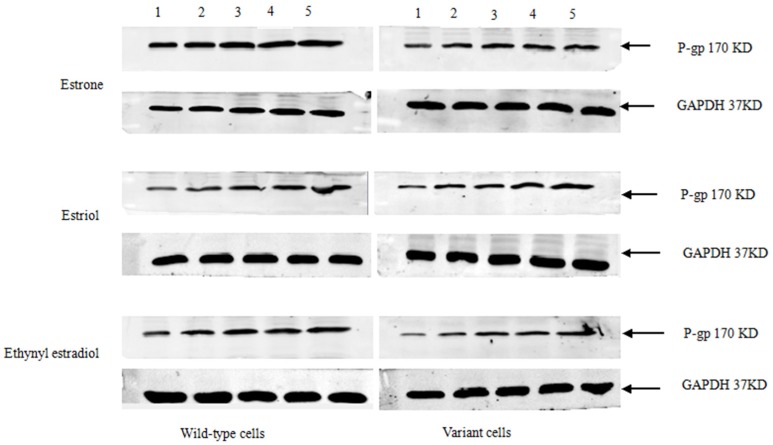
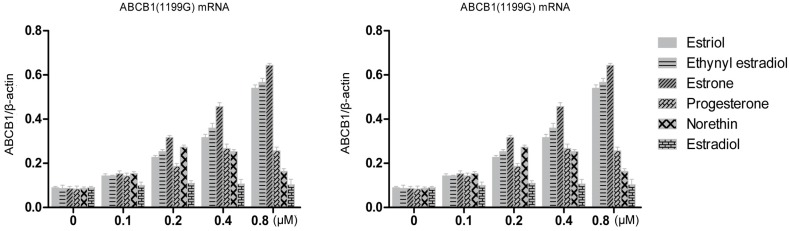
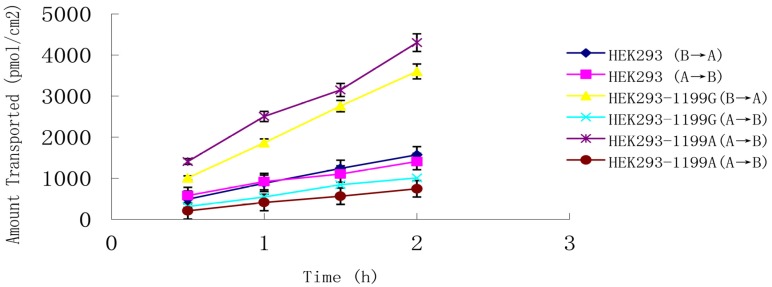
This study examined how the 1199G > A polymorphism in the gene encoding P-glycoprotein (P-gp) affects the protein's expression, ATPase activity, and ability to pump female steroid sex hormones out of LLC-PK1 cells. The (1199G) or (1199A) allele was transfected into cells, which were incubated for 48 h with various hormone concentrations, then analyzed by Western blotting to examine expression of P-gp protein and by reverse transcription-polymerase chain reaction (RT-PCR) to examine expression of mRNA. Cells were also compared in terms of their transepithelial permeability to steroid sex hormones in the presence and absence of the specific P-gp inhibitor GF120918. P-gp ATPase activity induced by steroid sex hormones was also assayed. Estriol and ethynyl estradiol up-regulated levels of mRNA in a concentration-dependent manner, with (1199A) mRNA showing greater up-regulation than (1199G) mRNA. Estrone, estriol, and ethynyl estradiol were substrates of both types of P-gp in transepithelial permeability assays, and the (1199A) protein showed a significantly higher net efflux ratio for estrone (13.4 7.4, < 0.005), estriol (5.6 3.3, < 0.05), and ethynyl estradiol (12.7 5.3, < 0.005). Induction of P-gp ATPase activity by ethynyl estradiol and progesterone increased with increasing hormone concentration, and the magnitude of stimulation was greater for (1199A) P-gp than for (1199G) P-gp. These results indicate that the (1199G > A) polymorphism influences steroid sex hormone-induced expression and function of P-gp, which may help to explain inter-patient differences in P-gp-mediated chemotherapy resistance .
本研究检测了编码P-糖蛋白(P-gp)基因中的1199G>A多态性如何影响该蛋白的表达、ATP酶活性以及将雌性甾体性激素泵出LLC-PK1细胞的能力。将野生型(1199G)或突变型(1199A)等位基因转染到细胞中,用不同激素浓度孵育48小时,然后通过蛋白质免疫印迹法分析P-gp蛋白的表达,通过逆转录聚合酶链反应(RT-PCR)分析mRNA的表达。在存在和不存在特异性P-gp抑制剂GF120918的情况下,还比较了细胞对甾体性激素的跨上皮通透性。同时也检测了甾体性激素诱导的P-gp ATP酶活性。雌三醇和乙炔雌二醇以浓度依赖的方式上调mRNA水平,(1199A)mRNA的上调幅度大于(1199G)mRNA。在跨上皮通透性试验中,雌酮、雌三醇和乙炔雌二醇都是两种类型P-gp的底物,(1199A)蛋白对雌酮(13.4±7.4,P<0.005)、雌三醇(5.6±3.3,P<0.05)和乙炔雌二醇(12.7±5.3,P<0.005)的净外排率显著更高。乙炔雌二醇和孕酮对P-gp ATP酶活性的诱导随着激素浓度的增加而增加,(1199A)P-gp的刺激幅度大于(1199G)P-gp。这些结果表明,(1199G>A)多态性影响甾体性激素诱导的P-gp表达和功能,这可能有助于解释患者间P-gp介导的化疗耐药性差异。