Sanz Guenhaël, Leray Isabelle, Muscat Adeline, Acquistapace Adrien, Cui Tao, Rivière Julie, Vincent-Naulleau Silvia, Giandomenico Valeria, Mir Lluis M
NBO, INRA, Université Paris Saclay, 78350, Jouy-En-Josas, France.
Biologie du Développement et Reproduction, INRA, ENVA, Université Paris-Saclay, 78350, Jouy-En-Josas, France.
BMC Res Notes. 2017 Oct 30;10(1):541. doi: 10.1186/s13104-017-2879-z.
We previously reported that the olfactory receptor OR51E2, overexpressed in LNCaP prostate cancer cells, promotes cell invasiveness upon stimulation of its agonist β-ionone, and this phenomenon increases metastatic spread. Furthermore, we showed that the induced cell invasiveness involves a PI3 kinase dependent signalling pathway. We report here the results of a new investigation to address whether gallein, a small inhibitor of G protein βγ subunit interaction with PI3 kinase, can inhibit β-ionone effects both in vitro and in vivo.
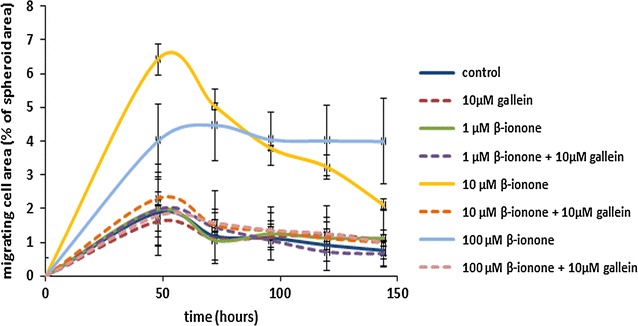
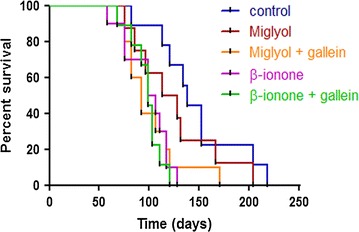
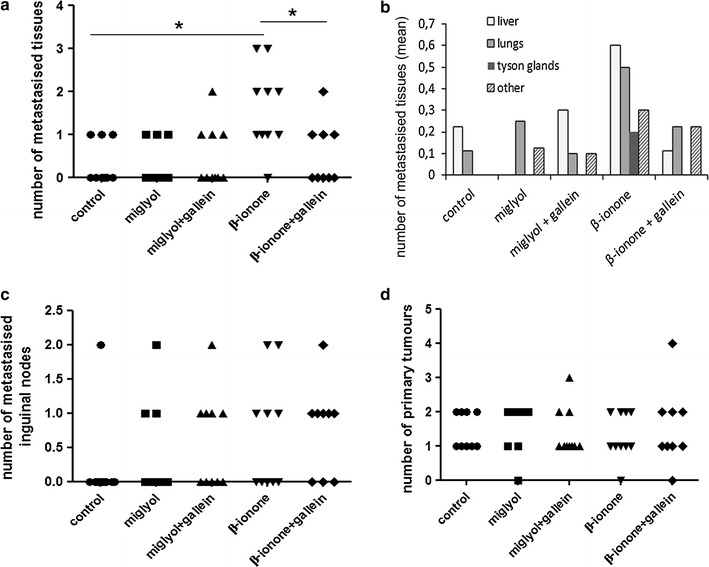
We demonstrate that gallein can inhibit the β-ionone-induced cell invasiveness in vitro, as well as the spread of metastases in vivo. LNCaP cell invasiveness, assessed using spheroid cultures in collagen gels in vitro, was increased by β-ionone and the effect was reversed by co-administration of gallein. LNCaP tumour cells, subcutaneously inoculated to immunodeficient mice, generated more metastases in vivo when β-ionone was applied through the skin. Furthermore, the intraperitoneal injection of gallein inhibited this increased metastasis spread. Our results thus support the role of OR51E2 in the β-ionone observed effects, and suggest that gallein could be a potential new agent in personalized medicine of the tumours expressing OR51E2.
我们之前报道过,在LNCaP前列腺癌细胞中过表达的嗅觉受体OR51E2,在其激动剂β-紫罗兰酮刺激后会促进细胞侵袭,且这种现象会增加转移扩散。此外,我们还表明,诱导的细胞侵袭涉及PI3激酶依赖性信号通路。我们在此报告一项新研究的结果,以探讨小G蛋白βγ亚基与PI3激酶相互作用的抑制剂加兰他敏是否能在体外和体内抑制β-紫罗兰酮的作用。
我们证明加兰他敏可以在体外抑制β-紫罗兰酮诱导的细胞侵袭以及在体内抑制转移扩散。使用体外胶原凝胶中的球体培养评估LNCaP细胞侵袭,β-紫罗兰酮会增加其侵袭,而加兰他敏共同给药可逆转这种作用。皮下接种到免疫缺陷小鼠的LNCaP肿瘤细胞,当通过皮肤应用β-紫罗兰酮时,在体内会产生更多转移灶。此外,腹腔注射加兰他敏可抑制这种增加的转移扩散。因此,我们的结果支持OR51E2在观察到的β-紫罗兰酮作用中的作用,并表明加兰他敏可能是表达OR51E2肿瘤个性化医疗中的一种潜在新药。