McCoy C Eric
University of California, Irvine, School of Medicine and Medical Center, Department of Emergency Medicine, Orange, California.
West J Emerg Med. 2017 Oct;18(6):1075-1078. doi: 10.5811/westjem.2017.8.35985. Epub 2017 Sep 18.
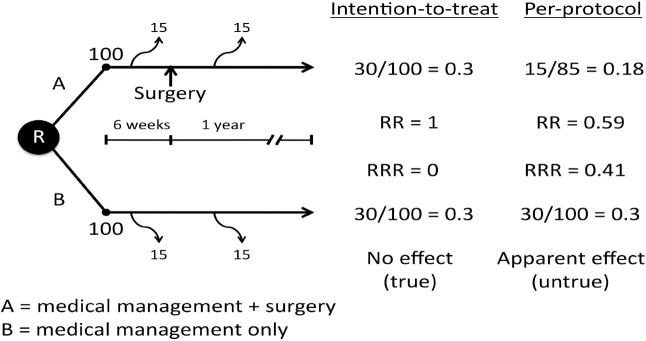
Clinicians, institutions, and policy makers use results from randomized controlled trials to make decisions regarding therapeutic interventions for their patients and populations. Knowing the effect the intervention has on patients in clinical trials is critical for making both individual patient as well as population-based decisions. However, patients in clinical trials do not always adhere to the protocol. Excluding patients from the analysis who violated the research protocol (did not get their intended treatment) can have significant implications that impact the results and analysis of a study. Intention-to-treat analysis is a method for analyzing results in a prospective randomized study where all participants who are randomized are included in the statistical analysis and analyzed according to the group they were originally assigned, regardless of what treatment (if any) they received. This method allows the investigator (or consumer of the medical literature) to draw accurate (unbiased) conclusions regarding the effectiveness of an intervention. This method preserves the benefits of randomization, which cannot be assumed when using other methods of analysis. The risk of bias is increased whenever treatment groups are not analyzed according to the group to which they were originally assigned. If an intervention is truly effective (truth), an intention-to-treat analysis will provide an unbiased estimate of the efficacy of the intervention at the level of adherence in the study. This article will review the "intention-to-treat" principle and its converse, "per-protocol" analysis, and illustrate how using the wrong method of analysis can lead to a significantly biased assessment of the effectiveness of an intervention.
临床医生、医疗机构和政策制定者利用随机对照试验的结果,就针对其患者和人群的治疗干预措施做出决策。了解干预措施在临床试验中对患者的影响,对于做出个体患者决策以及基于人群的决策都至关重要。然而,临床试验中的患者并不总是遵守方案。将违反研究方案(未接受预期治疗)的患者排除在分析之外,可能会产生重大影响,进而影响研究的结果和分析。意向性分析是一种在前瞻性随机研究中分析结果的方法,即所有随机分组的参与者都纳入统计分析,并根据他们最初被分配的组进行分析,无论他们接受了何种治疗(如果有的话)。这种方法使研究者(或医学文献的使用者)能够就干预措施的有效性得出准确(无偏)的结论。这种方法保留了随机化的益处,而使用其他分析方法时则无法假定这些益处。每当治疗组未按照其最初分配的组进行分析时,偏倚风险就会增加。如果一种干预措施确实有效(真实情况),意向性分析将在研究的依从性水平上提供对该干预措施疗效的无偏估计。本文将回顾“意向性治疗”原则及其相反的“符合方案”分析,并说明使用错误的分析方法如何导致对干预措施有效性的评估产生显著偏倚。