Roseen Eric J, Cornelio-Flores Oscar, Lemaster Chelsey, Hernandez Maria, Fong Calvin, Resnick Kirsten, Wardle Jon, Hanser Suzanne, Saper Robert
Boston Medical Center, Boston, Massachusetts.
Berklee College of Music, Boston, Massachusetts.
Glob Adv Health Med. 2017 Oct 16;6:2164957X17735816. doi: 10.1177/2164957X17735816. eCollection 2017.
Little is known about the feasibility of providing massage or music therapy to medical inpatients at urban safety-net hospitals or the impact these treatments may have on patient experience.
To determine the feasibility of providing massage and music therapy to medical inpatients and to assess the impact of these interventions on patient experience.
Single-center 3-arm feasibility randomized controlled trial.
Urban academic safety-net hospital.
Adult inpatients on the Family Medicine ward.
Massage therapy consisted of a standardized protocol adapted from a previous perioperative study. Music therapy involved a preference assessment, personalized compact disc, music-facilitated coping, singing/playing music, and/or songwriting. Credentialed therapists provided the interventions.
Patient experience was measured with the Hospital Consumer Assessment of Healthcare Providers and Systems (HCAHPS) within 7 days of discharge. We compared the proportion of patients in each study arm reporting "top box" scores for the following a priori HCAHPS domains: pain management, recommendation of hospital, and overall hospital rating. Responses to additional open-ended postdischarge questions were transcribed, coded independently, and analyzed for common themes.
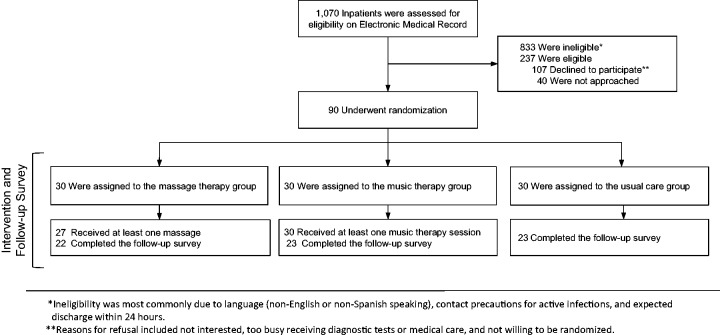
From July to December 2014, 90 medical inpatients were enrolled; postdischarge data were collected on 68 (76%) medical inpatients. Participants were 70% females, 43% non-Hispanic black, and 23% Hispanic. No differences between groups were observed on HCAHPS. The qualitative analysis found that massage and music therapy were associated with improved overall hospital experience, pain management, and connectedness to the massage or music therapist.
Providing music and massage therapy in an urban safety-net inpatient setting was feasible. There was no quantitative impact on HCAHPS. Qualitative findings suggest benefits related to an improved hospital experience, pain management, and connectedness to the massage or music therapist.
对于在城市安全网医院为内科住院患者提供按摩或音乐疗法的可行性以及这些治疗可能对患者体验产生的影响,人们了解甚少。
确定为内科住院患者提供按摩和音乐疗法的可行性,并评估这些干预措施对患者体验的影响。
单中心三臂可行性随机对照试验。
城市学术安全网医院。
家庭医学病房的成年住院患者。
按摩疗法采用了先前围手术期研究中的标准化方案。音乐疗法包括偏好评估、个性化光盘、音乐辅助应对、唱歌/演奏音乐和/或歌曲创作。由有资质的治疗师提供干预措施。
出院后7天内,采用医院医疗服务提供者及系统消费者评估(HCAHPS)来测量患者体验。我们比较了每个研究组中在以下预先设定的HCAHPS领域报告“最高等级”分数的患者比例:疼痛管理、医院推荐和整体医院评分。对出院后其他开放式问题的回答进行转录、独立编码并分析共同主题。
2014年7月至12月,90名内科住院患者入组;收集了68名(76%)内科住院患者的出院后数据。参与者中70%为女性,43%为非西班牙裔黑人,23%为西班牙裔。在HCAHPS方面,各组之间未观察到差异。定性分析发现,按摩和音乐疗法与整体医院体验改善、疼痛管理以及与按摩或音乐治疗师的联系增强有关。
在城市安全网住院环境中提供音乐和按摩疗法是可行的。对HCAHPS没有定量影响。定性研究结果表明,这与改善医院体验、疼痛管理以及与按摩或音乐治疗师的联系有关。