Pająk Marek, Woźniczka Magdalena, Vogt Andrzej, Kufelnicki Aleksander
Department of Physical and Biocoordination Chemistry, Faculty of Pharmacy, Medical University of Łódź, Muszyńskiego 1, 90-151, Lodz, Poland.
Faculty of Chemistry, University of Wrocław, F. Joliot-Curie 14, 50-383, Wrocław, Poland.
Chem Cent J. 2017 Sep 19;11(1):90. doi: 10.1186/s13065-017-0319-8.
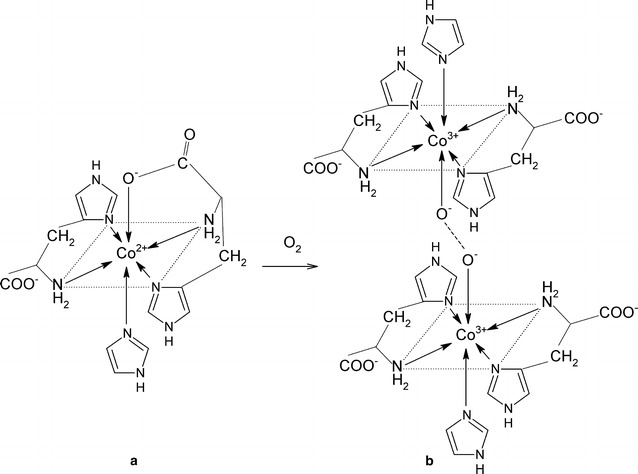
The paper examines Co(II)-amino acid-imidazole systems (where amino acid = L-α-amino acid: alanine, asparagine, histidine) which, when in aqueous solutions, activate and reversibly take up dioxygen, while maintaining the structural scheme of the heme group (imidazole as axial ligand and O uptake at the sixth, trans position) thus imitating natural respiratory pigments such as myoglobin and hemoglobin. The oxygenated reaction shows higher reversibility than for Co(II)-amac systems with analogous amino acids without imidazole. Unlike previous investigations of the heteroligand Co(II)-amino acid-imidazole systems, the present study accurately calculates all equilibrium forms present in solution and determines the [Formula: see text]equilibrium constants without using any simplified approximations. The equilibrium concentrations of Co(II), amino acid, imidazole and the formed complex species were calculated using constant data obtained for analogous systems under oxygen-free conditions. Pehametric and volumetric (oxygenation) studies allowed the stoichiometry of O uptake reaction and coordination mode of the central ion in the forming oxygen adduct to be determined. The values of dioxygen uptake equilibrium constants [Formula: see text] were evaluated by applying the full mass balance equations.
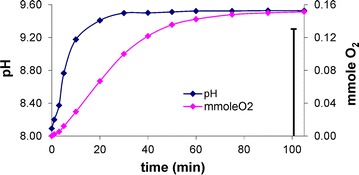
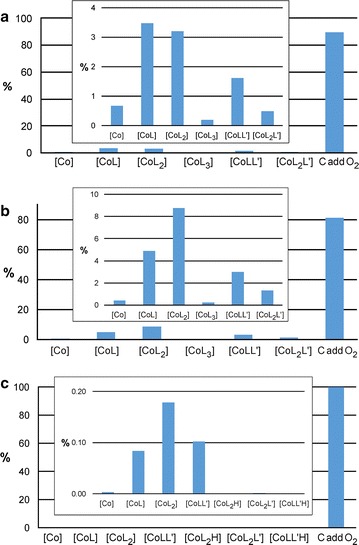
Investigations of oxygenation of the Co(II)-amino acid-imidazole systems indicated that dioxygen uptake proceeds along with a rise in pH to 9-10. The percentage of reversibility noted after acidification of the solution to the initial pH ranged within ca 30-60% for alanine, 40-70% for asparagine and 50-90% for histidine, with a rising tendency along with the increasing share of amino acid in the Co(II): amino acid: imidazole ratio. Calculations of the share of the free Co(II) ion as well as of the particular complex species existing in solution beside the oxygen adduct (regarding dioxygen bound both reversibly and irreversibly) indicated quite significant values for the systems with alanine and asparagine-in those cases the of oxygenation reaction is right shifted to a relatively lower extent. The experimental results indicate that the "active" complex, able to take up dioxygen, is a heteroligand CoLL'complex, where L = amac (an amino acid with a non-protonated amine group) while L' = Himid, with the N1 nitrogen protonated within the entire pH range under study. Moreover, the corresponding log [Formula: see text] value at various initial total Co(II), amino acid and imidazole concentrations was found to be constant within the limits of error, which confirms those results. The highest log [Formula: see text] value, 14.9, occurs for the histidine system; in comparison, asparagine is 7.8 and alanine is 9.7. This high value is most likely due to the participation of the additional effective N3 donor of the imidazole side group of histidine.
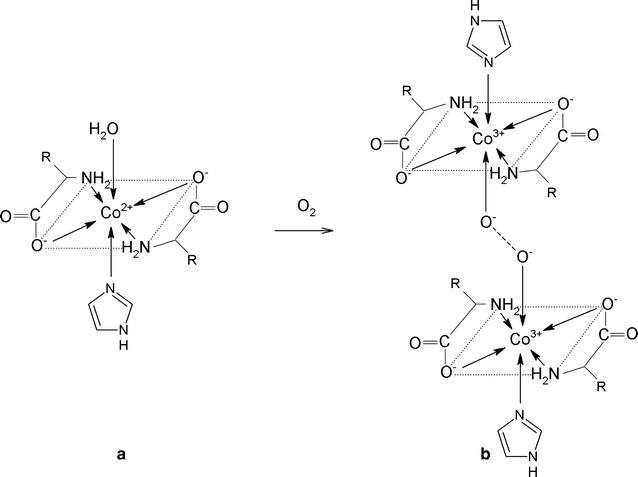
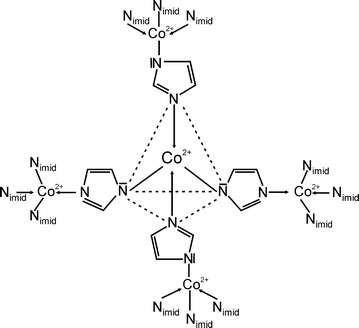
The Co(II)-amac-Himid systems formed by using a [Co(imid)] polymer as starting material demonstrate that the reversible uptake of molecular oxygen occurs by forming dimeric μ-peroxy adducts. The essential impact on the electron structure of the dioxygen bridge, and therefore, on the reversibility of O uptake, is due to the imidazole group at axial position (trans towards O). However, the results of reversibility measurements of O uptake, unequivocally indicate a much higher effectiveness of dioxygenation than in systems in which the oxygen adducts are formed in equilibrium mixtures during titration of solutions containing Co(II) ions, the amino acid and imidazole, separately.
本文研究了Co(II)-氨基酸-咪唑体系(其中氨基酸 = L-α-氨基酸:丙氨酸、天冬酰胺、组氨酸),该体系在水溶液中能活化并可逆地吸收双氧,同时保持血红素基团的结构模式(咪唑作为轴向配体,在第六个反位吸收氧),从而模仿了天然呼吸色素如肌红蛋白和血红蛋白。与不含咪唑的类似氨基酸的Co(II)-amac体系相比,该体系的氧化反应具有更高的可逆性。与以往对异配体Co(II)-氨基酸-咪唑体系的研究不同,本研究精确计算了溶液中存在的所有平衡形式,并在不使用任何简化近似的情况下确定了平衡常数。利用在无氧条件下类似体系获得的常数数据,计算了Co(II)、氨基酸、咪唑和形成的络合物物种的平衡浓度。通过电位滴定和体积法(氧化)研究,确定了氧吸收反应的化学计量比以及形成的氧加合物中中心离子的配位模式。通过应用完整的质量平衡方程评估了双氧吸收平衡常数的值。
对Co(II)-氨基酸-咪唑体系的氧化研究表明,双氧吸收随着pH值升高至9 - 10而进行。将溶液酸化至初始pH值后观察到的可逆性百分比,丙氨酸约为30 - 60%,天冬酰胺为40 - 70%,组氨酸为50 - 90%,且随着Co(II):氨基酸:咪唑比例中氨基酸份额的增加呈上升趋势。对游离Co(II)离子以及除氧加合物外溶液中存在的特定络合物物种(考虑可逆和不可逆结合的双氧)份额的计算表明,丙氨酸和天冬酰胺体系的值相当可观,在这些情况下氧化反应向右移动的程度相对较小。实验结果表明,能够吸收双氧的“活性”络合物是一种异配体CoLL'络合物,其中L = amac(具有非质子化胺基的氨基酸),而L' = Himid,在整个研究的pH范围内N1氮被质子化。此外,发现在各种初始总Co(II)、氨基酸和咪唑浓度下相应的log 值在误差范围内是恒定的,这证实了这些结果。组氨酸体系的log 值最高,为14.9;相比之下,天冬酰胺为7.8,丙氨酸为9.7。这个高值很可能是由于组氨酸咪唑侧基额外的有效N3供体的参与。
以[Co(imid)]聚合物为起始原料形成的Co(II)-amac-Himid体系表明,分子氧的可逆吸收是通过形成二聚体μ-过氧加合物发生的。轴向位置(与氧反位)的咪唑基团对双氧桥的电子结构以及因此对氧吸收的可逆性有重要影响。然而,氧吸收可逆性测量的结果明确表明,与在分别滴定含有Co(II)离子、氨基酸和咪唑的溶液过程中在平衡混合物中形成氧加合物的体系相比,双氧合的效率要高得多。