Zha Zhi-Min, Wang Jun-Hong, Li Shi-Ling, Guo Yan
Department of Gerontology, the First Affiliated Hospital of Nanjing Medical University, Nanjing, Jiangsu 210029, China.
Department of Cardiology, the First Affiliated Hospital of Nanjing Medical University, Nanjing, Jiangsu 210029, China.
J Biomed Res. 2018 Jul 23;32(4):281-287. doi: 10.7555/JBR.31.20160116.
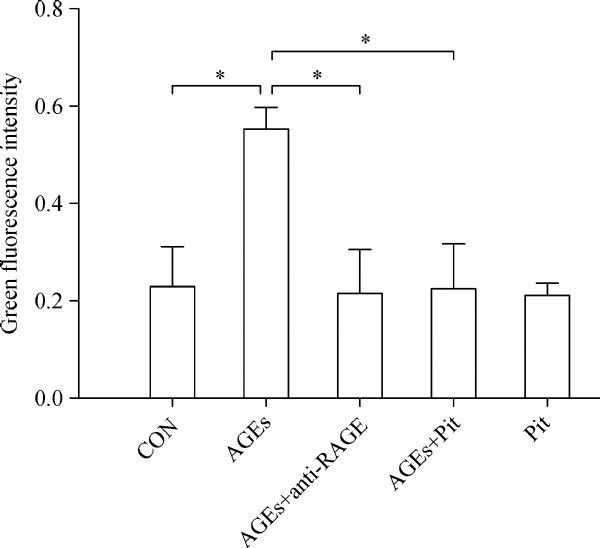
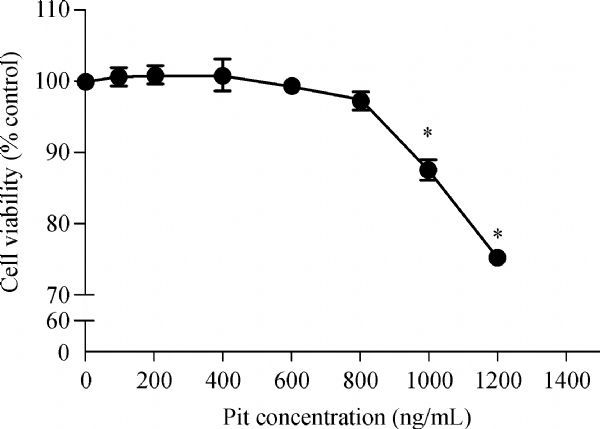
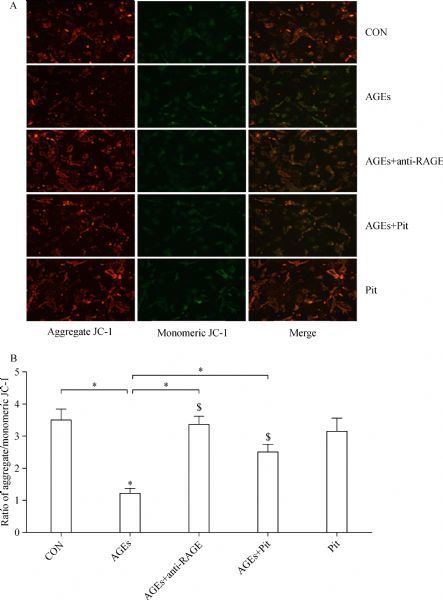
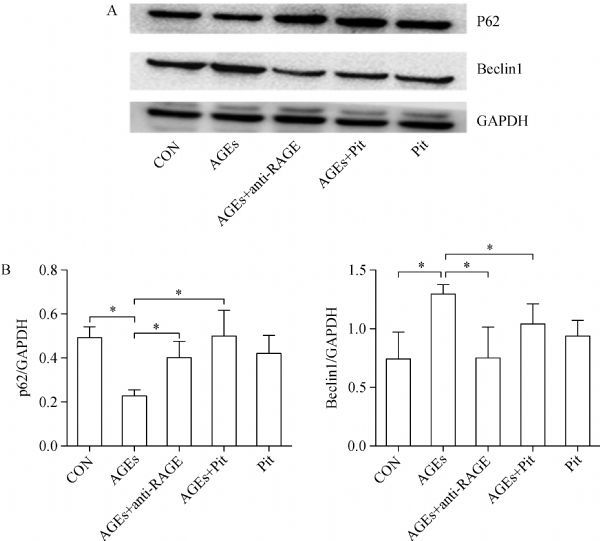
This study aimed to investigate whether pitavastatin protected against injury induced by advanced glycation end products products (AGEs) in neonatal rat cardiomyocytes, and to examine the underlying mechanisms. Cardiomyocytes of neonatal rats were incubated for 48 hours with AGEs (100 μg/mL), receptor for advanced glycation end products (RAGE), antibody (1 μg/mL) and pitavastatin (600 ng/mL). The levels of p62 and beclin1 were determined by Western blotting. Mitochondrial membrane potential (ΔΨm) and the generation of reactive oxygen species (ROS) were measured through the JC-1 and DCFH-DA. In the AGEs group, the expression of beclin1 was remarkably increased compared to the control group, while the expression of p62 was significantly decreased. AGEs also markedly decreased ΔΨm and significantly increased ROS compared with the control group. After treatment with RAGE antibody or pitavastatin, the level of beclin1 was markedly decreased compared with the AGEs group, but the level of p62 was remarkably increased. In the AGEs+ RAGE antibody group and AGEs+ pitavastatin group, ΔΨm was significantly increased and ROS was remarkably decreased compared with the AGEs group. In conclusion, AGEs-RAGE may induce autophagy of cardiomyocytes by generation of ROS and pitavastatin could protect against AGEs-induced injury against cardiomyocytes.
本研究旨在探讨匹伐他汀是否能保护新生大鼠心肌细胞免受晚期糖基化终末产物(AGEs)诱导的损伤,并研究其潜在机制。将新生大鼠心肌细胞与AGEs(100μg/mL)、晚期糖基化终末产物受体(RAGE)抗体(1μg/mL)和匹伐他汀(600ng/mL)共同孵育48小时。通过蛋白质免疫印迹法测定p62和beclin1的水平。通过JC-1和DCFH-DA检测线粒体膜电位(ΔΨm)和活性氧(ROS)的生成。在AGEs组中,与对照组相比,beclin1的表达显著增加,而p62的表达显著降低。与对照组相比,AGEs还显著降低了ΔΨm并显著增加了ROS。用RAGE抗体或匹伐他汀处理后,与AGEs组相比,beclin1水平显著降低,但p62水平显著升高。在AGEs+RAGE抗体组和AGEs+匹伐他汀组中,与AGEs组相比,ΔΨm显著升高,ROS显著降低。综上所述,AGEs-RAGE可能通过ROS生成诱导心肌细胞自噬,而匹伐他汀可以保护心肌细胞免受AGEs诱导的损伤。