Alves Claudia C, Waitzberg Dan L, de Andrade Laila S, Dos Santos Aguiar Laís, Reis Milene B, Guanabara Camila C, Júnior Odair A, Ribeiro Daniel A, Sala Priscila
Department of Biosciences, Federal University of São Paulo, Santos, Brazil.
Department of Gastroenterology, School of Medicine, University of São Paulo, São Paulo, Brazil.
Front Microbiol. 2017 Oct 17;8:2010. doi: 10.3389/fmicb.2017.02010. eCollection 2017.
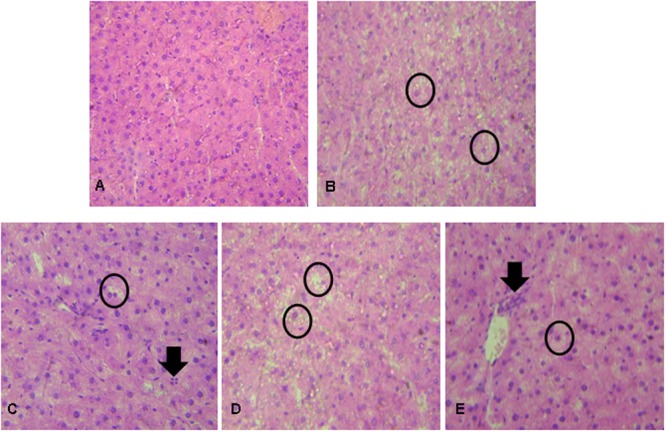
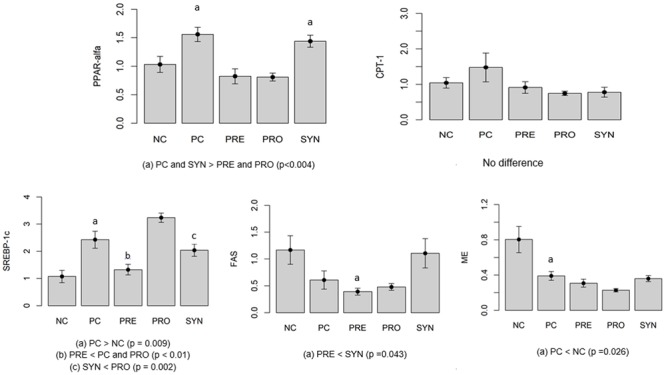
Non-alcoholic fatty liver disease (NAFLD) is characterized by the presence of fat in hepatocytes because of decreased β-oxidation and increased lipogenesis. Prebiotics, probiotics, and synbiotic have modulatory effects on intestinal microbiota and may influence the gut-liver axis. Our aim was to evaluate the effects of prebiotic, probiotics, and synbiotic on liver histopathology and gene expression related to β-oxidation and lipogenesis after hypercholesterolemia. Wistar male adult rats ( = 40) were submitted to hypercholesterolemic conditions (HPC) (60 days). On Day 30 of HPC, rats were subdivided in 5 groups: negative control (NC): without HPC + Gv (distilled water); positive control (PC): with HPC + Gv (distilled water); prebiotic (PRE): HPC + Gv with prebiotic (Fiber FOS); probiotic (PRO): HPC + Gv with probiotic strains Gv (Probiatop); and synbiotic (SYN): HPC + Gv with synbiotic (Simbioflora). All rats were sacrificed on Day 30 post-treatment. Blood was collected to verify total serum cholesterol, and liver tissue was sampled to verify histopathological changes and gene expression. Gene expression related to ß-oxidation (PPAR-α and CPT-1) and lipogenesis (SREBP-1c, FAS and ME) was evaluated in liver tissue using RT-qPCR. PC had higher cholesterol levels when compared to NC. PRE and SYN rats had lower cholesterol levels than PC. PC rats showed more histopathological changes than NC rats; PRE and SYN rats showed fewer alterations than PC rats. was expressed at higher levels in SYN and PC rats compared with PRE and PRO rats. expression was similar in all groups. was expressed at higher levels in PC rats compared with NC rats; levels were lower in SYN rats compared with PRO rats; levels were lower in PRE rats compared with PC and PRO rats. was expressed at lower levels in PRE rats compared with SYN rats. expression was lower in PC rats compared with NC rats. Prebiotic and synbiotic supplementation improve hepatic alterations related to hypercholesterolemia. These changes appear to be mediated by altered expression of genes related to β-oxidation and lipogenesis.
非酒精性脂肪性肝病(NAFLD)的特征是由于β-氧化减少和脂肪生成增加,肝细胞中存在脂肪。益生元、益生菌和合生元对肠道微生物群具有调节作用,并可能影响肠-肝轴。我们的目的是评估益生元、益生菌和合生元对高胆固醇血症后肝脏组织病理学以及与β-氧化和脂肪生成相关的基因表达的影响。将40只成年雄性Wistar大鼠置于高胆固醇血症条件(HPC)下60天。在HPC第30天,将大鼠分为5组:阴性对照(NC):未进行HPC + 给予Gv(蒸馏水);阳性对照(PC):进行HPC + 给予Gv(蒸馏水);益生元组(PRE):HPC + 给予含有益生元(低聚果糖)的Gv;益生菌组(PRO):HPC + 给予含有益生菌菌株Gv(Probiatop)的Gv;合生元组(SYN):HPC + 给予含有合生元(Simbioflora)的Gv。所有大鼠在治疗后第30天处死。采集血液以检测总血清胆固醇,并采集肝脏组织样本以检测组织病理学变化和基因表达。使用逆转录定量聚合酶链反应(RT-qPCR)评估肝脏组织中与β-氧化(PPAR-α和CPT-1)和脂肪生成(SREBP-1c、FAS和ME)相关的基因表达。与NC相比,PC组胆固醇水平更高。PRE组和SYN组大鼠的胆固醇水平低于PC组。PC组大鼠比NC组大鼠表现出更多的组织病理学变化;PRE组和SYN组大鼠比PC组大鼠表现出的变化更少。与PRE组和PRO组大鼠相比,SYN组和PC组大鼠中[未提及具体基因名称]表达水平更高。[未提及具体基因名称]在所有组中的表达相似。与NC组大鼠相比,PC组大鼠中[未提及具体基因名称]表达水平更高;与PRO组大鼠相比,SYN组大鼠中[未提及具体基因名称]水平更低;与PC组和PRO组大鼠相比,PRE组大鼠中[未提及具体基因名称]水平更低。与SYN组大鼠相比,PRE组大鼠中[未提及具体基因名称]表达水平更低。与NC组大鼠相比,PC组大鼠中[未提及具体基因名称]表达更低。补充益生元和合生元可改善与高胆固醇血症相关的肝脏改变。这些变化似乎是由与β-氧化和脂肪生成相关基因的表达改变介导的。