From the Gastroenterology Section, John D. Dingell Veterans Administration Medical Center, Detroit, Michigan, USA.
Division of Gastroenterology, Department of Medicine, Michigan Medicine, Ann Arbor, Michigan, USA.
Am J Gastroenterol. 2018 Jan;113(1):105-114. doi: 10.1038/ajg.2017.230. Epub 2017 Aug 22.
Linaclotide is a guanylate cyclase-C agonist approved in the United States, Canada, and Mexico at a once-daily 145-μg dose for the treatment of chronic idiopathic constipation (CIC); a once-daily 72-μg dose for CIC recently received FDA approval. The trial objective was to evaluate the efficacy and safety of a 72-μg linaclotide dose in CIC patients.
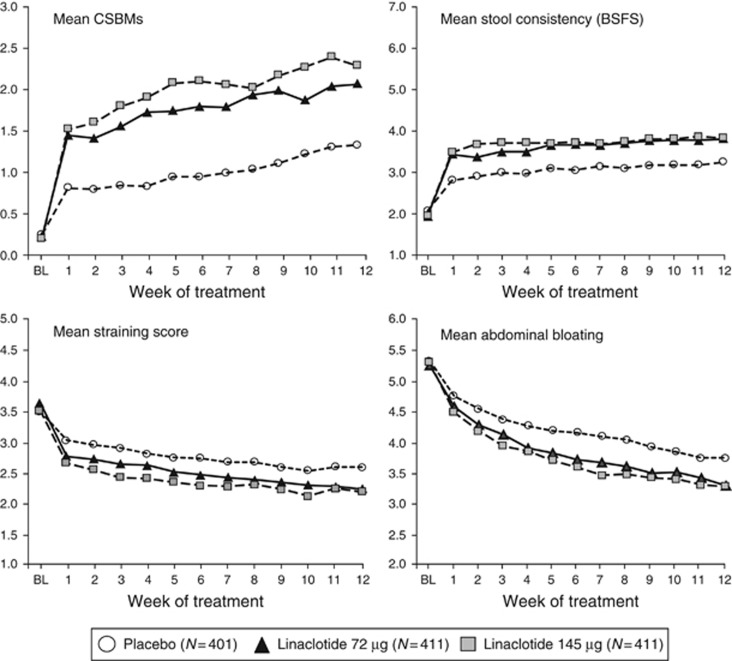
This double-blind, placebo-controlled trial randomized patients with CIC (Rome III criteria) to once-daily linaclotide 72 μg or 145 μg, or placebo for 12 weeks. The primary endpoint, 12-week complete spontaneous bowel movement (CSBM) overall responder, required patients to have ≥3 CSBMs and an increase of ≥1 CSBM per week from baseline in the same week for ≥9 of 12 weeks of the treatment period. Secondary endpoints included 12-week change from baseline in bowel (SBM and CSBM frequency, stool consistency, straining) and abdominal (bloating, discomfort) symptoms, monthly CSBM responders, and 12-week CSBM responders among patients who averaged >1 SBM/week at baseline. Sustained response (12-week CSBM overall responders who met weekly criteria for 3 of the 4 final weeks (weeks 9-12) of treatment) was evaluated as an additional endpoint. Adverse events (AEs) were monitored.
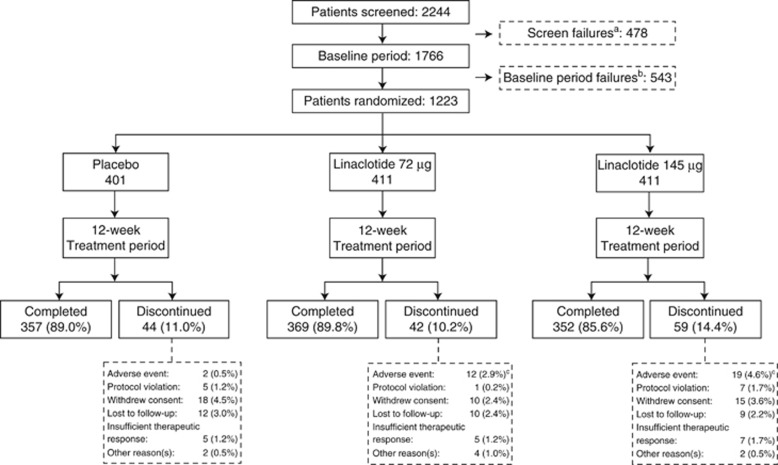
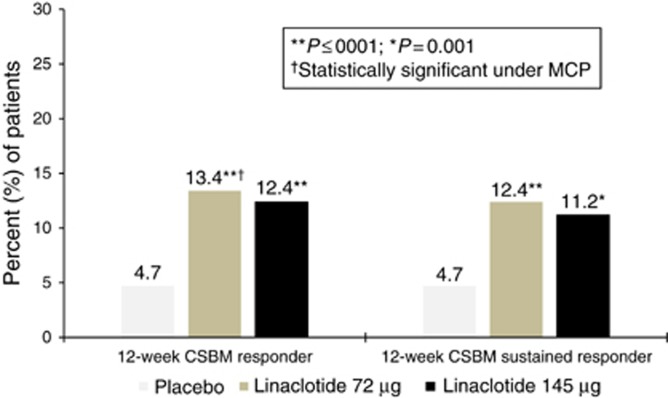
The intent-to-treat population included 1,223 patients (mean age=46 years, female=77%, white=71%). The primary endpoint was met by 13.4% of linaclotide 72-μg patients vs. 4.7% of placebo patients (P<0.0001, odds ratio=3.0; statistically significant controlling for multiplicity). Sustained response was achieved by 12.4% of linaclotide 72-μg patients vs. 4.2% of placebo patients (nominal P<0.0001). Linaclotide 72-μg patients met 9-of-10 secondary endpoints vs. placebo (P<0.05; abdominal discomfort, P=0.1028). Patients treated with linaclotide 145 μg also improved CIC symptoms for the primary (12.4%) and sustained responder endpoint parameters (11.4%) and for all 10 of the secondary endpoint parameters including abdominal discomfort (P<0.05). Diarrhea, the most common AE, was mild in most instances and resulted in discontinuation of 0, 2.4%, and 3.2% of patients in the placebo, linaclotide 72-μg, and linaclotide 145-μg groups, respectively.
Once-daily linaclotide 72 μg significantly improved CIC symptoms in both men and women with a low rate of discontinuation due to diarrhea over 12 weeks of treatment.
利那洛肽是一种鸟苷酸环化酶-C 激动剂,已获美国、加拿大和墨西哥批准,每日一次使用 145μg 剂量治疗慢性特发性便秘(CIC);最近,每日一次使用 72μg 剂量获得了 FDA 的批准。本试验的目的是评估 CIC 患者使用利那洛肽 72μg 剂量的疗效和安全性。
这是一项双盲、安慰剂对照试验,将 CIC(罗马 III 标准)患者随机分为利那洛肽 72μg 或 145μg 每日一次,或安慰剂组,治疗 12 周。主要终点为 12 周时完全自发排便(CSBM)总应答者,需要患者在治疗期间的 12 周内,每周至少有 3 次 CSBM,且每周至少增加 1 次 CSBM,持续 9 周以上。次要终点包括治疗 12 周时的肠道(SBM 和 CSBM 频率、粪便稠度、用力程度)和腹部(腹胀、不适)症状的变化,每月 CSBM 应答者,以及基线每周平均 >1 次 SBM 的患者中 12 周 CSBM 应答者。(持续应答者:治疗的最后 4 周(第 9-12 周)每周符合标准的 12 周 CSBM 总应答者)作为另一个终点进行评估。监测不良事件(AE)。
意向治疗人群包括 1223 名患者(平均年龄 46 岁,女性 77%,白人 71%)。利那洛肽 72μg 组有 13.4%的患者达到主要终点,而安慰剂组为 4.7%(P<0.0001,优势比=3.0;在多重比较中具有统计学意义)。利那洛肽 72μg 组有 12.4%的患者达到持续应答,而安慰剂组为 4.2%(名义 P<0.0001)。利那洛肽 72μg 组有 9 项次要终点达到了 10 项(P<0.05;腹部不适,P=0.1028)。接受利那洛肽 145μg 治疗的患者在主要(12.4%)和持续应答者终点参数(11.4%)以及所有 10 项次要终点参数(包括腹部不适)方面也改善了 CIC 症状(P<0.05)。腹泻是最常见的不良事件,大多数情况下为轻度,导致安慰剂、利那洛肽 72μg 和利那洛肽 145μg 组分别有 0%、2.4%和 3.2%的患者停药。
利那洛肽 72μg 每日一次治疗男性和女性的 CIC 症状,12 周的治疗期间因腹泻导致停药的发生率较低。