Department of Epidemiology, Capital Institute of Pediatrics.
Department of Children and Adolescents Health Care, School of Public Health, Ningxia Medical University.
J Epidemiol. 2018 Jan 5;28(1):19-26. doi: 10.2188/jea.JE20160141. Epub 2017 Oct 25.
The potential mechanism underlying the relationship between the risk of cardiovascular diseases and metabolically healthy obese (MHO) individuals remains unclear. The aim of the study was to prospectively investigate the potential role of the adipokines in the association between the MHO phenotype and hypertension in children and adolescents.
A total of 1184 participants at baseline were recruited from a cohort of the Beijing Child and Adolescent Metabolic Syndrome (BCAMS) study. The participants were classified according to their body mass index (BMI) and metabolic syndrome (MS) components. The levels of the adipokines, including leptin, adiponectin, and resistin, were measured.
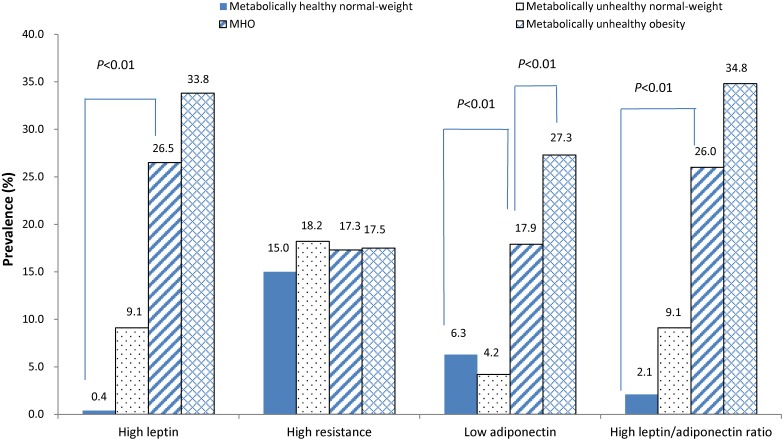
MHO individuals had higher leptin levels (11.58 ug/L vs 1.20 ug/L), leptin/adiponectin ratio (1.18 vs 0.07), and lower adiponectin (11.65 ug/L vs 15.64 ug/L) levels compared to metabolically healthy normal-weight individuals (all P < 0.05). Compared to metabolically healthy normal-weight individuals, the prevalence of high leptin levels (26.5% vs 0.4%), low adiponectin levels (17.9% vs 6.3%) and a high leptin/adiponectin ratio (26.0% vs 2.1%) was higher in MHO individuals (all P < 0.01). The MHO individuals with abnormal adipokines were significantly more likely to developing hypertension (high leptin, relative risk 11.04; 95% confidence interval, 1.18-103.35; and high leptin/adiponectin ratio, relative risk 9.88; 95% confidence interval, 1.11-87.97) compared to metabolically healthy normal-weight individuals with normal adipokine levels.
The abnormal adipokine levels contribute to the increased hypertension risk in MHO children and adolescents. The non-traditional risk factors should be highlighted in MHO children and adolescents in clinical practice and research.
心血管疾病风险与代谢健康肥胖(MHO)个体之间的潜在机制尚不清楚。本研究旨在前瞻性研究脂肪因子在 MHO 表型与儿童和青少年高血压之间关联中的潜在作用。
本研究共纳入了北京儿童青少年代谢综合征(BCAMS)研究队列中的 1184 名基线参与者。参与者根据其体重指数(BMI)和代谢综合征(MS)成分进行分类。测量了脂肪因子,包括瘦素、脂联素和抵抗素的水平。
与代谢健康正常体重个体相比,MHO 个体的瘦素水平(11.58 ug/L 比 1.20 ug/L)、瘦素/脂联素比值(1.18 比 0.07)较高,脂联素水平(11.65 ug/L 比 15.64 ug/L)较低(均 P < 0.05)。与代谢健康正常体重个体相比,MHO 个体中高瘦素水平(26.5%比 0.4%)、低脂联素水平(17.9%比 6.3%)和高瘦素/脂联素比值(26.0%比 2.1%)的患病率更高(均 P < 0.01)。脂肪因子异常的 MHO 个体发生高血压的风险显著高于代谢健康正常体重且脂肪因子正常的个体(高瘦素:相对风险 11.04;95%置信区间:1.18-103.35;高瘦素/脂联素比值:相对风险 9.88;95%置信区间:1.11-87.97)。
异常的脂肪因子水平导致 MHO 儿童和青少年高血压风险增加。在临床实践和研究中,应强调 MHO 儿童和青少年的非传统危险因素。