Department of Cardiology, Lanzhou University Second Hospital, Lanzhou 730030, China.
Department of Urology, Lanzhou University Second Hospital, Lanzhou 730030, China.
Biomed Res Int. 2017;2017:4368474. doi: 10.1155/2017/4368474. Epub 2017 Sep 28.
Antihypertensive drug use is inconsistently associated with the risk of dementia, Alzheimer's disease, cognitive impairment, and cognitive decline. Therefore, we conducted a meta-analysis of available prospective cohort studies to summarize the evidence on the strength of these relationships.
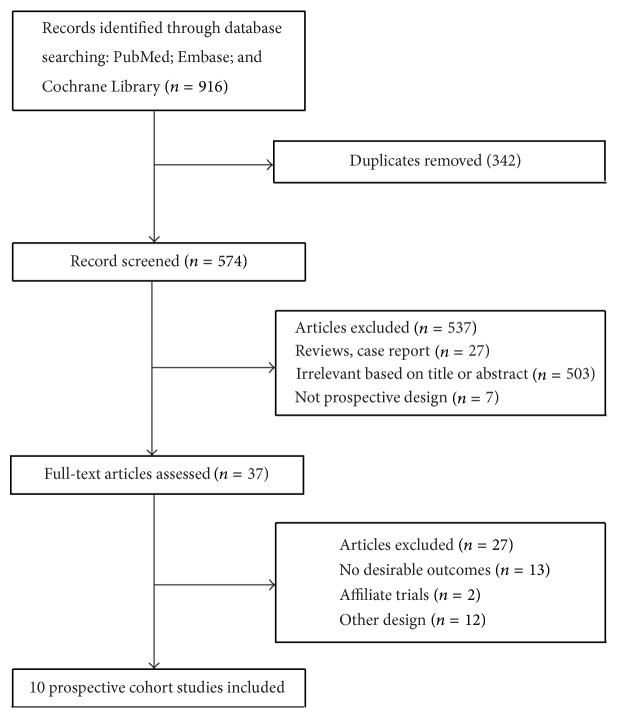
Three electronic databases including MedLine, Embase, and the Cochrane Library were searched to identify studies from inception to April 2017. Only prospective cohort studies that reported effect estimates with corresponding 95% confidence intervals (CIs) of dementia, Alzheimer's disease, cognitive impairment, and cognitive decline for antihypertensive drug use versus not using antihypertensive drugs were included.
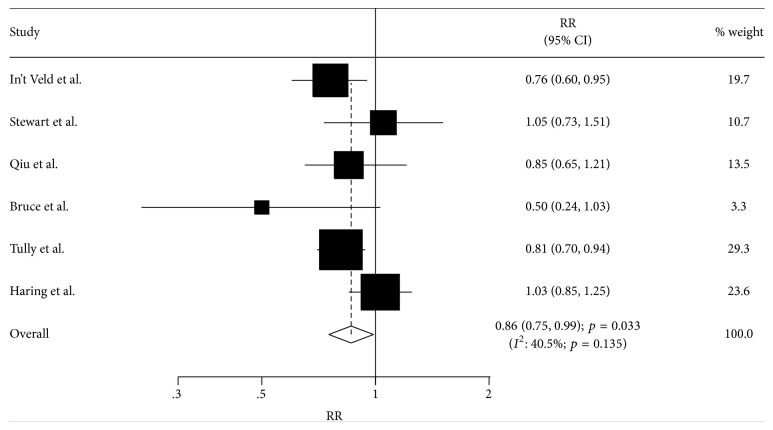
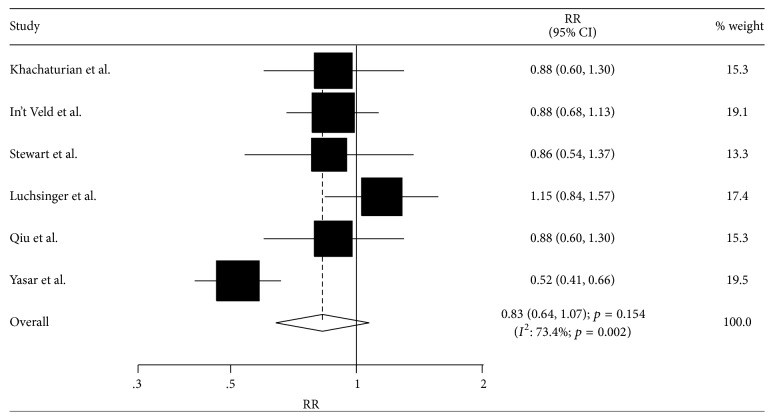
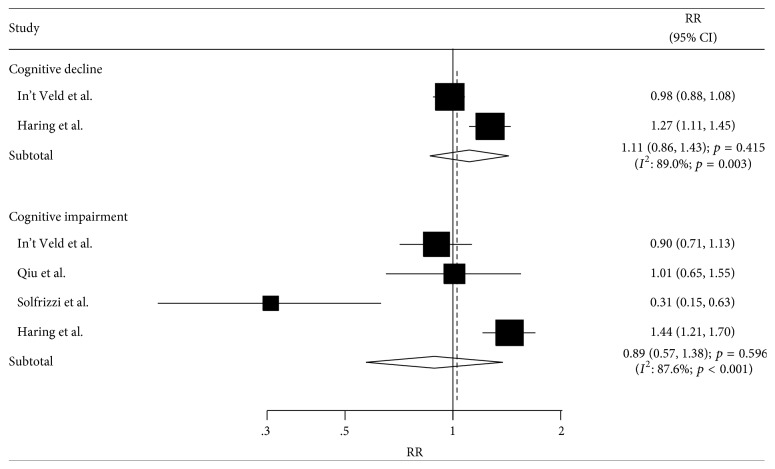
We included 10 prospective cohort studies reporting data on 30,895 individuals. Overall, participants who received antihypertensive drugs had lower incidence of dementia (relative risk [RR]: 0.86; 95% CI: 0.75-0.99; = 0.033), while there was no significant effect on the incidence of Alzheimer's disease (RR: 0.83; 95% CI: 0.64-1.09; = 0.154), cognitive impairment (RR: 0.89; 95% CI: 0.57-1.38; = 0.596), and cognitive decline (RR: 1.11; 95% CI: 0.86-1.43; = 0.415). Further, the incidence of Alzheimer's disease might be affected by antihypertensive drug use in participants with specific characteristics.
Antihypertensive drug use was associated with a significantly reduced risk of dementia, but not with the risk of Alzheimer's disease, cognitive impairment, and cognitive decline.
抗高血压药物的使用与痴呆、阿尔茨海默病、认知障碍和认知能力下降的风险之间的关联并不一致。因此,我们对现有的前瞻性队列研究进行了荟萃分析,以总结这些关系的证据强度。
我们检索了三个电子数据库,包括 MedLine、Embase 和 Cochrane Library,以确定从研究开始到 2017 年 4 月的研究。仅纳入报告了抗高血压药物与不使用抗高血压药物相比,对痴呆、阿尔茨海默病、认知障碍和认知能力下降的风险的效应估计值及其相应 95%置信区间(CI)的前瞻性队列研究。
我们纳入了 10 项报告了 30895 名参与者数据的前瞻性队列研究。总体而言,使用抗高血压药物的参与者痴呆的发生率较低(相对风险 [RR]:0.86;95%CI:0.75-0.99; = 0.033),但对阿尔茨海默病的发生率(RR:0.83;95%CI:0.64-1.09; = 0.154)、认知障碍(RR:0.89;95%CI:0.57-1.38; = 0.596)和认知能力下降(RR:1.11;95%CI:0.86-1.43; = 0.415)无显著影响。此外,在具有特定特征的参与者中,抗高血压药物的使用可能会影响阿尔茨海默病的发生率。
抗高血压药物的使用与痴呆风险显著降低相关,但与阿尔茨海默病、认知障碍和认知能力下降的风险无关。