Radhakrishnan Venkatraman, Dhanushkodi Manikandan, Ganesan Trivadi S, Ganesan Prasanth, Sundersingh Shirley, Selvaluxmy Ganesarajah, Swaminathan Rajaraman, Rama Ranganathan, Sagar Tenali Gnana
All authors: Cancer Institute (WIA), Adyar, Chennai, India.
J Glob Oncol. 2016 Nov 9;3(5):545-554. doi: 10.1200/JGO.2016.005314. eCollection 2017 Oct.
Pediatric Hodgkin lymphoma (HL) is a highly curable malignancy. Outcomes for pediatric HL may vary between developed and developing countries for multiple reasons. This study was conducted to ascertain the outcomes of children with HL at our center and to identify risk factors for recurrent disease.
We analyzed the outcomes of 172 consecutive, previously untreated patients with pediatric HL presenting at our center from 2001 to 2010. Patients were treated with either adriamycin, bleomycin, vinblastine, and dacarbazine or adriamycin, bleomycin, vinblastine, cyclophosphamide, vincristine, prednisone, and procarbazine chemotherapy initially, and radiation to bulky sites or a single site of residual disease when appropriate.
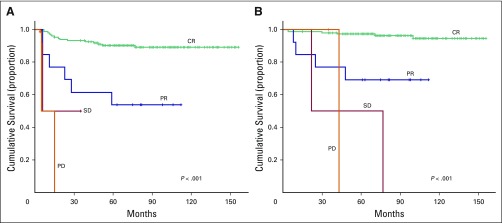
The median duration of follow-up was 77 months. The median age of the patients was 10 years; 127 (74%) of the 172 patients were male. The extent of disease was stage I and II in 59% of the patients. B symptoms were present in 32% of the patients, and 27% had bulky disease. The most common histologic subtype was mixed cellularity (45%). The 5-year overall survival (OS) and progression-free survival (PFS) of the entire cohort were 92.9% and 83.1%, respectively. The 5-year OS rates for patients with stage I, II, III, and IV were 96%, 94.7%, 84%, and 69.8%, respectively. On univariate analysis, advanced stage, response on interim radiologic assessment, and presence of B symptoms significantly predicted inferior PFS and OS. On multivariate analysis, only interim radiologic response significantly predicted PFS ( < .001) and OS ( < .001).
Overall, the outcomes of patients treated at our center are comparable to those observed in other centers in India and globally.
儿童霍奇金淋巴瘤(HL)是一种治愈率很高的恶性肿瘤。由于多种原因,发达国家和发展中国家儿童HL的治疗结果可能有所不同。本研究旨在确定我院儿童HL患者的治疗结果,并确定疾病复发的危险因素。
我们分析了2001年至2010年在我院就诊的172例连续的、未经治疗的儿童HL患者的治疗结果。患者最初接受阿霉素、博来霉素、长春花碱和达卡巴嗪或阿霉素、博来霉素、长春花碱、环磷酰胺、长春新碱、泼尼松和丙卡巴嗪化疗,并在适当的时候对大块病灶或残留疾病的单个部位进行放疗。
中位随访时间为77个月。患者的中位年龄为10岁;172例患者中有127例(74%)为男性。59%的患者疾病分期为I期和II期。32%的患者有B症状,27%有大块病灶。最常见的组织学亚型是混合细胞型(45%)。整个队列的5年总生存率(OS)和无进展生存率(PFS)分别为92.9%和83.1%。I期、II期、III期和IV期患者的5年OS率分别为96%、94.7%、84%和69.8%。单因素分析显示,晚期、中期影像学评估反应和B症状的存在显著预示着较差的PFS和OS。多因素分析显示,只有中期影像学反应显著预示着PFS(<0.001)和OS(<0.001)。
总体而言,我院治疗患者的结果与印度其他中心和全球其他中心观察到的结果相当。