Kee Youn Kyung, Yoon Chan-Yun, Kim Seung Jun, Moon Sung Jin, Kim Chan Ho, Park Jung Tak, Lim Beom Jin, Chang Tae Ik, Kang Ea Wha, Kie Jeong Hae, Yoo Tae-Hyun, Jeong Hyun Joo, Kang Shin-Wook, Han Seung Hyeok
Department of Internal Medicine, College of Medicine, Institute of Kidney Disease Research, Yonsei University Department of Internal Medicine, International St. Mary's Hospital, Catholic Kwandong University Department of Pathology, College of Medicine, Institute of Kidney Disease Research, Yonsei University Department of Internal Medicine, NHIS Medical Center, Ilsan Hospital, Seoul, South Korea.
Medicine (Baltimore). 2017 Nov;96(44):e8154. doi: 10.1097/MD.0000000000008154.
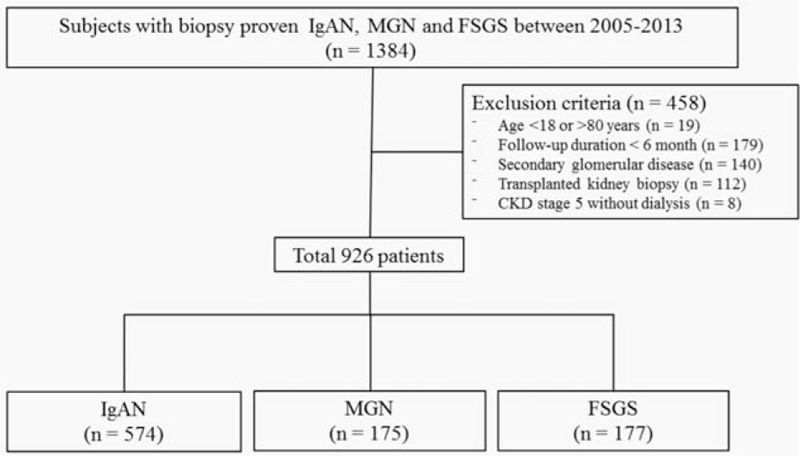
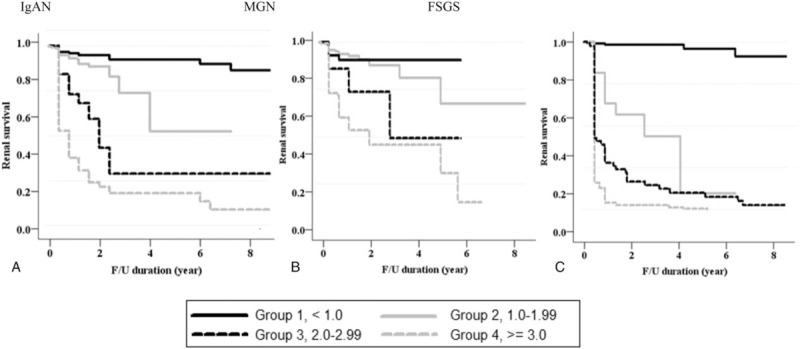
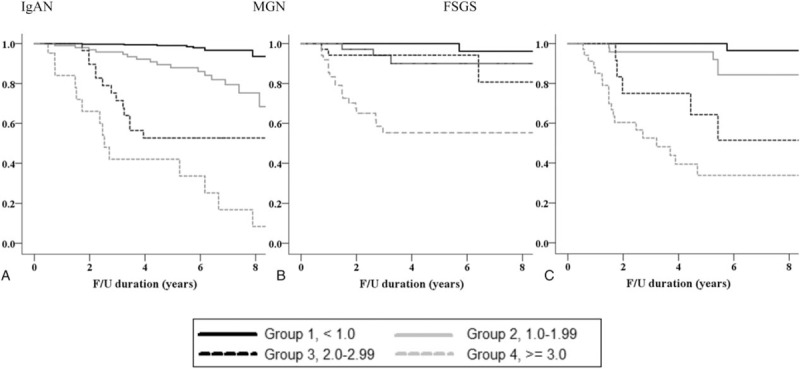
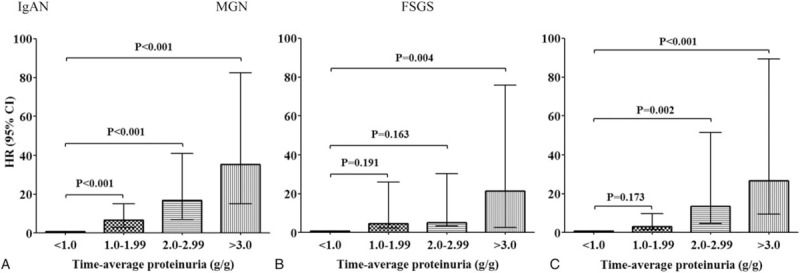
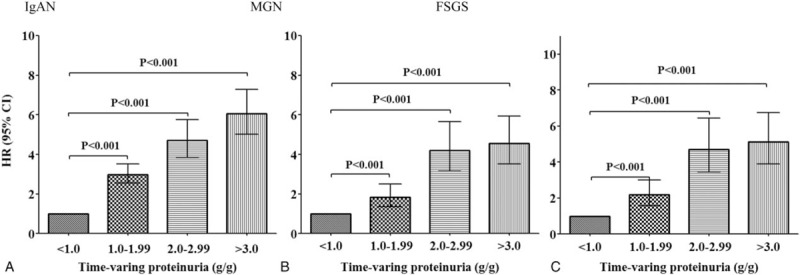
Proteinuria is a major determinant of adverse renal outcome, and its reduction slows renal progression in glomerular diseases. However, the optimal target of proteinuria in glomerular diseases is unclear, and discrepancies in the definition of proteinuria produce ambiguous findings. Here we investigated the optimal target of proteinuria by using different definitions of proteinuria. We analyzed 574 IgA nephropathy (IgAN), 175 membranous nephropathy (MGN), and 177 focal segmental glomerulosclerosis (FSGS) cases from 3 Korean kidney centers. We evaluated the impact of proteinuria on renal outcome with 2 definitions: time-average proteinuria (TAP) and time-varying proteinuria (TVP). The endpoint was renal progression, defined as a 50% decline in glomerular filtration rate or end-stage renal disease. During a median follow-up of 57.3 months, the primary outcome occurred in 54 patients with IgAN, 26 with MGN, and 30 with FSGS. Multivariate Cox regression using TAP indicated that there was a linear association between proteinuria and risk of renal progression in IgAN. However, moderate proteinuria was not associated with an increased risk of renal progression in MGN and FSGS. In contrast, the analysis by TVP showed that the risk significantly increased in proportion to proteinuria during follow-up in all 3 diseases. Our findings suggest that TVP-based model can delineate association between proteinuria and risk of renal progression better than TAP-based model, considering that TVP reflects the dynamic change of proteinuria over time. Thus, proteinuria reduction to the lowest possible level is required to improve renal outcomes in patients with glomerular diseases.
蛋白尿是不良肾脏结局的主要决定因素,降低蛋白尿可减缓肾小球疾病的肾脏进展。然而,肾小球疾病中蛋白尿的最佳目标尚不清楚,蛋白尿定义的差异产生了模糊的结果。在此,我们通过使用不同的蛋白尿定义来研究蛋白尿的最佳目标。我们分析了来自3个韩国肾脏中心的574例IgA肾病(IgAN)、175例膜性肾病(MGN)和177例局灶节段性肾小球硬化(FSGS)病例。我们用两种定义评估了蛋白尿对肾脏结局的影响:时间平均蛋白尿(TAP)和时间变化蛋白尿(TVP)。终点为肾脏进展,定义为肾小球滤过率下降50%或终末期肾病。在中位随访57.3个月期间,54例IgAN患者、26例MGN患者和30例FSGS患者出现了主要结局。使用TAP的多变量Cox回归表明,IgAN中蛋白尿与肾脏进展风险之间存在线性关联。然而,中度蛋白尿与MGN和FSGS的肾脏进展风险增加无关。相比之下,TVP分析显示,在所有3种疾病的随访期间,风险与蛋白尿成比例显著增加。我们的研究结果表明,考虑到TVP反映了蛋白尿随时间的动态变化,基于TVP的模型比基于TAP的模型能更好地描绘蛋白尿与肾脏进展风险之间的关联。因此,为改善肾小球疾病患者的肾脏结局,需要将蛋白尿降至尽可能低的水平。