Herzig Shoshana J, LaSalvia Mary T, Naidus Elliot, Rothberg Michael B, Zhou Wenxiao, Gurwitz Jerry H, Marcantonio Edward R
Division of General Medicine and Primary Care, Department of Medicine, Beth Israel Deaconess Medical Center, Boston, Massachusetts.
Harvard Medical School, Boston, Massachusetts.
J Am Geriatr Soc. 2017 Dec;65(12):2580-2586. doi: 10.1111/jgs.15066. Epub 2017 Nov 2.
BACKGROUND/OBJECTIVES: Off-label use of antipsychotics is common in hospitals, most often for delirium management. Antipsychotics have been associated with aspiration pneumonia in community and nursing home settings, but the association in hospitalized individuals is unexplored. We aimed to investigate the association between antipsychotic exposure and aspiration pneumonia during hospitalization.
Retrospective cohort study.
Large academic medical center.
All adult hospitalizations between January 2007 and July 2013. We excluded outside hospital transfers, hospitalizations shorter than 48 hours, and psychiatric hospitalizations.
Antipsychotic use defined as any pharmacy charge for an antipsychotic medication. Aspiration pneumonia was defined according to a discharge diagnosis code for aspiration pneumonia not present on admission and validated using chart review. A generalized estimating equation was used to control for 43 potential confounders.
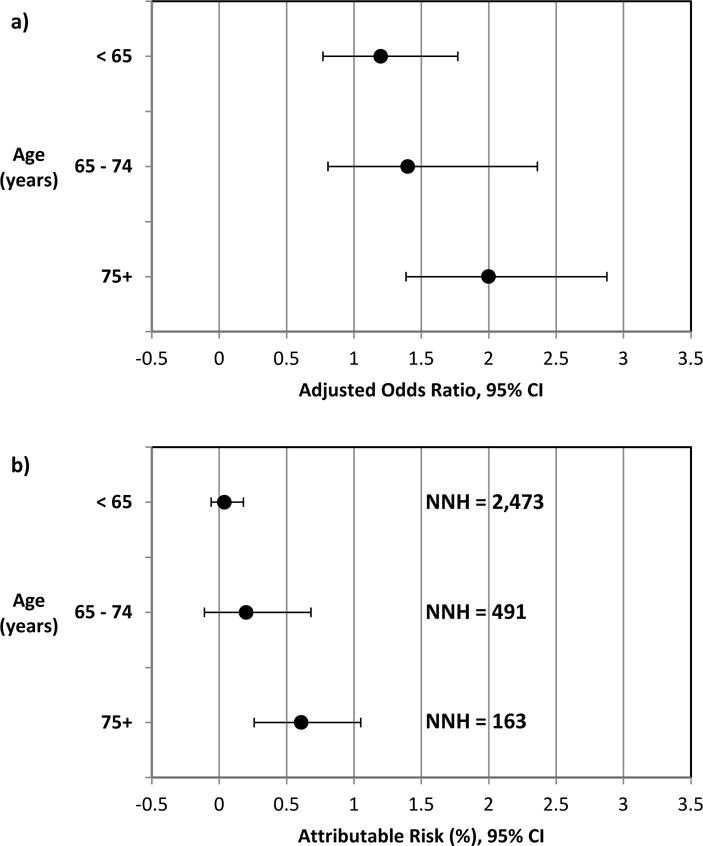
Our cohort included 146,552 hospitalizations (median age 56; 39% male). Antipsychotics were used in 10,377 (7.1%) hospitalizations (80% atypical, 35% typical, 15% both). Aspiration pneumonia occurred in 557 (0.4%) hospitalizations. The incidence of aspiration pneumonia was 0.3% in unexposed individuals and 1.2% in those with antipsychotic exposure (odds ratio (OR) = 3.9, 95% confidence interval (CI) = 3.2-4.8). After adjustment, antipsychotic exposure was significantly associated with aspiration pneumonia (adjusted OR = (aOR) = 1.5, 95% CI = 1.2-1.9). Similar results were demonstrated in a propensity-matched analysis and in an analysis restricted to those with delirium or dementia. The magnitude of the association was similar for typical (aOR = 1.4, 95% CI = 0.94-2.2) and atypical (aOR = 1.5, 95% CI = 1.1-2.0) antipsychotics.
Antipsychotics were associated with greater odds of aspiration pneumonia after extensive adjustment for participant characteristics. This risk should be considered when prescribing antipsychotics in the hospital.
背景/目的:抗精神病药物的非标签使用在医院中很常见,最常用于谵妄管理。在社区和疗养院环境中,抗精神病药物与吸入性肺炎有关,但在住院患者中的关联尚未得到研究。我们旨在调查住院期间抗精神病药物暴露与吸入性肺炎之间的关联。
回顾性队列研究。
大型学术医疗中心。
2007年1月至2013年7月期间所有成年住院患者。我们排除了院外转院、住院时间短于48小时的患者以及精神科住院患者。
抗精神病药物的使用定义为任何抗精神病药物的药房收费。吸入性肺炎根据出院诊断代码定义为入院时不存在的吸入性肺炎,并通过病历审查进行验证。使用广义估计方程来控制43个潜在的混杂因素。
我们的队列包括146,552例住院患者(中位年龄56岁;39%为男性)。10,377例(7.1%)住院患者使用了抗精神病药物(80%为非典型药物,35%为典型药物,15%两者都用)。557例(0.4%)住院患者发生了吸入性肺炎。未暴露个体中吸入性肺炎的发生率为0.3%,抗精神病药物暴露个体中为1.2%(比值比(OR)=3.9,95%置信区间(CI)=3.2 - 4.8)。调整后,抗精神病药物暴露与吸入性肺炎显著相关(调整后OR =(aOR)=1.5,95% CI =1.2 - 1.9)。在倾向匹配分析和仅限于谵妄或痴呆患者的分析中也得到了类似结果。典型抗精神病药物(aOR =1.4,95% CI =0.94 - 2.2)和非典型抗精神病药物(aOR =1.5,95% CI =1.1 - 2.0)的关联程度相似。
在对参与者特征进行广泛调整后,抗精神病药物与吸入性肺炎的较高发生率相关。在医院开具抗精神病药物时应考虑这种风险。