Department of Obstetrics and Gynecology, School of Medicine and Dentistry, College of Health Sciences, University of Ghana, P.O. Box GP 4236, Accra, Ghana.
University Medical Center Utrecht, Utrecht, The Netherlands.
Reprod Health. 2017 Nov 2;14(1):143. doi: 10.1186/s12978-017-0388-0.
The global increase in Cesarean section rate is associated with short- and long-term complications, including adhesions with potential serious maternal and fetal consequences. This study investigated the prevalence of adhesions and association between adhesions and postoperative complications in a tertiary referral hospital in Accra, Ghana.
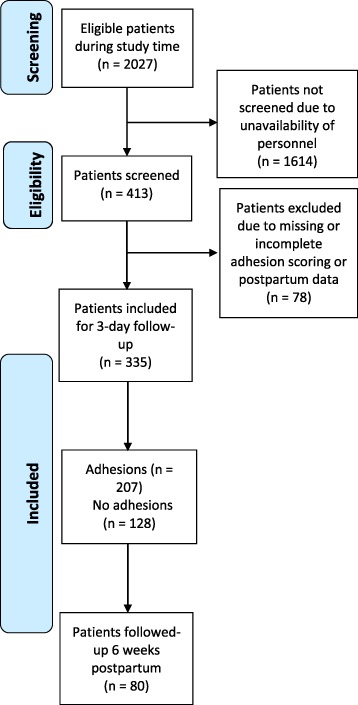
In this prospective cohort study, 335 women scheduled for cesarean section at Korle-Bu Teaching Hospital in Accra, Ghana were included from June to December 2015. Presence or absence of adhesions was recorded and the severity of the adhesions was scored using a classification system. Associations between presence and severity of adhesions, postoperative complications, and maternal and infant outcomes at discharge and 6 weeks postpartum were assessed using multivariate logistic and linear regression analysis.
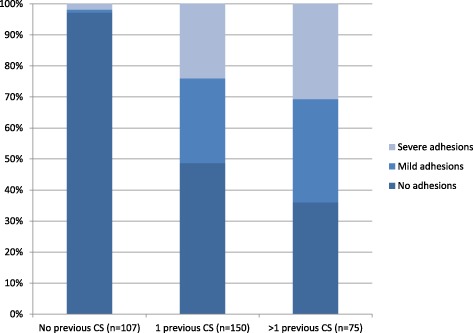
Of the participating women, 128 (38%) had adhesions and 207 (62%) did not. Prevalence of adhesions increased with history of caesarean section; 2.8% with no CS but may have had an abdominal surgery, 51% with one previous CS, 62% with >1 CS). Adhesions significantly increased operation time (mean 39.2 (±15.1) minutes, absolute adjusted difference with presence of adhesions 9.6 min, 95%CI 6.4-12.8), infant delivery time (mean 5.4 (±4.8) minutes, adjusted difference 2.4 min, 95%CI 1.3-3.4), and blood loss for women with severe adhesions (mean blood loss 418.8 ml (±140.6), adjusted difference 57.6 ml (95%CI 12.1-103.0). No differences for other outcomes were observed.
With cesarean section rates rising globally, intra-abdominal adhesions occur more frequently. Risks of adhesions and associated complications should be considered in counseling patients for cesarean section.
全球剖宫产率的上升与短期和长期并发症相关,包括粘连,这可能对母婴造成严重后果。本研究在加纳阿克拉的一家三级转诊医院调查了粘连的发生率,以及粘连与术后并发症之间的关系。
在这项前瞻性队列研究中,2015 年 6 月至 12 月期间,加纳科勒布教学医院计划行剖宫产的 335 名妇女被纳入研究。记录粘连的存在和严重程度,并使用分类系统对粘连的严重程度进行评分。使用多变量逻辑回归和线性回归分析评估粘连的存在和严重程度、术后并发症,以及产妇和婴儿在出院时和 6 周时的结局之间的关系。
参加研究的妇女中,128 名(38%)有粘连,207 名(62%)没有粘连。粘连的发生率随剖宫产史而增加:无剖宫产史但有腹部手术史的妇女为 2.8%,有 1 次剖宫产史的妇女为 51%,有>1 次剖宫产史的妇女为 62%。粘连显著增加了手术时间(平均 39.2(±15.1)分钟,有粘连存在的绝对调整差异为 9.6 分钟,95%CI 6.4-12.8)、婴儿分娩时间(平均 5.4(±4.8)分钟,调整差异为 2.4 分钟,95%CI 1.3-3.4)和重度粘连妇女的出血量(平均出血量 418.8 毫升(±140.6),调整差异为 57.6 毫升,95%CI 12.1-103.0)。其他结局没有观察到差异。
随着全球剖宫产率的上升,腹腔内粘连的发生更为频繁。在为剖宫产术患者提供咨询时,应考虑粘连和相关并发症的风险。