Bridges Daniel J, Miller John M, Chalwe Victor, Moonga Hawela, Hamainza Busiku, Steketee Rick, Silumbe Kafula, Nyangu Jenala, Larsen David A
PATH-Malaria Control and Elimination Partnership in Africa (MACEPA), National Malaria Control Centre, Chainama Hospital College Grounds, Lusaka, Zambia.
Zambia Ministry of Health, Provincial Medical Office, Mansa, Luapula Province, Zambia.
Trials. 2017 Nov 2;18(1):511. doi: 10.1186/s13063-017-2249-0.
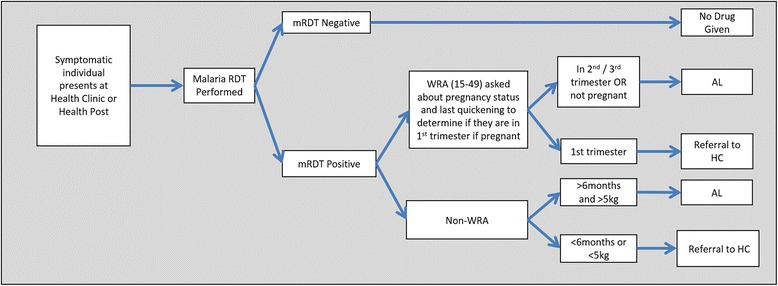
Zambia is pushing for, and has made great strides towards, the elimination of malaria transmission in Southern Province. Reactive focal test and treat (RFTAT) using rapid diagnostic tests and artemether-lumefantrine (AL) has been key in making this progress. Reactive focal drug administration (RFDA) using dihydroartemisinin-piperaquine (DHAP), may be superior in accelerating clearance of the parasite reservoir in humans due to the provision of enhanced chemoprophylactic protection of at-risk populations against new infections. The primary aim of this study is to quantify the relative effectiveness of RFDA with DHAP against RFTAT with AL (standard of care) for reducing Plasmodium falciparum prevalence and incidence.
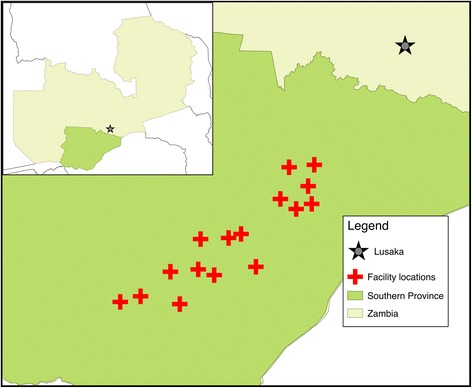
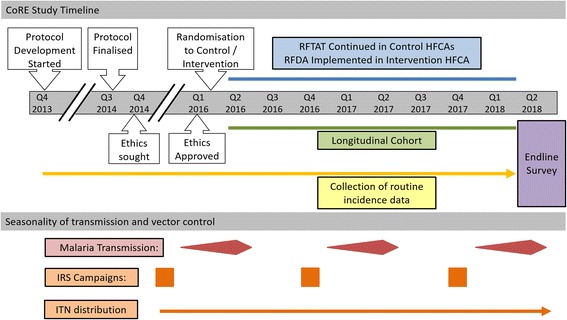
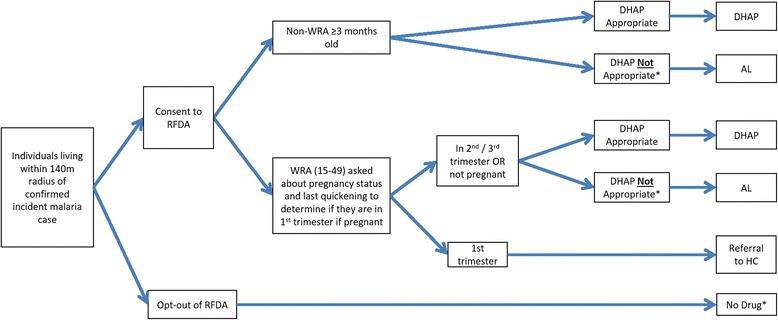
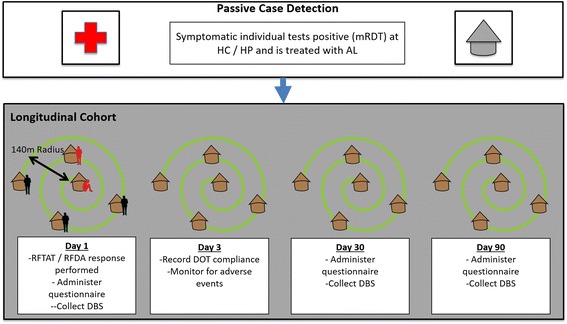
METHODS/DESIGN: The study will be conducted in four districts in Southern Province, Zambia; an area of low malaria transmission and high coverage of vector control. A community randomized controlled trial of 16 health facility catchment areas will be used to evaluate the impact of sustained year-round routine RFDA for 2 years, relative to a control of year-round routine RFTAT. Reactive case detection will be triggered by a confirmed malaria case, e.g., by microscopy or rapid diagnostic test at any government health facility. Reactive responses will be performed by community health workers (CHW) within 7 days of the index case confirmation date. Responses will be performed out to a radius of 140 m from the index case household. A subset of responses will be followed longitudinally for 90 days to examine reinfection rates. Primary outcomes include a post-intervention survey of malaria seropositivity (n = 4800 children aged 1 month to under 5 years old) and a difference-in-differences analysis of malaria parasite incidence, as measured through routine passive case detection at health facilities enrolled in the study. The study is powered to detect approximately a 65% relative reduction in these outcomes between the intervention versus the control.
Strengths of this trial include a robust study design and an endline cross-sectional parasite survey as well as a longitudinal sample. Primary limitations include statistical power to detect only a 65% reduction in primary outcomes, and the potential for contamination to dilute the effects of the intervention.
ClinicalTrials.gov, ID: NCT02654912 . Registered on 12 November 2015.
赞比亚正在推动并已在消除南部省份疟疾传播方面取得了重大进展。使用快速诊断检测和蒿甲醚-本芴醇(AL)进行反应性病灶检测和治疗(RFTAT)是取得这一进展的关键。使用双氢青蒿素-哌喹(DHAP)进行反应性病灶药物给药(RFDA),由于为高危人群提供了增强的化学预防保护以防止新感染,可能在加速清除人体寄生虫库方面更具优势。本研究的主要目的是量化使用DHAP的RFDA与使用AL(标准治疗方法)的RFTAT在降低恶性疟原虫流行率和发病率方面的相对有效性。
方法/设计:该研究将在赞比亚南部省份的四个地区进行;这是一个疟疾传播率低且病媒控制覆盖率高的地区。一项针对16个卫生设施集水区的社区随机对照试验将用于评估持续两年全年进行常规RFDA的影响,与全年常规RFTAT的对照进行比较。确诊疟疾病例将触发反应性病例检测,例如在任何政府卫生设施通过显微镜检查或快速诊断检测确诊。反应性应对措施将由社区卫生工作者(CHW)在索引病例确认日期后的7天内执行。应对范围将以索引病例家庭为中心,半径140米。一部分应对措施将进行90天的纵向跟踪,以检查再感染率。主要结局包括干预后对疟疾血清阳性率的调查(n = 4800名1个月至5岁以下儿童)以及通过参与研究的卫生设施的常规被动病例检测所测量的疟原虫发病率的差异分析。该研究有能力检测干预组与对照组之间这些结局约65%的相对降低。
该试验的优势包括强大的研究设计、终末横断面寄生虫调查以及纵向样本。主要局限性包括仅能检测主要结局65%降低的统计效力,以及污染可能稀释干预效果的可能性。
ClinicalTrials.gov,ID:NCT02654912。于2015年11月12日注册。