Department of Pharmacology, Tulane University School of Medicine, New Orleans, 70112, USA.
Neuroscience Program, Brain Institute, Tulane University, New Orleans, 70118, USA.
Sci Rep. 2017 Nov 2;7(1):14959. doi: 10.1038/s41598-017-14971-z.
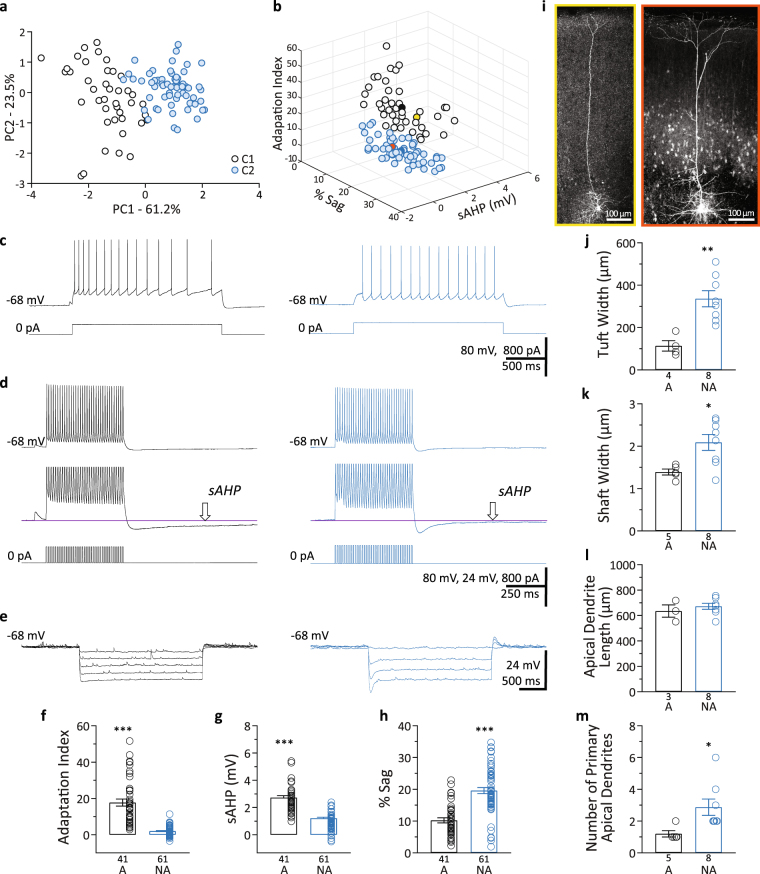
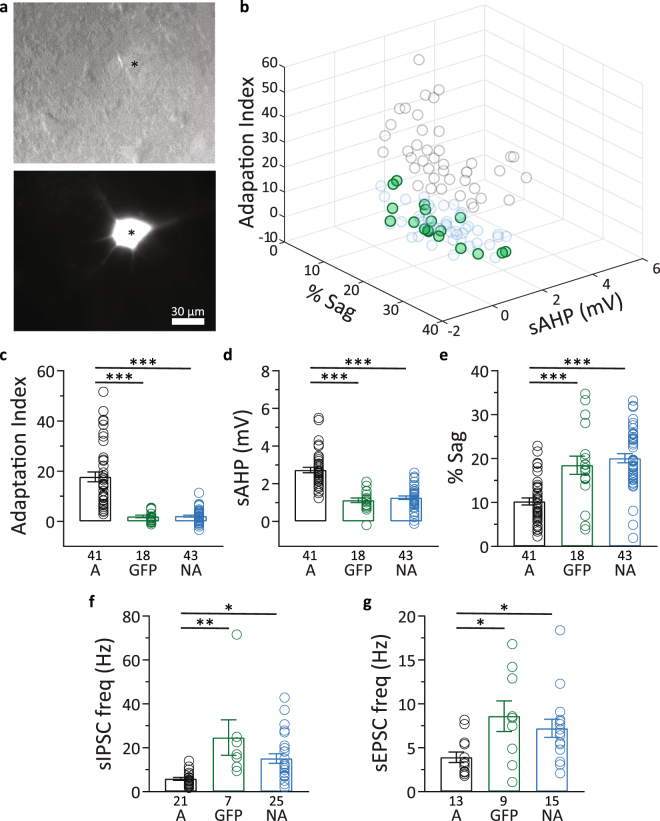
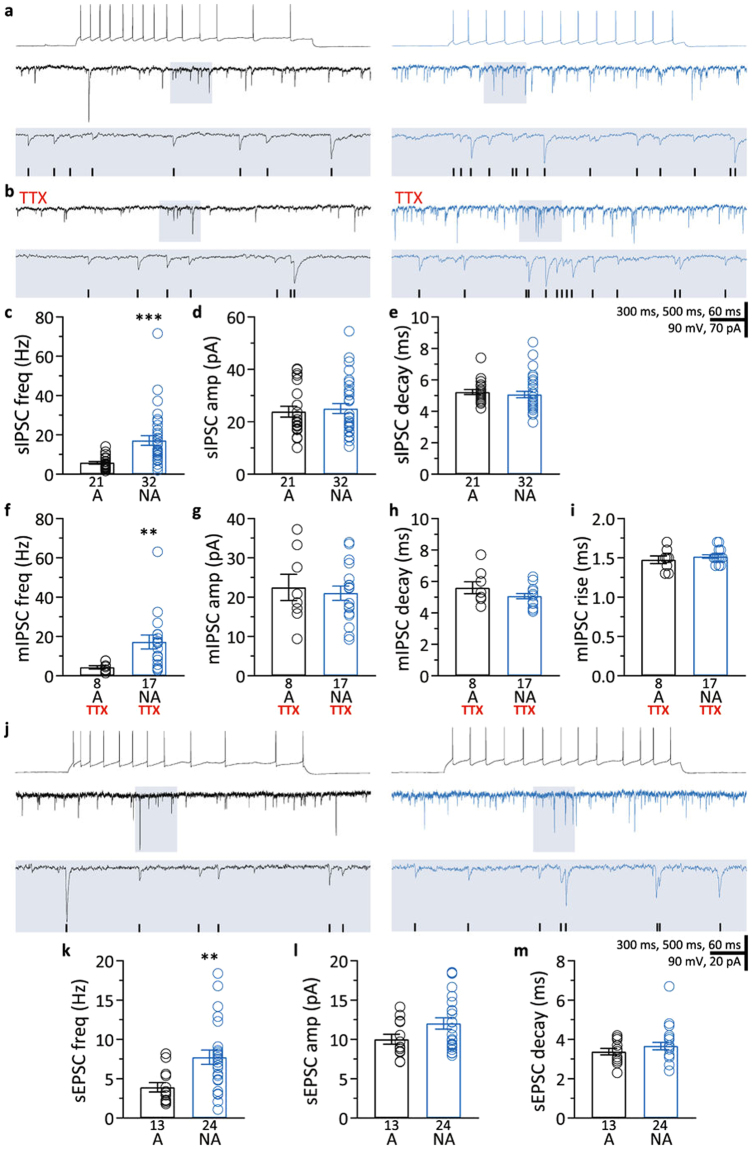
Pyramidal neuron subtypes differ in intrinsic electrophysiology properties and dendritic morphology. However, do different pyramidal neuron subtypes also receive synaptic inputs that are dissimilar in frequency and in excitation/inhibition balance? Unsupervised clustering of three intrinsic parameters that vary by cell subtype - the slow afterhyperpolarization, the sag, and the spike frequency adaptation - split layer 5 barrel cortex pyramidal neurons into two clusters: one of adapting cells and one of non-adapting cells, corresponding to previously described thin- and thick-tufted pyramidal neurons, respectively. Non-adapting neurons presented frequencies of spontaneous inhibitory postsynaptic currents (sIPSCs) and spontaneous excitatory postsynaptic currents (sEPSCs) three- and two-fold higher, respectively, than those of adapting neurons. The IPSC difference between pyramidal subtypes was activity independent. A subset of neurons were thy1-GFP positive, presented characteristics of non-adapting pyramidal neurons, and also had higher IPSC and EPSC frequencies than adapting neurons. The sEPSC/sIPSC frequency ratio was higher in adapting than in non-adapting cells, suggesting a higher excitatory drive in adapting neurons. Therefore, our study on spontaneous synaptic inputs suggests a different extent of synaptic information processing in adapting and non-adapting barrel cortex neurons, and that eventual deficits in inhibition may have differential effects on the excitation/inhibition balance in adapting and non-adapting neurons.
锥体神经元亚型在内在电生理学特性和树突形态上存在差异。然而,不同的锥体神经元亚型是否也接收频率和兴奋-抑制平衡不同的突触输入?对三个内在参数的无监督聚类,这些参数因细胞亚型而异 - 慢后超极化、凹陷和尖峰频率适应 - 将第 5 层桶状皮层锥体神经元分为两个簇:一个适应细胞簇和一个非适应细胞簇,分别对应于先前描述的薄树突和厚树突锥体神经元。非适应神经元的自发抑制性突触后电流(sIPSCs)和自发兴奋性突触后电流(sEPSCs)的频率分别比适应神经元高 3 倍和 2 倍。锥体亚型之间的 IPSC 差异与活动无关。一部分神经元为 thy1-GFP 阳性,表现出非适应锥体神经元的特征,并且 IPSC 和 EPSC 频率也高于适应神经元。适应细胞的 sEPSC/sIPSC 频率比高于非适应细胞,表明适应神经元的兴奋性驱动更高。因此,我们对自发突触输入的研究表明,适应和非适应桶状皮层神经元在突触信息处理的程度上存在差异,并且最终抑制的不足可能对适应和非适应神经元的兴奋-抑制平衡产生不同的影响。