Suresh Ragavendra, Wig Naveet, Panda Prasan Kumar, Jyotsna V P, Chaturvedi P K, Pandey R M
Department of Internal Medicine, All India Institute of Medical Sciences, New Delhi, India.
Department of Endocrinology, All India Institute of Medical Sciences, New Delhi, India.
J Emerg Trauma Shock. 2017 Oct-Dec;10(4):194-198. doi: 10.4103/JETS.JETS_123_16.
The relationship between cortisol level and sepsis is not known in Indian patients of severe sepsis/septic shock.
The study was done to determine the optimal range of cortisol levels, defining the adrenocortical response, and predicting the mortality, if possible, in the above type of patients.
The study was a single-centered prospective cohort study, conducted in a tertiary referral center, North India.
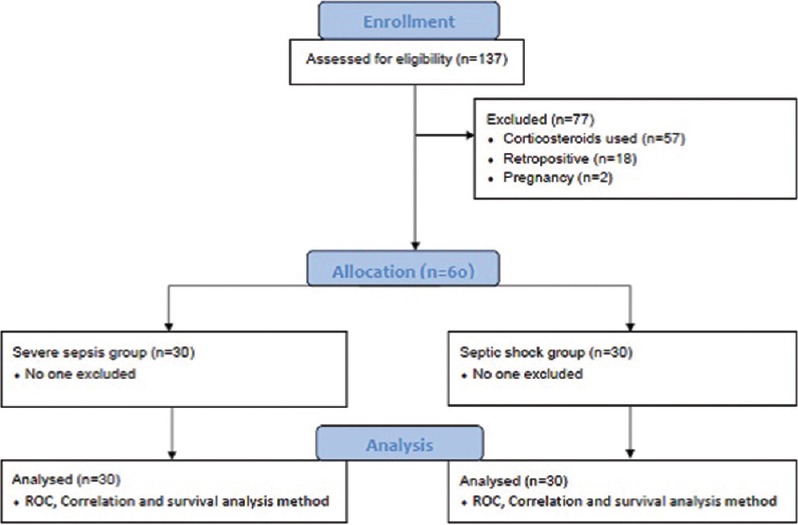
Sixty patients with severe sepsis ( = 30) and septic shock ( = 30) were recruited. Basal and postcosyntropin (1 μg)-stimulated cortisol levels were measured, and all patients were closely monitored with daily assessments of clinical and laboratory variables. Western diagnostic criteria were followed for defining adrenal insufficiency (AI). The end point was the survival assessed at day 28 or death, whichever came earlier.
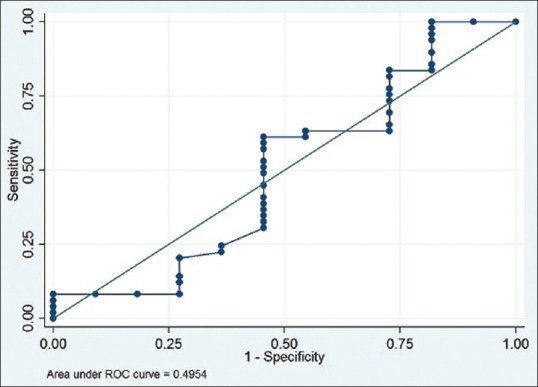
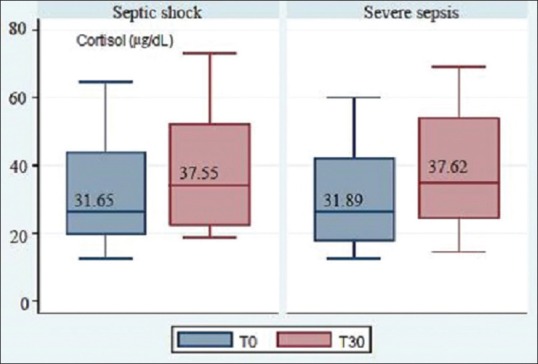
The mean basal (T0) and poststimulation (T30) cortisol levels were 31.77 ± 15.9 μg/dL and 37.58 ± 17.31 μg/dL, respectively. In all sepsis patients, 48.33% qualified as AI at T0 ≤ 24 μg/dL, 61.67% at delta cortisol (Δ = T30-T0) ≤7 μg/dL, and 78.33% at Δ ≤9 μg/dL. Using receiver operating characteristic curve, the area under the curve (AUC) was 0.4954, signifying poor prediction to death.
Indians have completely different characteristics of cortisol levels in sepsis patients, in comparison to the Western data. They have higher range of basal cortisol levels, higher percentage of AI, and an inability to predict mortality with the cortisol levels. Hence, there is requirement of an international study to confirm the dichotomy of the results.
在印度严重脓毒症/脓毒性休克患者中,皮质醇水平与脓毒症之间的关系尚不清楚。
开展本研究以确定皮质醇水平的最佳范围,明确肾上腺皮质反应,并尽可能预测上述类型患者的死亡率。
本研究为单中心前瞻性队列研究,在印度北部的一家三级转诊中心进行。
招募了60例严重脓毒症患者(n = 30)和脓毒性休克患者(n = 30)。测量基础和促肾上腺皮质激素(1μg)刺激后的皮质醇水平,所有患者均接受密切监测,每天评估临床和实验室变量。遵循西方诊断标准定义肾上腺功能不全(AI)。终点为28天时评估的生存情况或死亡,以先发生者为准。
基础(T0)和刺激后(T30)皮质醇水平的平均值分别为31.77±15.9μg/dL和37.58±17.31μg/dL。在所有脓毒症患者中,48.33%在T0≤24μg/dL时符合AI标准,61.67%在皮质醇变化量(Δ = T30 - T0)≤7μg/dL时符合,78.33%在Δ≤9μg/dL时符合。使用受试者工作特征曲线,曲线下面积(AUC)为0.4954,表明对死亡的预测能力较差。
与西方数据相比,印度脓毒症患者的皮质醇水平特征完全不同。他们的基础皮质醇水平范围更高,AI百分比更高,且无法通过皮质醇水平预测死亡率。因此,需要开展一项国际研究来证实结果的差异。