Belury Martha A, Bowman Emily, Gabriel Janelle, Snyder Brandon, Kulkarni Manjusha, Palettas Marilly, Mo Xiaokui, Lake Jordan E, Zidar David, Sieg Scott F, Rodriguez Benigno, Playford Martin P, Andrade Adriana, Kuritzkes Daniel R, Mehta Nehal N, Lederman Michael M, Funderburg Nicholas T
Department of Human Sciences, Ohio State University, Columbus, Ohio.
School of Health and Rehabilitation Sciences, Division of Medical Laboratory Science, Ohio State University, Columbus, Ohio.
Pathog Immun. 2017;2(3):376-403. doi: 10.20411/pai.v2i3.218. Epub 2017 Oct 6.
Lipid profiles are altered by HIV infection and antiretroviral therapy (ART). Among HIV-uninfected (HIV-) populations the concentrations of various lipid classes (ie, lyso-phosphatidylcholine, LPC) and their saturated (SaFA), mono-unsaturated (MUFA), and polyunsaturated fatty acid (PUFA) composition are related to cardiometabolic disease risk. Associations between changes in the lipidome and immune activation in HIV-infected (HIV+) individuals beginning ART have not been described.
Plasma lipid concentrations and their fatty acid composition were measured by differential mobility spectroscopy in samples from 35 treatment-naive HIV+ participants beginning raltegravir (RAL)-based ART and from HIV- individuals (n = 13) matched for age and sex.
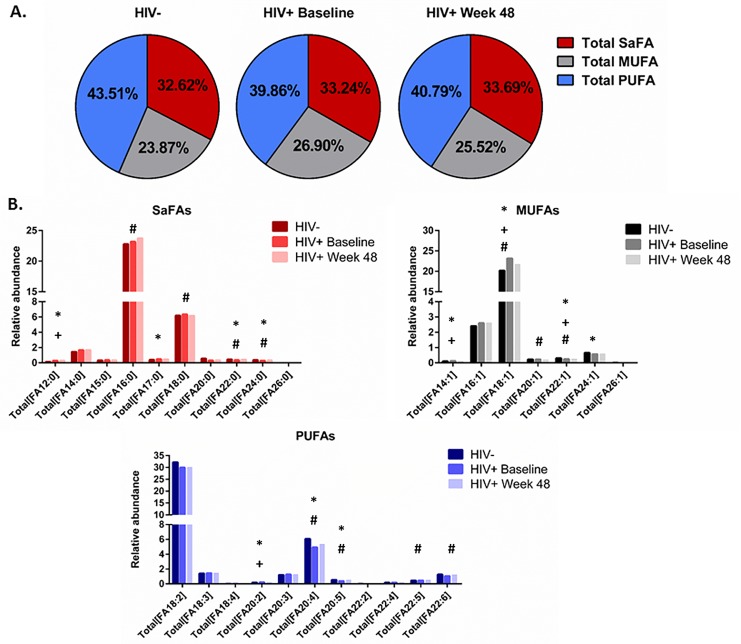
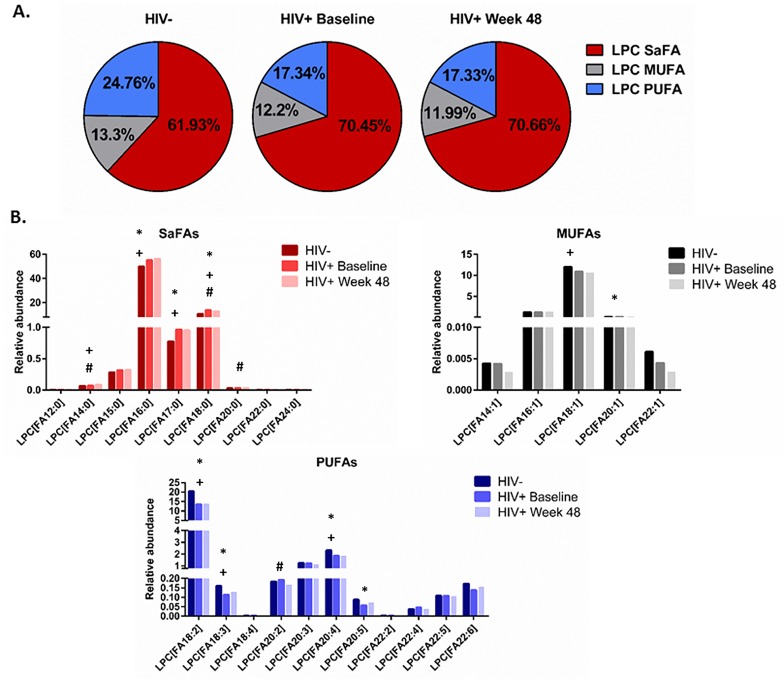
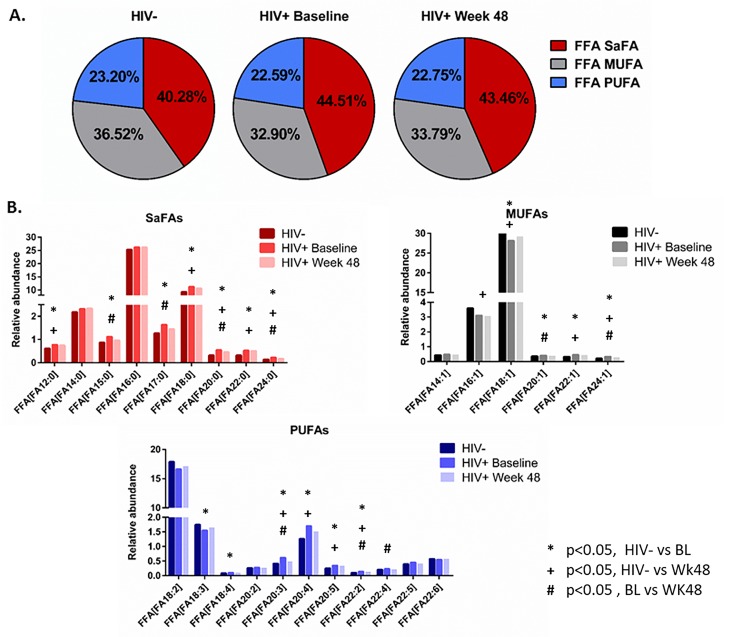
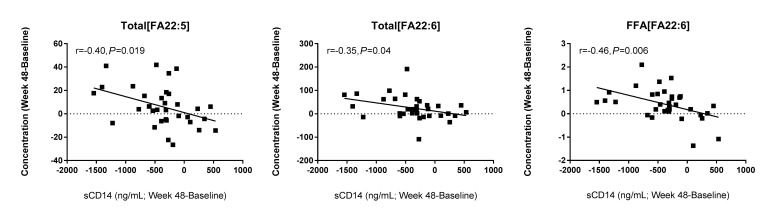
The levels of SaFA, including palmitic (16:0) and stearic (18:0) acid were enriched in HIV+ participants (pre- and post-ART), and SaFA levels were often positively correlated with levels of immune activation (ie, IL-6, sCD14, and TNFR1) at baseline and week 48. Levels of PUFAs (including 18:3, 20:4, and 20:5) were lower in HIV+ participants at baseline compared to levels in HIV- participants ( < 0.01), and levels of these PUFAs were increased following 48 weeks of ART. Levels of PUFAs were often inversely related to immune activation. Levels of LPC were increased in HIV+ participants, both pre- and post-ART vs HIV- participants, and the composition of LPC was enriched for SaFAs among HIV+ individuals. At week 48, several LPC molecules containing SaFAs were positively correlated with levels of sCD14, D-dimer, and TNFR1 ( < 0.01), and levels of PUFA-containing LPC (18:3, 20:5, 22:5, 22:6) were positively correlated with CD4+ T cell counts and inversely correlated with sCD14 and IL-6 ( < 0.01).
The composition of the lipidome is altered in HIV infection and changes when ART is administered. Alterations in SaFAs were generally associated with inflammatory markers and may contribute to comorbid disease pathogenesis.
HIV感染和抗逆转录病毒疗法(ART)会改变血脂谱。在未感染HIV(HIV-)的人群中,各种脂质类别(即溶血磷脂酰胆碱,LPC)的浓度及其饱和脂肪酸(SaFA)、单不饱和脂肪酸(MUFA)和多不饱和脂肪酸(PUFA)组成与心脏代谢疾病风险相关。尚未描述开始接受ART的HIV感染(HIV+)个体的脂质组变化与免疫激活之间的关联。
通过差分迁移光谱法测量了35名开始接受基于拉替拉韦(RAL)的ART的初治HIV+参与者以及年龄和性别匹配的HIV-个体(n = 13)样本中的血浆脂质浓度及其脂肪酸组成。
在HIV+参与者(ART治疗前和治疗后)中,包括棕榈酸(16:0)和硬脂酸(18:0)在内的饱和脂肪酸水平升高,并且饱和脂肪酸水平在基线和第48周时通常与免疫激活水平(即IL-6、sCD14和TNFR1)呈正相关。与HIV-参与者相比,HIV+参与者在基线时的多不饱和脂肪酸水平(包括18:3、20:4和20:5)较低(<0.01),并且在接受48周ART治疗后这些多不饱和脂肪酸水平升高。多不饱和脂肪酸水平通常与免疫激活呈负相关。与HIV-参与者相比,HIV+参与者在ART治疗前和治疗后的LPC水平均升高,并且在HIV+个体中LPC的组成富含饱和脂肪酸。在第48周时,几种含有饱和脂肪酸的LPC分子与sCD14、D-二聚体和TNFR1水平呈正相关(<0.01),而含有多不饱和脂肪酸的LPC(18:3、20:5、22:5、22:6)水平与CD4+ T细胞计数呈正相关,与sCD14和IL-6呈负相关(<0.01)。
HIV感染会改变脂质组的组成,并且在接受ART治疗时会发生变化。饱和脂肪酸的改变通常与炎症标志物相关,可能有助于合并疾病的发病机制。