Hu Chuanzhen, Wen Junxiang, Gong Liangzhi, Chen Xu, Wang Jun, Hu Fangqiong, Zhou Qi, Liang Jing, Wei Li, Shen Yuhui, Zhang Weibin
Department of Orthopaedics, Ruijin Hospital, Shanghai Jiaotong University School of Medicine, Shanghai 200025, People's Republic of China.
Shanghai Key Laboratory for Bone and Joint Diseases, Shanghai Institute of Orthopedics and Traumatology, Ruijin Hospital, Shanghai Jiaotong University School of Medicine, Shanghai 200025, People's Republic of China.
Oncotarget. 2017 Apr 26;8(44):75881-75892. doi: 10.18632/oncotarget.17427. eCollection 2017 Sep 29.
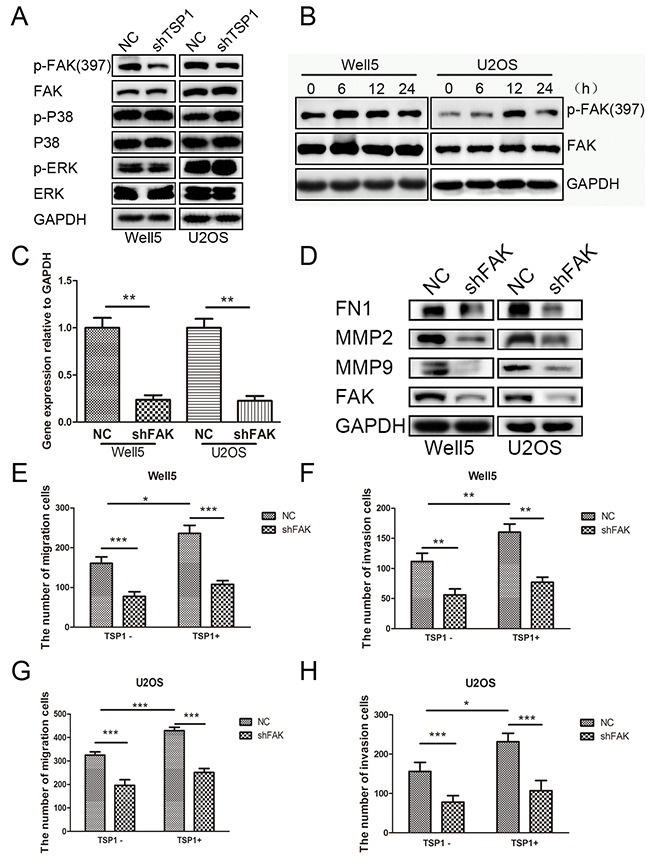
Microenvironment at the metastatic locus usually differs greatly from that present in the site of primary tumor formation and it has a significant impact on the fate of the extravasated cancer cells. We compared gene expression signatures of primary tumors and lung metastatic tumors, and identified Thrombospondin-1 (TSP1) as highly up-regulated in the lung metastatic tumors. Immunohistochemical staining further indicated that TSP1 protein expression was higher in lung metastatic tumors compared to primary tumors in both osteosarcoma xenograft model and human clinical samples. TSP1 mRNA level is significantly associated with the Enneking stage of osteosarcoma and lung metastasis. TGF-β pathways could stimulate the TSP1 expression in osteosarcoma cells. Knockdown of TSP1 expression in osteosarcoma cells dramatically suppressed cell wound healing, migration and invasion. Treatment with recombinant TSP1 protein in osteosarcoma cells significantly promoted cell wound healing, migration and invasion. Meanwhile, suppression of TSP1 in osteosarcoma cells resulted in decreased pulmonary metastasis . Mechanistically, TSP1 increased expression of metastasis related genes, including MMP2, MMP9 and Fibronectin 1. TSP1 promoted osteosarcoma cell motility through the activation of FAK pathway. Taken together, our study provides evidence of the contributions of TSP1 to the lung metastasis of osteosarcoma and suggests that this protein may represent a potential therapeutic target for osteosarcoma lung metastasis.
转移灶处的微环境通常与原发性肿瘤形成部位的微环境有很大差异,并且对渗出的癌细胞的命运有重大影响。我们比较了原发性肿瘤和肺转移瘤的基因表达特征,发现血小板反应蛋白-1(TSP1)在肺转移瘤中高度上调。免疫组织化学染色进一步表明,在骨肉瘤异种移植模型和人类临床样本中,肺转移瘤中TSP1蛋白表达均高于原发性肿瘤。TSP1 mRNA水平与骨肉瘤的Enneking分期及肺转移显著相关。TGF-β信号通路可刺激骨肉瘤细胞中TSP1的表达。敲低骨肉瘤细胞中TSP1的表达可显著抑制细胞伤口愈合、迁移和侵袭。用重组TSP1蛋白处理骨肉瘤细胞可显著促进细胞伤口愈合、迁移和侵袭。同时,抑制骨肉瘤细胞中的TSP1可导致肺转移减少。机制上,TSP1增加了包括MMP2、MMP9和纤连蛋白1在内的转移相关基因的表达。TSP1通过激活FAK信号通路促进骨肉瘤细胞运动。综上所述,我们的研究提供了TSP1对骨肉瘤肺转移有作用的证据,并表明该蛋白可能是骨肉瘤肺转移的潜在治疗靶点。