Fasching Peter A, Häberle Lothar, Rack Brigitte, Li Liang, Hein Alexander, Ekici Arif B, Reis Andre, Lux Michael P, Cunningham Julie M, Ruebner Matthias, Jenkins Gergory, Fridley Brooke, Schneeweiss Andreas, Tesch Hans, Lichtenegger Werner, Fehm Tanja, Heinrich Georg, Rezai Mahdi, Beckmann Matthias W, Janni Wolfgang, Weinshilboum Richard M, Wang Liewei
Department of Gynecology and Obstetrics, Erlangen University Hospital, Friedrich-Alexander-University Erlangen-Nuremberg, Comprehensive Cancer Center Erlangen-EMN, Erlangen, Germany.
Department of Medicine, Division of Hematology/Oncology, University of California at Los Angeles, David Geffen School of Medicine, Los Angeles, CA, USA.
Oncotarget. 2017 May 9;8(44):78133-78143. doi: 10.18632/oncotarget.17726. eCollection 2017 Sep 29.
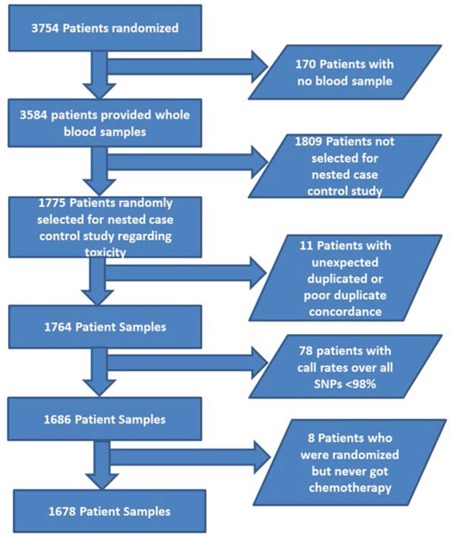
Hematotoxicity is one of the major side effects of chemotherapy. The aim of this study was to examine the association between single nucleotide polymorphisms (SNPs) and hematotoxicity in breast cancer patients in a subset of patients of the SUCCESS prospective phase III chemotherapy study. All patients (n = 1678) received three cycles of 5-fluorouracil, epirubicin, and cyclophosphamide (FEC) followed by three cycles of docetaxel or docetaxel/gemcitabine, depending on randomization. Germline DNA was genotyped for 246 SNPs selected from a previous genome-wide association study (GWAS) in a panel of lymphoblastoid cell lines, with gemcitabine toxicity as the phenotype. All SNPs were tested for their value in predicting grade 3 or 4 neutropenic or leukopenic events (NLEs). Their prognostic value in relation to overall survival and disease-free survival was also tested. None of the SNPs was found to be predictive for NLEs during treatment with docetaxel/gemcitabine. Two SNPs in and close to the gene significantly improved the prediction of NLEs after FEC, in addition to the factors of age and body surface area. The top SNP (rs12050587) had an odds ratio of 1.38 per minor allele (95% confidence interval, 1.17 to 1.62). No associations were identified for predicting disease-free or overall survival. Genetic variance in the gene may play a role in determining interindividual differences in relation to hematotoxicity after FEC chemotherapy.
血液毒性是化疗的主要副作用之一。本研究的目的是在SUCCESS前瞻性III期化疗研究的部分患者中,检测乳腺癌患者单核苷酸多态性(SNP)与血液毒性之间的关联。所有患者(n = 1678)接受三个周期的5-氟尿嘧啶、表柔比星和环磷酰胺(FEC),随后根据随机分组接受三个周期的多西他赛或多西他赛/吉西他滨治疗。在一组淋巴母细胞系中,对从先前全基因组关联研究(GWAS)中选择的246个SNP进行种系DNA基因分型,以吉西他滨毒性作为表型。检测所有SNP在预测3级或4级中性粒细胞减少或白细胞减少事件(NLE)方面的价值。还检测了它们与总生存期和无病生存期相关的预后价值。在多西他赛/吉西他滨治疗期间,未发现任何SNP可预测NLE。除年龄和体表面积因素外,基因内及附近的两个SNP显著改善了FEC后NLE的预测。顶级SNP(rs12050587)每个次要等位基因的优势比为1.38(95%置信区间,1.17至1.62)。在预测无病生存期或总生存期方面未发现关联。基因的遗传变异可能在决定FEC化疗后个体间血液毒性差异方面发挥作用。