Division of Physics and Applied Physics, School of Physical and Mathematical Sciences, Nanyang Technological University, 21 Nanyang Link, Singapore, 637371, Singapore.
Energy Research Institute @NTU (ERI@N), Research Techno Plaza, X-Frontier Block, Level 5, 50 Nanyang Drive, Singapore, 637553, Singapore.
Nat Commun. 2017 Nov 3;8(1):1300. doi: 10.1038/s41467-017-01360-3.
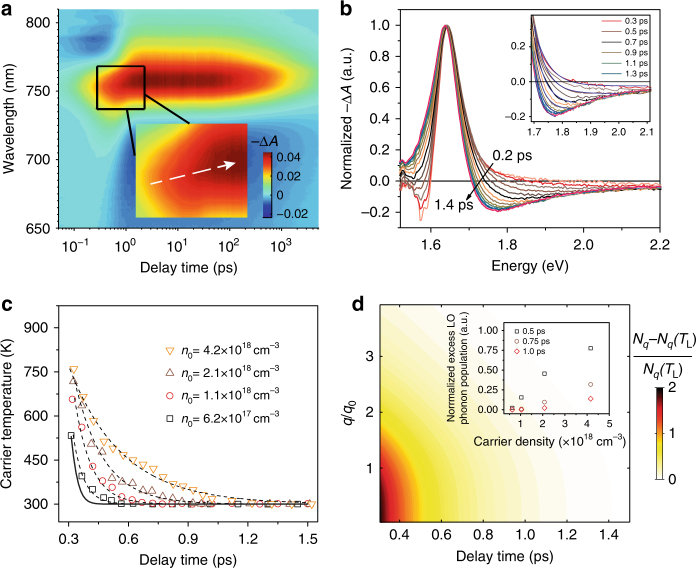
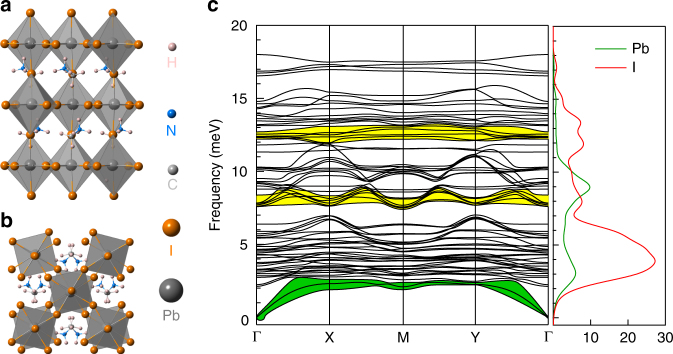
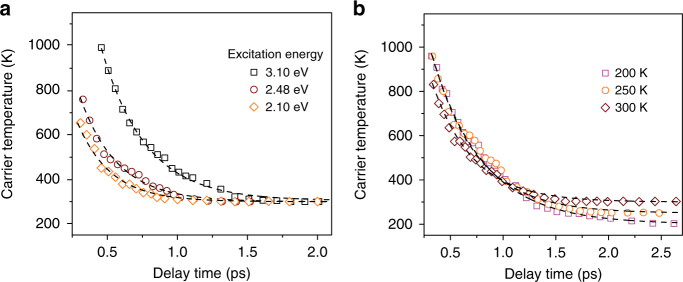
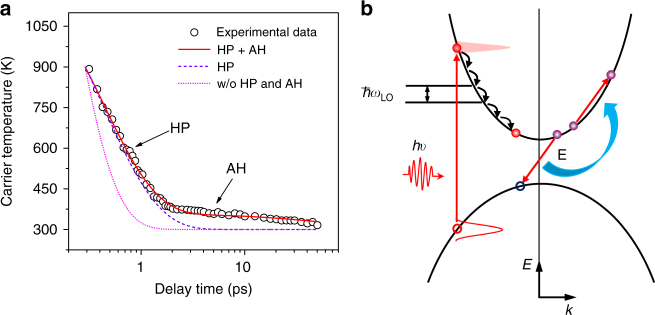
Halide perovskites exhibit unique slow hot-carrier cooling properties capable of unlocking disruptive perovskite photon-electron conversion technologies (e.g., high-efficiency hot-carrier photovoltaics, photo-catalysis, and photodetectors). Presently, the origins and mechanisms of this retardation remain highly contentious (e.g., large polarons, hot-phonon bottleneck, acoustical-optical phonon upconversion etc.). Here, we investigate the fluence-dependent hot-carrier dynamics in methylammonium lead triiodide using transient absorption spectroscopy, and correlate with theoretical modeling and first-principles calculations. At moderate carrier concentrations (around 10 cm), carrier cooling is mediated by polar Fröhlich electron-phonon interactions through zone-center delayed longitudinal optical phonon emissions (i.e., with phonon lifetime τ around 0.6 ± 0.1 ps) induced by the hot-phonon bottleneck. The hot-phonon effect arises from the suppression of the Klemens relaxation pathway essential for longitudinal optical phonon decay. At high carrier concentrations (around 10 cm), Auger heating further reduces the cooling rates. Our study unravels the intricate interplay between the hot-phonon bottleneck and Auger heating effects on carrier cooling, which will resolve the existing controversy.
卤化物钙钛矿表现出独特的慢热载流子冷却特性,能够解锁颠覆性的钙钛矿光电子转换技术(例如,高效热载流子光伏、光催化和光电探测器)。目前,这种延迟的起源和机制仍然存在很大争议(例如,大极化子、热声子瓶颈、声光学声子上转换等)。在这里,我们使用瞬态吸收光谱研究了碘化甲基铵中与辐照强度相关的热载流子动力学,并与理论建模和第一性原理计算相关联。在中等载流子浓度(约 10 cm)下,通过热声子瓶颈诱导的通过中心延迟纵向光学声子发射(即声子寿命τ约为 0.6 ± 0.1 ps),载流子冷却由极化弗罗利希电子-声子相互作用介导。热声子效应源于对纵向光学声子衰减至关重要的克莱门斯弛豫途径的抑制。在高载流子浓度(约 10 cm)下,俄歇加热进一步降低了冷却速率。我们的研究揭示了热声子瓶颈和俄歇加热效应对载流子冷却的复杂相互作用,这将解决现有的争议。