Medicus Economics, Milton, MA, USA.
AbbVie, North Chicago, IL, USA.
Adv Ther. 2017 Nov;34(11):2491-2502. doi: 10.1007/s12325-017-0630-8. Epub 2017 Nov 3.
We sought to characterize changes in healthcare spending associated with the onset of 22 endometriosis-related comorbidities.
Women aged 18-49 years with endometriosis (N = 180,278) were extracted from 2006-2015 de-identified Clinformatics DataMart claims data. For 22 comorbidities, comorbidity patients were identified on the basis of having a first comorbidity diagnosis after their initial endometriosis diagnosis. Controls were identified on the basis of having no comorbidity diagnosis and were matched 1:1 to comorbidity patients on demographics and baseline spending. Total medical and pharmacy spending was measured during 12 months before and after each patient's index date (first comorbidity diagnosis for comorbidity patients, and equal number of days after earliest endometriosis claim for controls). Pre-post spending differences were compared using difference-in-differences linear regression. Total and comorbidity-related cumulative spending per patient for all endometriosis patients were calculated annually for the 5 years following endometriosis diagnosis.
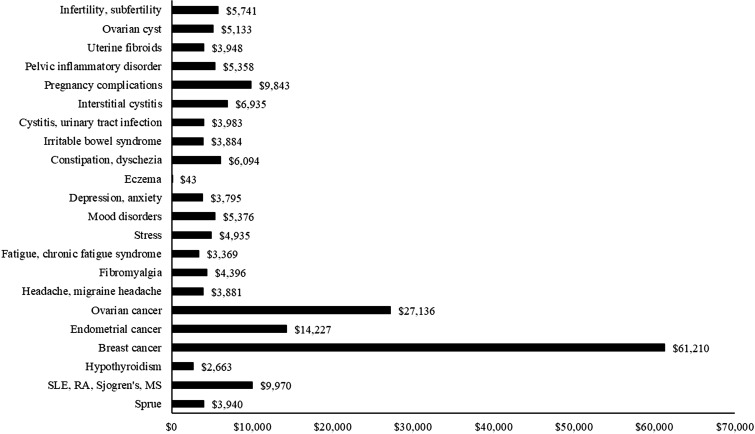
The number of endometriosis patients with each comorbidity varied between 121 for endometrial cancer and 16,177 for fatigue. Healthcare spending increased significantly with the onset of eight comorbidities: breast cancer, ovarian cancer, pregnancy complications, systemic lupus erythematosus/rheumatoid arthritis/Sjogren's/multiple sclerosis, infertility, uterine fibroids, ovarian cyst, and headache [p < 0.001 except for headache (p = 0.045)]. Spending decreased significantly for fatigue, cystitis/UTI, and eczema [p < 0.001 except for fatigue (p = 0.048)] and was not statistically different for the other 11 comorbidities. Difference-in-differences estimates were significantly higher for comorbidity patients for all comorbidities except eczema (p ≤ 0.003). Mean 5-year total cumulative spending was $58,191 per endometriosis patient, of which between 11% and 23% was attributable to comorbidity-related medical claims.
For all but one of the 22 comorbidities associated with endometriosis, comorbidity onset was associated with a relative increase in total healthcare spending.
AbbVie Inc.
本研究旨在描述与 22 种子宫内膜异位症相关共病的发生相关的医疗保健支出变化。
从 2006 年至 2015 年的 Clinformatics DataMart 匿名索赔数据中提取年龄在 18-49 岁之间的 180278 例子宫内膜异位症患者。对于 22 种共病,共病患者的诊断依据是在最初的子宫内膜异位症诊断后首次出现共病诊断。对照组的诊断依据是没有共病诊断,并且按照人口统计学和基线支出与共病患者进行 1:1 匹配。在每位患者的索引日期(共病患者的首次共病诊断日期,以及对照组最早的子宫内膜异位症索赔后相同天数)前后的 12 个月内,测量总医疗和药房支出。使用差异中的差异线性回归比较治疗前后的支出差异。对于所有子宫内膜异位症患者,每年计算其在诊断后 5 年内的总支出和与共病相关的累计支出。
患有每种共病的子宫内膜异位症患者人数从子宫内膜癌的 121 例到疲劳的 16177 例不等。随着八种共病的发生,医疗保健支出显著增加:乳腺癌、卵巢癌、妊娠并发症、系统性红斑狼疮/类风湿关节炎/干燥综合征/多发性硬化症、不孕、子宫肌瘤、卵巢囊肿和头痛[除头痛(p=0.045)外,p<0.001]。疲劳、膀胱炎/尿路感染和湿疹的支出显著减少[p<0.001 除疲劳外(p=0.048)],而其他 11 种共病的支出没有统计学差异。除湿疹外(p≤0.003),差异中的差异估计值对于所有共病患者均显著高于对照组。每位子宫内膜异位症患者的 5 年平均总累计支出为 58191 美元,其中 11%至 23%归因于与共病相关的医疗索赔。
除与子宫内膜异位症相关的一种共病外,所有共病的发生均与总医疗保健支出的相对增加相关。
艾伯维公司。