Rodenas Motos Pau, Molina Gonzalo, Ter Heijne Annemiek, Sleutels Tom, Saakes Michel, Buisman Cees
WetsusEuropean Centre of Excellence for Sustainable Water TechnologyOostergowegLeeuwardenThe Netherlands.
Sub-Department of Environmental TechnologyWageningen UniversityWageningenThe Netherlands.
J Chem Technol Biotechnol. 2017 Nov;92(11):2817-2824. doi: 10.1002/jctb.5353. Epub 2017 Jul 24.
Bioelectrochemical systems (BESs) enable recovery of electrical energy through oxidation of a wide range of substrates at an anode and simultaneous recovery of metals at a cathode. Scale-up of BESs from the laboratory to pilot scale is a challenging step in the development of the process, and there are only a few successful experiences to build on. This paper presents a prototype BES for the recovery of copper.
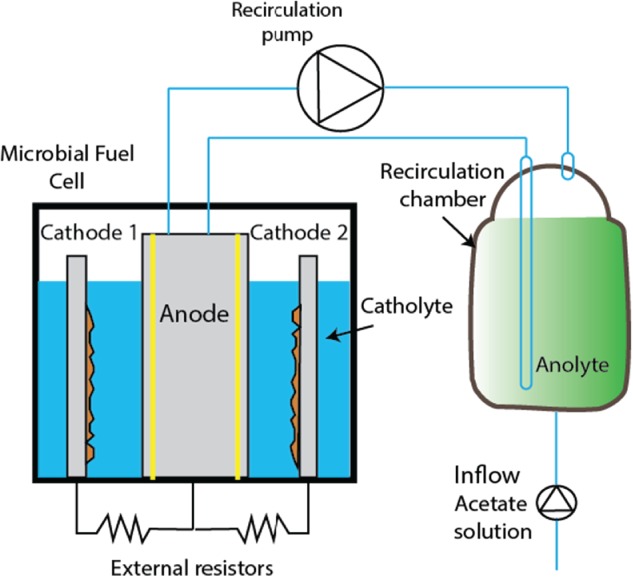
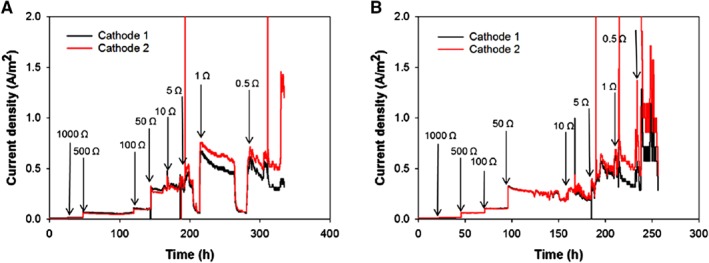
The cell design presented here had removable electrodes, similar to those in electroplating baths. The anode and cathode in this design could be replaced independently. The prototype bioelectrochemical cell consisted of an 835 cm bioanode fed with acetate, and a 700 cm cathode fed with copper. A current density of 1.2 A/ was achieved with 48 mW m of power production. The contribution of each component (anode, electrolytes, cathode and membrane) was evaluated through the analysis of the internal resistance distribution. This revealed that major losses occurred at the anode, and that the design with removable electrodes results in higher internal resistance compared with other systems. To further assess the practical applicability of BES for copper recovery, an economic evaluation was performed.
Analysis shows that the internal resistance of several lab-scale BESs is already sufficiently low to make the system economic, while the internal resistance for scaled-up systems still needs to be improved considerably to become economically applicable.© 2017 The Authors. published by John Wiley & Sons Ltd on behalf of Society of Chemical Industry.
生物电化学系统(BESs)能够通过在阳极氧化多种底物来回收电能,并同时在阴极回收金属。将生物电化学系统从实验室规模扩大到中试规模是该工艺开发过程中具有挑战性的一步,可供借鉴的成功经验很少。本文介绍了一种用于回收铜的生物电化学系统原型。
本文介绍的电池设计具有可移除电极,类似于电镀槽中的电极。该设计中的阳极和阴极可独立更换。该生物电化学原型电池由一个835平方厘米的以醋酸盐为原料的生物阳极和一个700平方厘米的以铜为原料的阴极组成。实现了1.2 A/的电流密度,功率输出为48 mW/m。通过分析内阻分布评估了每个组件(阳极、电解质、阴极和膜)的贡献。结果表明,主要损耗发生在阳极,并且与其他系统相比,具有可移除电极的设计导致内阻更高。为了进一步评估生物电化学系统在铜回收方面的实际适用性,进行了经济评估。
分析表明,几个实验室规模的生物电化学系统的内阻已经足够低,使系统具有经济性,而扩大规模系统的内阻仍需要大幅改善才能在经济上适用。© 2017作者。由John Wiley & Sons Ltd代表化学工业协会出版。