Macaluso Thomas, Bourdin Christophe, Buloup Frank, Mille Marie-Laure, Sainton Patrick, Sarlegna Fabrice R, Vercher Jean-Louis, Bringoux Lionel
Aix Marseille Univ, CNRS, ISM, Marseille, France.
UFR STAPS, Université de Toulon, La Garde, France.
Front Physiol. 2017 Oct 20;8:821. doi: 10.3389/fphys.2017.00821. eCollection 2017.
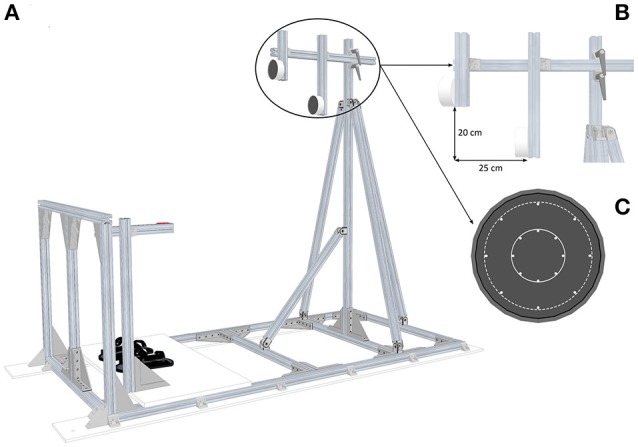
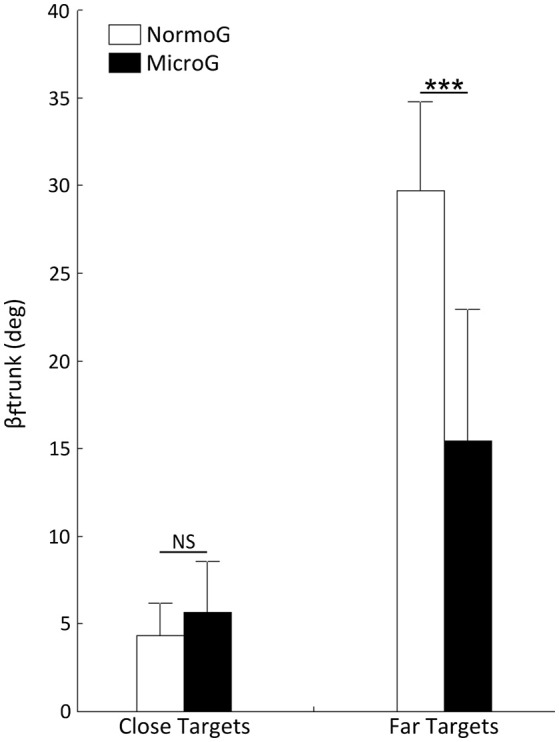
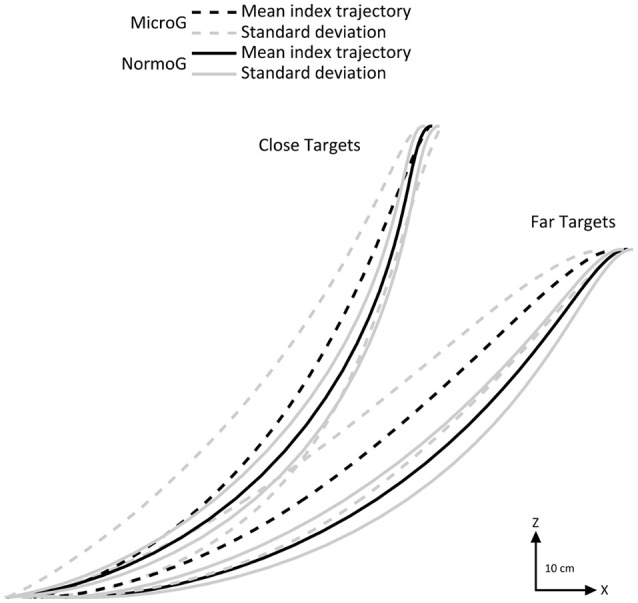
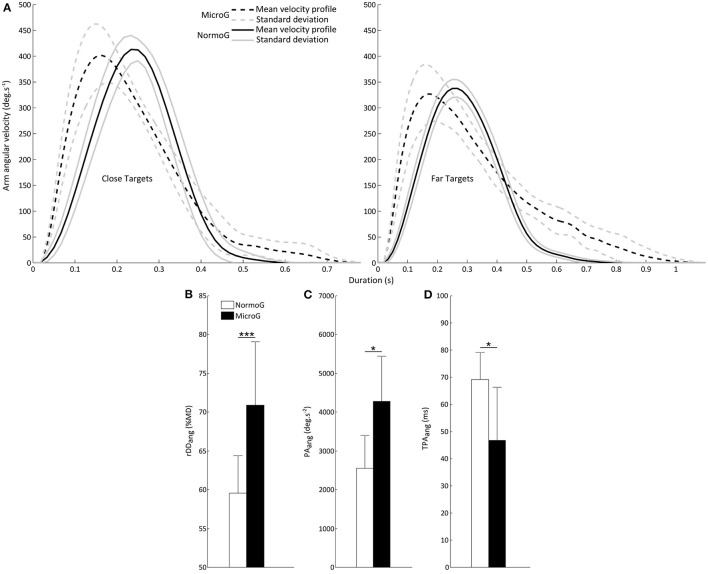
Understanding the impact of weightlessness on human behavior during the forthcoming long-term space missions is of critical importance, especially when considering the efficiency of goal-directed movements in these unusual environments. Several studies provided a large set of evidence that gravity is taken into account during the planning stage of arm reaching movements to optimally anticipate its consequence upon the moving limbs. However, less is known about sensorimotor changes required to face weightless environments when individuals have to perform fast and accurate goal-directed actions with whole-body displacement. We thus aimed at characterizing kinematic features of whole-body reaching movements in microgravity, involving high spatiotemporal constraints of execution, to question whether and how humans are able to maintain the performance of a functional behavior in the standards of normogravity execution. Seven participants were asked to reach as fast and as accurately as possible visual targets while standing during microgravity episodes in parabolic flight. Small and large targets were presented either close or far from the participants (requiring, in the latter case, additional whole-body displacement). Results reported that participants successfully performed the reaching task with general temporal features of movement (e.g., movement speed) close to land observations. However, our analyses also demonstrated substantial kinematic changes related to the temporal structure of focal movement and the postural strategy to successfully perform -constrained- whole-body reaching movements in microgravity. These immediate reorganizations are likely achieved by rapidly taking into account the absence of gravity in motor preparation and execution (presumably from cues about body limbs unweighting). Specifically, when compared to normogravity, the arm deceleration phase substantially increased. Furthermore, greater whole-body forward displacements due to smaller trunk flexions occurred when reaching far targets in microgravity. Remarkably, these changes of focal kinematics and postural strategy appear close to those previously reported when participants performed the same task underwater with neutral buoyancy applied to body limbs. Overall, these novel findings reveal that humans are able to maintain the performance of functional goal-directed whole-body actions in weightlessness by successfully managing spatiotemporal constraints of execution in this unusual environment.
了解失重对即将到来的长期太空任务期间人类行为的影响至关重要,尤其是在考虑这些特殊环境中目标导向运动的效率时。多项研究提供了大量证据表明,在手臂伸展运动的规划阶段会考虑重力,以便最佳地预测其对运动肢体的影响。然而,当个体必须进行涉及全身位移的快速且准确的目标导向动作时,对于应对失重环境所需的感觉运动变化却知之甚少。因此,我们旨在表征微重力环境下全身伸展运动的运动学特征,这些运动涉及执行的高时空限制,以探讨人类是否以及如何能够在正常重力执行标准下维持功能性行为的表现。七名参与者被要求在抛物线飞行的微重力阶段站立时尽可能快速且准确地够到视觉目标。呈现给参与者的小目标和大目标距离有近有远(在后一种情况下,需要额外的全身位移)。结果表明,参与者成功完成了够物任务,运动的一般时间特征(例如,运动速度)与地面观察结果相近。然而,我们的分析还表明,在微重力环境下成功执行受限的全身伸展运动时,与焦点运动的时间结构和姿势策略相关的运动学有显著变化。这些即时的重新组织可能是通过在运动准备和执行过程中迅速考虑到重力的缺失(大概是来自身体肢体失重的线索)而实现的。具体而言,与正常重力相比,手臂减速阶段大幅增加。此外,在微重力环境下够到远处目标时,由于较小的躯干弯曲,全身向前位移更大。值得注意的是,这些焦点运动学和姿势策略的变化与之前参与者在身体肢体施加中性浮力的水下执行相同任务时所报告的变化相似。总体而言,这些新发现表明,人类能够通过在这种特殊环境中成功管理执行的时空限制,在失重状态下维持功能性目标导向的全身动作的表现。